

More news on this day
Kuwait is quietly preparing a bold new front door to the country and the wider Gulf region. At the heart of a 5.8 billion dollar expansion of Kuwait International Airport, the long-delayed but now fast-progressing Terminal 2 is taking shape as one of the most ambitious aviation projects in the Middle East.
With completion targeted for late 2026, the T2 terminal is designed to turn Kuwait City into a serious regional hub, competing for long-haul transfer traffic while reshaping the passenger experience with sustainability, scale and striking architecture.
More News
- Caribbean Travel to U.S. Upended by New Visa Freezes and Expanded Bans
- Mexico Restores E-Visas for Brazilians, Paving the Way for Borderless Tourism
- Philippine Airlines Joins Regional Carriers Powering Southeast Asia’s Tourism Boom
A Megaproject Back on Schedule
Terminal 2 has been under construction since 2017 and has weathered cost pressures, design refinements and pandemic-era disruptions. Initially slated to open in 2022, the project was pushed back several times, but Kuwaiti authorities now say the finish line is firmly in sight. The Central Agency for Public Tenders has set November 30, 2026, as the final deadline to complete all works on the new passenger terminal and related facilities, signaling a renewed sense of urgency and accountability around one of the country’s flagship infrastructure schemes.
Recent briefings from the Ministry of Public Works and the Directorate General of Civil Aviation indicate that structural works are roughly 70 percent complete and that ancillary packages covering access roads, aircraft aprons and taxiways are advancing in parallel. Officials describe the project as a central pillar of Kuwait’s aviation renaissance, intended to reverse years of underinvestment that saw major international airlines scale back or suspend service to the country while favoring better-equipped Gulf hubs.
The government has repeatedly emphasized that T2 is not just another terminal, but a national priority tied directly to Kuwait Vision 2035, the long-term strategy to diversify the economy and position the country as a regional logistics, finance and tourism center. Cabinet-level reviews and cross-ministerial task forces have been convened to keep the terminal on track, an unusual degree of political focus that underlines how high the stakes have become.
Designing a Landmark for the Gulf Sky
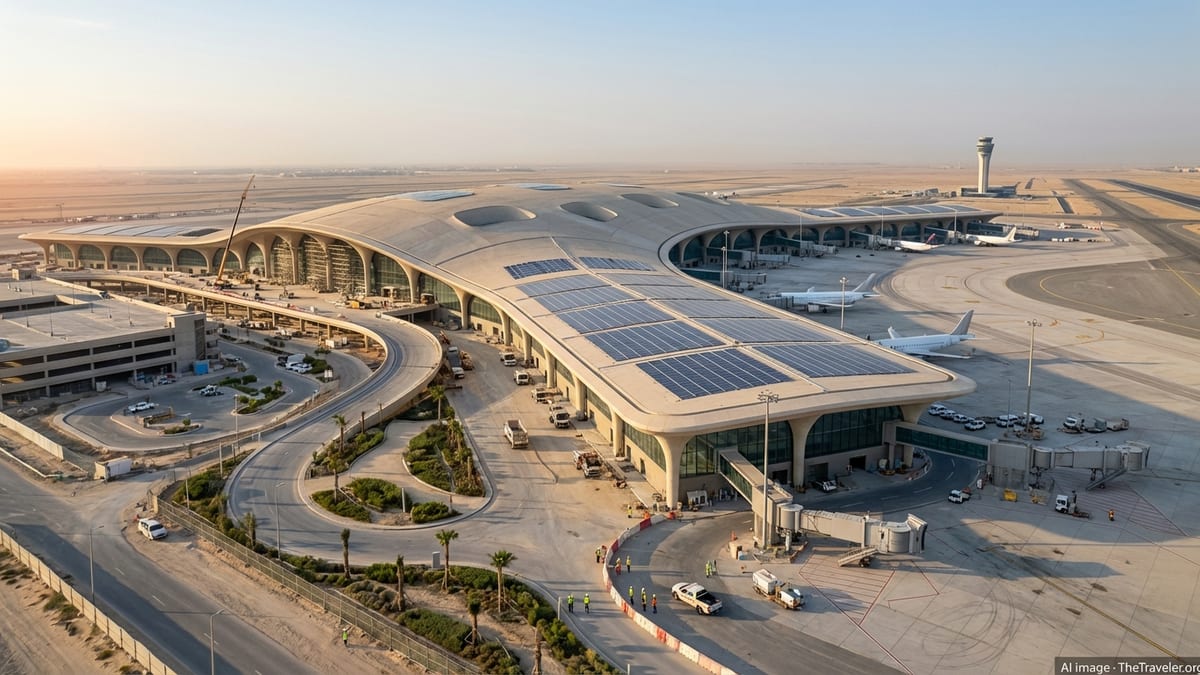
The architectural statement of T2 is as important as its operational capabilities. Designed by renowned British practice Foster + Partners, the terminal adopts a distinctive trefoil, or three-wing, plan in which three symmetrical piers radiate from a dramatic central hall. Each wing stretches around 1.2 kilometers, connected beneath a vast concrete shell roof that unifies the building into a single sculptural volume.
This roof is more than a visual flourish. The tri-wing canopy spans more than 1.2 kilometers and features a series of dramatic vaulted forms supported by tapering concrete columns inspired by Kuwait’s traditional dhow boats. The soaring central space reaches about 25 meters in height, creating a grand civic hall effect that aims to be instantly recognizable to arriving and departing passengers while remaining legible and easy to navigate.
Inside, the design minimizes level changes and relies on natural wayfinding, with clear sightlines from check-in to security and departure gates. Generous glazing and carefully controlled skylights are intended to flood the interior with indirect daylight without exposing travelers to the country’s intense summer heat. For Kuwait, which has long lacked a signature aviation landmark on par with regional peers, T2 is being crafted as both an efficient machine and a symbol of national ambition.
Capacity, Connectivity and the Hub Ambition
From an aviation planning perspective, Terminal 2 is a transformative leap. Once operational, it is expected to handle around 25 million passengers a year in its initial phase, with the ability to scale up to 50 million with further expansion. That would more than double Kuwait International Airport’s current capacity and reposition it from a primarily origin-and-destination facility to a contender in the lucrative transfer and long-haul connection market.
The terminal’s layout and supporting airfield works have been master-planned to integrate closely with existing operations while allowing for future growth in traffic and airlines. New taxiways, service roads and a reconfigured apron network are being developed in three major construction packages that also include multi-storey car parks, landscaped access corridors and upgraded service buildings. A third runway and new air traffic control tower have already entered service, allowing the airport to maintain operations while central runway rehabilitation and other airfield upgrades proceed.
For passengers, the benefits will be felt in more direct flights, reduced congestion and a modernized ground experience. Kuwait has seen up to 14 international carriers, including some of Europe’s flag airlines, exit the market in recent years, citing capacity bottlenecks and dated infrastructure. The authorities and airport planners clearly hope that a new, world-class terminal will entice some of these airlines back and attract new entrants, particularly on Europe–Asia and Africa–Asia corridors where Gulf hubs already dominate.
Sustainability at the Core of the Terminal
One of the most striking aspects of Kuwait’s T2 project is its environmental ambition. In June 2025, the Kuwaiti Cabinet was briefed that the terminal had achieved LEED Gold certification under the US Green Building Council’s widely recognized rating system, placing it among the most sustainable airport terminals under development anywhere in the Gulf.
The concrete-shell roof structure provides significant thermal mass, helping to buffer the extreme temperature swings that define Kuwait’s climate, where summer highs routinely exceed 45 degrees Celsius. Integrated shading devices and deeply recessed skylights are designed to admit abundant diffuse daylight while sharply limiting direct solar gain, reducing the cooling load. According to contractors involved in the project, these passive design strategies, combined with high-performance building systems, are expected to cut energy consumption by roughly 40 percent compared with conventional terminals of similar size.
The roof will also host a vast field of photovoltaic panels, turning the terminal into a major generator of on-site solar power. Reports from project partners refer to tens of thousands of photovoltaic modules spread across approximately 315,000 square meters of roof area, part of a broader attempt to align the airport expansion with Kuwait’s renewable energy and emissions reduction goals.
Water-efficient fixtures, optimized cooling distribution, and attention to local accessibility standards round out the sustainability story. The government has highlighted compliance not only with global certification frameworks but also with national codes for accessibility and inclusive design, signaling an intent to make T2 a benchmark for future public buildings in the country.
Passenger Experience: From Check-in to Boarding Bridge
The hardware of a major terminal is more than just its shells and wings. Kuwait’s new T2 is being outfitted with a suite of passenger processing and mobility systems that aim to bring the airport into line with the latest global standards. Among the recent milestones is a contract awarded to TK Elevator to supply, install and maintain 55 passenger boarding bridges, including specialized units capable of serving the largest widebody aircraft operating today.
The boarding bridge package, which forms part of the third construction bundle, will give T2 a mix of triple, double and single stands compatible with aircraft ranging from single-aisle workhorses to double-deck superjumbos. This flexibility is critical for an airport seeking to capture long-haul traffic, charter operations and a blend of low-cost and full-service carriers, all of which operate different fleet types and boarding preferences.
Behind the scenes, T2 will house advanced baggage systems and security screening technologies. Industry reports have pointed to a baggage handling network stretching several kilometers and capable of processing close to 3,000 bags an hour at peak, backed by an array of check-in desks, self-service options and transfer facilities designed to keep connection times competitive. Immigration and security lanes are also being designed with high throughput in mind, supported by modern identity verification systems and dedicated fast-track options for premium passengers.
For travelers spending longer in the terminal, the concourses are expected to feature a broad mix of retail, dining and relaxation spaces, alongside a hotel located within the transit area. With thousands of square meters of commercial space built into the scheme, planners are aiming for an experience that blends regional character with the expectations of global travelers accustomed to the offerings at hubs in Doha, Dubai or Abu Dhabi.
Economic Catalyst for Kuwait and the Region
Beyond the aviation metrics, the T2 project is being framed domestically as an economic catalyst. During construction, officials have cited figures of up to 15,000 direct and indirect job opportunities tied to the terminal and its associated works, spanning engineering, skilled trades, logistics, hospitality and retail. For Kuwait’s youthful population, the project is frequently presented as both a training ground and a long-term employment engine.
Once in operation, a higher-capacity, better-connected airport is expected to strengthen Kuwait’s appeal for foreign investment, tourism and business travel. The ability to host more point-to-point and connecting flights should make it easier for multinationals and regional firms to base staff and operations in the country, while improved connectivity can support sectors from financial services to healthcare and education.
Regional competition, however, will be intense. Gulf neighbors have already invested heavily in next-generation terminals and runways, and Kuwait will enter a crowded field of hubs vying for passengers and airlines. The government’s bet is that a combination of strategic geographic location, a modern terminal and targeted aviation policies, including potential incentives for carriers, will be enough to carve out a sustainable niche in the market.
Timelines, Challenges and What Travelers Should Expect
With the hard deadline of late 2026 now publicly reinforced, attention is turning to how quickly systems integration, testing and trial operations can be completed once the main civil works are finished. Experience from other large Gulf terminals suggests that even after construction wraps up, months of phased commissioning are typically required to ensure everything from boarding bridges and baggage belts to security scanners and air-conditioning systems function smoothly under real-world conditions.
Kuwaiti officials insist that the project currently has positive momentum, pointing to the commissioning of the new runway and control tower and the awarding of key systems contracts as evidence that the broader airport expansion program is finally overcoming earlier delays. However, global supply chain uncertainties and the sheer complexity of coordinating multiple contractors and government agencies mean that some risk around the schedule remains.
For travelers, the first visible changes are likely to come in the form of new approach roads, parking structures and signage as the wider airport campus is reshaped to feed traffic into T2. Once the terminal opens, passengers can expect more check-in capacity, higher ceilings, abundant natural light and a significantly upgraded retail and lounge offering compared with the existing facilities. The eventual goal is to have a multi-terminal complex where T2 anchors long-haul and high-volume operations, integrated with other terminals serving low-cost carriers, regional flights and dedicated cargo services.
FAQ
Q1. When is Kuwait International Airport’s T2 terminal expected to open?
The current target set by Kuwaiti authorities is to complete all works on Terminal 2 by late 2026, with November 30, 2026 named as a key deadline. Trial operations and a phased opening are likely to follow before full-scale use.
Q2. How many passengers will T2 be able to handle each year?
In its initial phase, T2 is designed to accommodate around 25 million passengers annually, with built-in flexibility to expand capacity up to about 50 million passengers as traffic grows and additional facilities are developed.
Q3. Who designed the new terminal and what is special about its architecture?
The terminal was designed by Foster + Partners, a British architecture firm known for high-profile aviation projects. T2 features a trefoil plan with three long wings extending from a central hall under a sweeping concrete-shell roof, emphasizing natural light, clear wayfinding and a strong architectural identity.
Q4. What makes T2 an environmentally sustainable project?
T2 has achieved LEED Gold certification, reflecting a combination of passive cooling strategies, high thermal-mass concrete structures, carefully shaded skylights, energy-efficient systems and a large array of rooftop photovoltaic panels that will generate on-site solar power and reduce overall energy use.
Q5. How will the new terminal improve the passenger experience?
Passengers can expect more spacious check-in and security areas, extensive natural lighting, advanced baggage systems, a wide range of retail and dining options, upgraded lounges and direct boarding via new passenger boarding bridges capable of serving everything from narrowbody jets to large widebodies.
Q6. What role will T2 play in Kuwait’s wider economic plans?
The terminal is a core component of Kuwait Vision 2035, aimed at diversifying the economy and enhancing the country’s status as a regional hub. By boosting capacity and connectivity, T2 is expected to attract more airlines, facilitate business travel and tourism, and support job creation across multiple sectors.
Q7. Will the new terminal help bring back international airlines that left Kuwait?
Authorities and industry observers hope that a modern, high-capacity terminal with improved operating conditions will encourage some carriers that previously suspended operations in Kuwait to reconsider, and will also make the airport more attractive to new entrants on long-haul and regional routes.
Q8. What kind of aircraft and gates will T2 be able to accommodate?
The terminal will be equipped with 55 passenger boarding bridges of various configurations, allowing it to handle everything from standard single-aisle aircraft like the Airbus A320 and Boeing 737 to large widebody and double-deck aircraft such as the Airbus A380, depending on airline demand.
Q9. How will travelers get to and from the new terminal?
T2 is being integrated into a wider program of road, parking and airfield upgrades, including multi-storey car parks, new access roads and reconfigured internal circulation. Long-term plans also envision stronger public transport links, with discussions around future rail or metro connections to the airport.
Q10. Why is Terminal 2 seen as the “future of travel” in the Gulf?
T2 combines large-scale capacity, cutting-edge sustainability measures and a high-profile architectural concept at a time when the Gulf is redefining its air hub landscape. For Kuwait, the terminal represents a chance to reset its aviation fortunes and compete on a more equal footing with regional neighbors by offering a modern, efficient and environmentally conscious gateway for international travel.