

More news on this day
Kwetsani Camp in Botswana’s Okavango Delta is scheduled to reopen in June 2026 after a major rebuild, with publicly available information indicating that the treehouse-style lodge will once again welcome guests seeking sustainable luxury and low-impact wilderness experiences in one of Africa’s most coveted wetland ecosystems.
Get the latest news straight to your inbox!
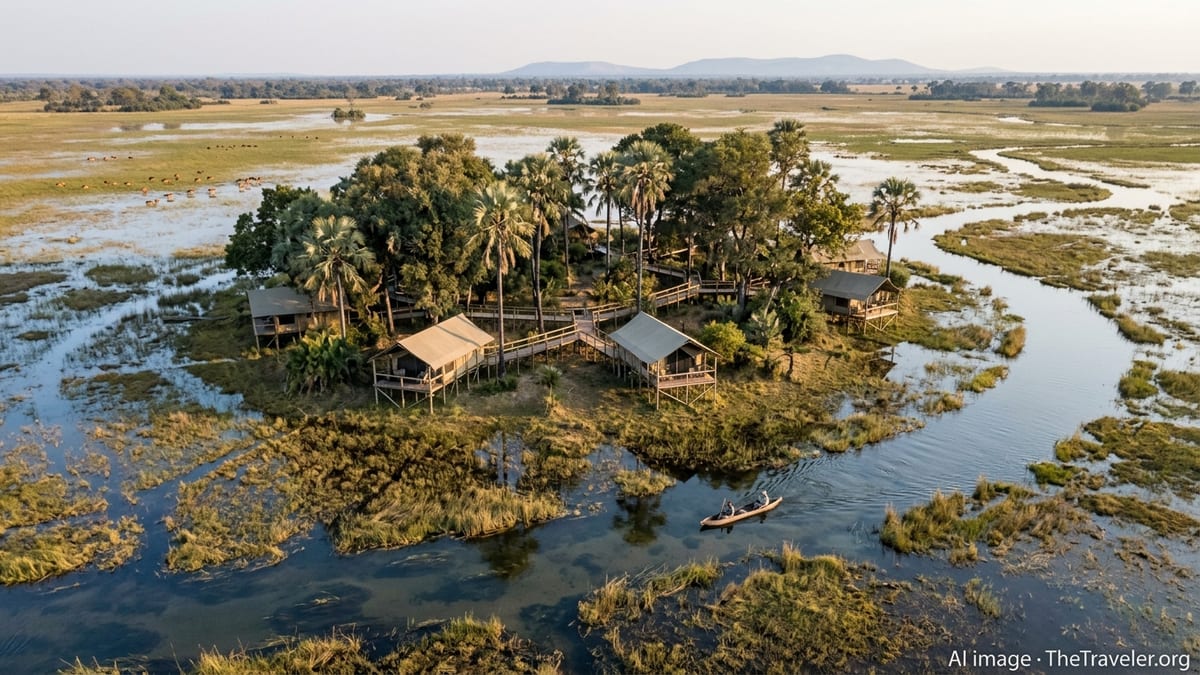
Rebuilt Treehouse Retreat in the Heart of the Jao Concession
Travel industry information shows that Kwetsani Camp, set on an island in the central Okavango’s Jao concession, has been closed for a substantial rebuild since late 2025, positioning the June 2026 reopening as a significant moment for the region’s high-end safari market. The intimate camp is known for elevated wooden structures nestled among palm and mangosteen trees, giving guests an immersive view over floodplains that attract red lechwe, sitatunga and prolific birdlife.
Brochures and operator updates describe a camp that blends contemporary comforts with a lightweight, natural aesthetic, using timber walkways and canvas-and-wood suites to minimize ground disturbance in this sensitive wetland. The upcoming reopening is expected to retain Kwetsani’s hallmark of spacious, open-fronted rooms and expansive decks, while integrating updated design features aligned with current sustainability benchmarks for remote safari properties.
The Jao concession, where Kwetsani sits, is recognized as one of the more exclusive parts of the Okavango Delta, with tightly controlled bed numbers and guided access that limit vehicle density. By returning to operation in June 2026, the camp is poised to increase the area’s capacity slightly while still operating within Botswana’s long-standing low-volume, high-value tourism model.
Early trade references to the reopening suggest that interest from international tour operators is building, with Kwetsani once again appearing in sample itineraries that combine water-based wilderness in the Delta with drier, predator-rich regions elsewhere in Botswana.
Sustainable Luxury and Low-Impact Design
Publicly available material on the camp’s rebuild indicates that Kwetsani’s 2026 incarnation will place a stronger emphasis on renewable energy and resource-efficient systems, mirroring wider trends in Botswana’s safari sector. Solar power, energy-efficient lighting and improved insulation are expected to reduce fuel consumption for generators, while back-of-house upgrades aim to limit emissions and operational waste.
Water management is a central sustainability concern in the Okavango, where seasonal flooding shapes both wildlife patterns and camp logistics. According to recent product notes covering the Jao concession, operators are increasingly investing in closed-loop or reduced-impact water treatment systems and careful greywater management, practices that Kwetsani is anticipated to adopt or expand as part of its rebuild. These systems help maintain the integrity of floodplain habitats and protect the waterways that support mokoro excursions and birdlife.
Construction and design guidelines for the area prioritize elevated walkways and stilted structures to allow wildlife to move beneath the camp and to keep infrastructure safely above changing water levels. Industry updates on Botswana’s premium safari properties point to growing use of sustainably sourced timber, low-VOC finishes and lightweight materials at new or refurbished camps, measures that align with Kwetsani’s treehouse-style architecture and the stated intention to keep the footprint as unobtrusive as possible.
The camp’s sustainable positioning also extends to its operational model, with a strong focus on small guest numbers, personalized guiding and limited vehicle routes. This style of operation typically results in fewer disturbances to wildlife and reduced pressure on sensitive floodplain soils compared with higher-density tourism formats.
Eco-Friendly Experiences in the Okavango Delta
Kwetsani’s reopening comes at a time when interest in eco-friendly safari experiences is rising, and the camp’s activities are expected to highlight water-based and low-impact exploration of the Okavango Delta. Operator documentation for the Jao concession notes that water levels fluctuate seasonally, but that iconic mokoro excursions, guided by experienced polers through reed-lined channels, remain a core component of the Kwetsani experience when conditions allow.
In addition to mokoro trips, guests typically join small-group game drives on Hunda Island and surrounding floodplains, with an emphasis on responsible viewing distances and adherence to concession rules that limit the number of vehicles at sightings. Birding is a particular strength of this central Okavango area, and the camp’s vantage point over wetlands is suited to observing herons, kingfishers, African jacanas and raptors that patrol the open skies.
Eco-conscious travelers are also likely to be drawn to interpretive walks and nature-focused experiences that reveal how the Delta functions as an inland oasis in the Kalahari Basin. Published descriptions of guiding in the concession highlight the role of local naturalists in explaining seasonal flood dynamics, the importance of papyrus and reed beds, and the intricate web of life that connects aquatic insects, fish, antelope and apex predators.
By centering activities on small-group, knowledge-rich outings rather than high-adrenaline pursuits, Kwetsani’s offering aligns with broader efforts in Botswana to position conservation-focused tourism as a premium product in its own right, rather than a niche alternative to more conventional big-game viewing.
Boost to Botswana’s High-Value Tourism Strategy
The June 2026 reopening of Kwetsani Camp is expected to contribute to Botswana’s long-standing tourism strategy, which prioritizes low-impact, high-value travel as a cornerstone of economic diversification. Travel trade coverage in recent years has underscored how premium camps in the Okavango support jobs, supply chains and conservation fees that feed directly into government revenues and community programs.
Each additional high-end bed in the Delta typically generates significant spending on charter flights, guiding, park and concession fees, as well as local goods and services. Kwetsani’s return to operation will therefore add incremental capacity at the upper end of the market at a time when demand for remote, nature-based travel remains strong among long-haul visitors.
The camp is part of a broader wave of investment and refurbishment across Botswana’s safari portfolio, reflected in industry newsletters that document new openings, reconstructions and experience-based add-ons ranging from sleep-out platforms to specialist photographic safaris. Within this context, Kwetsani’s rebuilt facilities and sustainability messaging are likely to help keep the Okavango Delta near the forefront of global safari planning for 2026 and beyond.
Analysts who follow regional tourism trends note that Botswana’s consistent policy framework, combined with its reputation for safety and political stability, has helped encourage owners to upgrade older properties such as Kwetsani rather than retire them. The result is a pipeline of refreshed camps that maintain the country’s competitive positioning while aiming to lower environmental impacts per guest.
Strategic Timing Ahead of Peak Flood and Safari Season
Reopening in June 2026 positions Kwetsani Camp at the start of one of the Delta’s most sought-after periods, when floodwaters typically fan out across the plains and concentrate wildlife on islands and higher ground. Travel planners often promote June to August as prime months for combining water-based exploration with strong game-viewing, and Kwetsani’s elevated location gives guests a dramatic vantage point as water levels rise.
Marketing materials for Botswana’s 2026 safari season indicate that travelers are booking earlier and seeking stays that balance comfort with environmental accountability, particularly in flagship destinations such as the Okavango. Kwetsani’s sustainable luxury positioning and fresh infrastructure are expected to resonate with this audience, especially those looking to pair a classic Delta experience with newer camps or community-focused properties elsewhere in the country.
The timing also allows the camp to operate through the full 2026 dry season, gathering performance data on new systems and guest preferences while the Delta is at its most accessible. Feedback from these first post-rebuild months is likely to shape how operators refine programming, from the mix of boat, mokoro and vehicle activities to the level of interpretive content provided on climate resilience and conservation funding.
For the wider Okavango region, Kwetsani’s return adds another well-known name to the roster of premium lodges welcoming travelers in 2026, signaling continued confidence in Botswana’s nature-based tourism model and its capacity to deliver both memorable journeys and tangible conservation outcomes.