

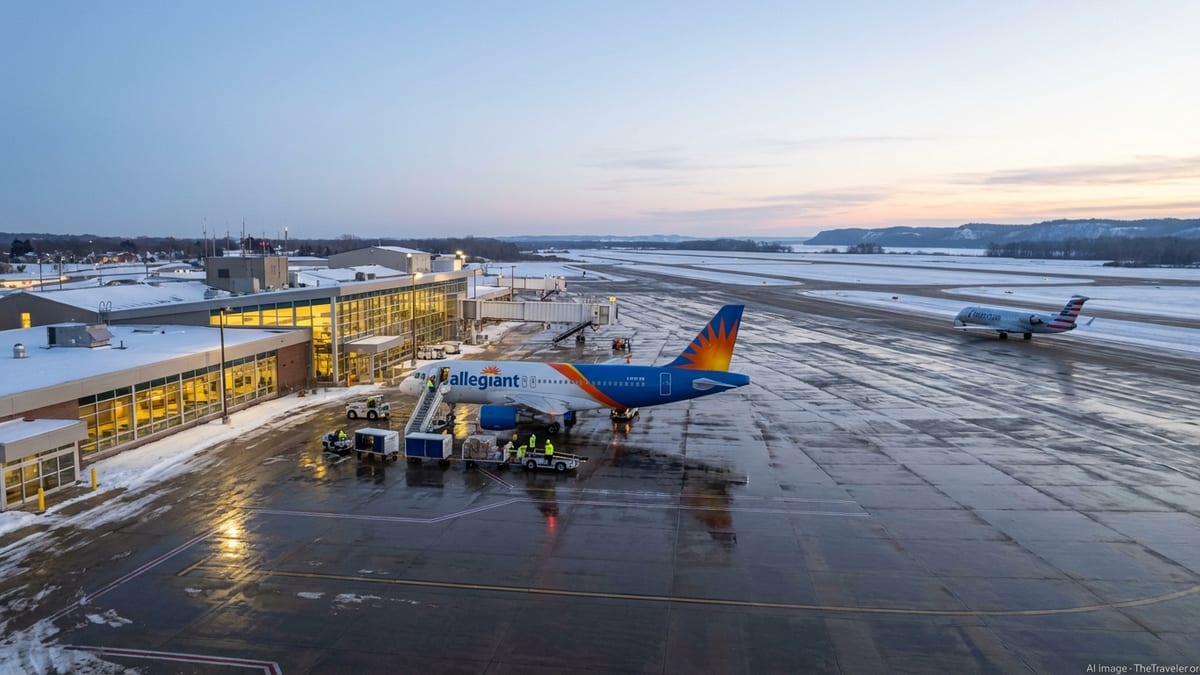
La Crosse Regional Airport in western Wisconsin began 2026 with a slight drop in passengers, even as long sought after new service from Allegiant Air launches this month and local officials wager that leisure routes to warm weather destinations can reverse years of volatility in the small city’s air travel market.
Early 2026 Numbers Signal Soft Demand
Airport data released this week show La Crosse Regional handled 3,048 departing and arriving passengers in January 2026, down from 3,189 in December and about 1 percent below January 2025, when 3,082 passengers used the facility. While the decline is modest in absolute terms, it interrupts the momentum the airport had built through most of last year and underscores how fragile small market air service can be.
The January figures also arrive with an important asterisk. They do not yet capture the impact of Allegiant Air, which began operating at La Crosse in early February with nonstop flights to Phoenix Mesa and Orlando Sanford. That means airport leaders will not know until at least March whether the highly anticipated new flights are starting to draw fresh demand or simply shifting travelers who might otherwise have driven to larger hubs.
For now, the headline is that 2026 has opened on a softer note. Airport managers say that is not entirely surprising given seasonal patterns and broader economic uncertainty that can weigh on discretionary leisure trips. Still, they acknowledge the numbers sharpen the pressure on new service to perform and on existing carriers to maintain their schedules.
“January is always one of our quieter months, but we watch every percentage point very closely,” one airport official said, noting that in a market La Crosse’s size, a few lightly booked flights can quickly move the needle on monthly statistics.
From Post Pandemic Slump to Gradual Recovery
The dip at the start of this year follows a period of gradual recovery after steep losses in the wake of the COVID 19 pandemic and the exit of Delta Air Lines from La Crosse in 2023. According to figures presented to local officials, the airport carried 43,125 passengers on scheduled commercial flights in 2025, up from 38,339 in 2024. That represents a double digit year over year increase but still leaves the airport far below pre pandemic levels.
In 2019, more than 95,000 passengers boarded flights in La Crosse, with service to hubs such as Minneapolis and Detroit. That network shrank dramatically when Delta pulled its regional flights amid broader cutbacks at small airports across the United States. The decision effectively cut La Crosse’s enplanements roughly in half and left American Airlines as the sole carrier, operating three daily flights to Chicago.
Airport business manager JD Roberts and director Jeff Tripp have repeatedly described the last three years as a rebuilding phase. Monthly passenger totals in 2025 show that pattern clearly. Only November recorded fewer passengers than the same month a year earlier, while peak travel stretched from May through August, when more than 4,000 riders passed through the terminal each month.
Those gains, however, have not yet restored the critical mass of traffic needed to easily attract and support multiple airlines. That is why local and county officials have taken the unusual step of backing new service with financial guarantees and marketing support in a bid to preserve La Crosse’s status as a full service regional airport.
Allegiant Brings Long Sought Leisure Routes
The newest entrant to La Crosse’s market is Allegiant Air, the Las Vegas based low cost carrier that specializes in connecting smaller communities with sun and leisure destinations. After several years of on and off talks punctuated by staffing and fleet constraints during the pandemic, Allegiant confirmed in late 2025 that it would launch two routes from La Crosse in early 2026.
Service to Phoenix Mesa Gateway Airport began on February 6, with flights to Orlando Sanford International Airport scheduled to follow on May 21. Introductory one way fares on the routes started at under 70 dollars, positioning the new service squarely at budget minded families and vacationers who might otherwise drive several hours to Milwaukee, Minneapolis or Madison in search of low fares and nonstop options.
Allegiant’s arrival makes it the second major airline at La Crosse alongside American. Unlike American’s hub and spoke service to Chicago, which primarily caters to business travelers and those connecting onward, the new Allegiant flights will operate several days a week and focus exclusively on leisure itineraries. Airport leaders say that adds a complementary layer of demand rather than directly cannibalizing existing schedules.
“Adding not one but two nonstop destinations out of La Crosse shows real belief in the capabilities of our passengers and our region,” Tripp said when the service was announced, calling the new routes a sign that airlines still see opportunity in mid sized Midwest cities despite broader industry consolidation.
Local Incentives and Regional Competition
The Allegiant deal is the most visible piece of a broader campaign by La Crosse County to rebuild air service. In early 2025, county supervisors approved up to 250,000 dollars in local funding to provide what is known as a minimum revenue guarantee for a new airline. Under that model, the community effectively shares the financial risk of new routes by covering some portion of any revenue shortfall during the first year.
Airport officials have framed the incentive as a necessity in a fiercely competitive environment, where small cities vie for a limited pool of regional jets and ultra low cost carriers. They estimate that attracting and sustaining a new airline could require as much as 1.5 million dollars in combined local, state and federal support for marketing, risk mitigation and infrastructure upgrades.
At the same time, La Crosse faces stiff competition from other Wisconsin airports that have been adding service of their own. Appleton International recently announced its fifth airline, bringing in Sun Country with seasonal nonstop flights to Fort Myers. Chippewa Valley Regional Airport in Eau Claire is extending Sun Country’s seasonal service to southwest Florida as well, while larger hubs in Madison and Milwaukee continue to expand both legacy and low cost options.
The growing menu of flights elsewhere in the state raises the stakes for La Crosse. Travelers in western Wisconsin have increasingly been willing to drive to Minneapolis Saint Paul International Airport or other larger facilities to access cheaper fares and more direct routes. Local leaders argue that every such trip represents not just lost passenger counts but lost economic activity tied to parking, concessions and visitor spending in La Crosse itself.
Ground Connections Fill Gaps in Air Network
Even before Allegiant’s arrival, La Crosse had been experimenting with alternative ways to plug itself back into the broader air network. In April 2025, the airport partnered with Landline, a motorcoach company that links smaller cities to major hubs under airline brands. The new service allows travelers who book on Sun Country Airlines to board a bus in La Crosse that is treated as a leg of their air itinerary to Minneapolis Saint Paul.
Passengers check in for their flights in La Crosse, then ride in reclining leather seats with onboard Wi Fi to Minneapolis, where they connect to Sun Country jets bound for warm weather destinations. Because the bus segment is integrated into the airline’s system, travelers are rebooked at no charge if delays on the ground cause them to miss a flight, similar to protections on traditional connecting flights.
Airport management has promoted the service as a way to offer more destinations without the immediate need for additional based aircraft or crews in La Crosse. It also serves as a hedge against the long running challenge of luring back Delta or attracting another network carrier, which would require airlines to commit scarce regional jets at a time when many have pulled back from smaller markets.
Critics, however, worry that extensive use of branded bus connections could make it harder to convince airlines to resume nonstop flying. If carriers can tap demand from La Crosse and similar communities via motorcoach links instead of airplanes, they may feel less urgency to restore full regional jet service.
Balancing Convenience, Cost and Community Identity
For residents, the shifting landscape presents both opportunities and trade offs. Some, like La Crosse resident Timothy Pierce, say they continue to prefer using the local airport despite higher fares or limited options compared to larger hubs. Short security lines, easy parking and the ability to drop off family members within minutes remain strong selling points.
Others make a more utilitarian calculation, choosing to drive to Minneapolis or Madison when the price difference justifies the extra time. Airport leaders argue that the new Allegiant flights and the Sun Country Landline connection could tilt that equation back toward La Crosse by offering lower fares and more destinations without sacrificing the convenience of a hometown airport.
There is also a civic dimension. Local officials warn that if residents do not use the airport regularly, existing service could erode further, creating a downward spiral that is difficult and expensive to reverse. They point to national data showing that dozens of regional airports have lost all service from at least one major carrier since the pandemic, with some communities no longer having any commercial flights at all.
In that context, every new route announcement carries symbolic weight. Allegiant’s entry is being cast not just as a transportation upgrade but as a validation of La Crosse’s regional role, supporting tourism on the Mississippi River, the city’s growing healthcare sector and its university community.
Risks Ahead as Airlines Restructure
While excitement around Allegiant is palpable, industry analysts caution that route launches in small markets come with no guarantees. Ultra low cost carriers regularly adjust their networks in response to seasonal demand and cost pressures, sometimes exiting cities as quickly as they enter them. The broader airline industry is also in flux, with Allegiant’s planned acquisition of fellow leisure carrier Sun Country expected to reshape competition in the upper Midwest over the next two years.
Under the proposed deal, Allegiant would absorb Sun Country in a cash and stock transaction and operate the combined carrier under the Allegiant name. Company executives say the merger will allow them to deploy aircraft more efficiently across 600 plus routes, many serving secondary cities and vacation destinations in Florida, the Southwest and beyond.
For La Crosse, the tie up could eventually prove beneficial if it helps stabilize leisure oriented flying and gives the combined carrier more flexibility to add seasonal routes. On the other hand, consolidation has historically led airlines to concentrate on their most profitable markets, sometimes at the expense of smaller communities.
Local officials say they are closely watching those developments while emphasizing that the best insurance policy is strong, consistent demand from area travelers. If Allegiant’s Phoenix and Orlando flights regularly go out full, the thinking goes, they are more likely to remain in the schedule or even be supplemented by additional destinations.
What to Watch in the Coming Months
The next test for La Crosse Regional Airport will come as winter turns to spring. By then, managers will have several weeks of data from Allegiant’s Phoenix route and early bookings for the Orlando service. They will also be able to compare total 2026 passenger counts to the strong summer months of 2025, when travel rebounded on the back of pent up demand.
City and county boards are expected to receive regular updates on load factors, fare levels and the use of any public funds tied to minimum revenue guarantees. Those reports will inform future decisions about whether to extend or expand incentive packages and how aggressively to pursue additional carriers such as United or a return of Delta.
In the meantime, airport staff are focused on the basics: keeping operations smooth, marketing the new flights to residents across the tri state region of Wisconsin, Minnesota and Iowa, and reminding travelers that using their local airport helps determine what choices will be available in the future.
The slight passenger decline that opened 2026 serves as a cautionary note in that campaign. But with a new airline on the tarmac and a slate of leisure routes designed to capture winter weary Midwesterners, La Crosse leaders say the real test of their strategy is only just beginning.