

More news on this day
Air travel in and out of Lagos was thrown into disarray this week after a fire at Murtala Muhammed International Airport’s ageing Terminal 1 destroyed critical air traffic control communication systems, forcing authorities to rely on emergency backups and rush in a mobile control tower to keep Nigeria’s busiest airspace open.
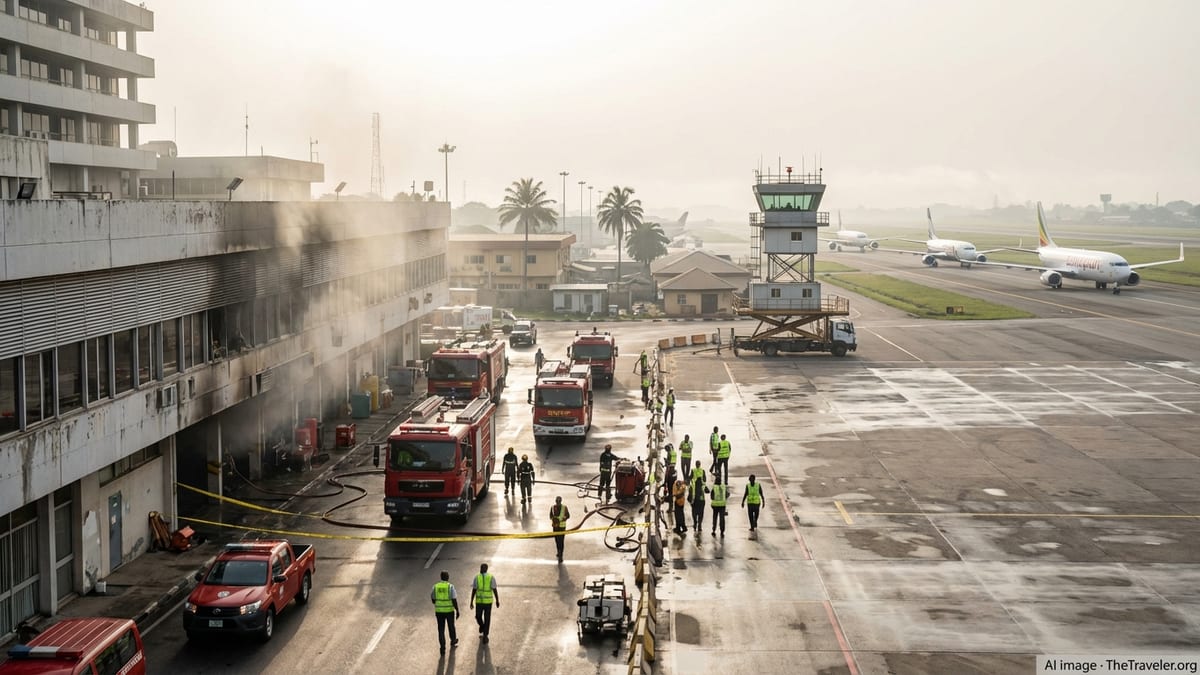
Fire Rips Through Terminal 1, Knocking Out Communications
The blaze broke out on Monday afternoon, February 23, at the old Terminal 1 of Murtala Muhammed International Airport, quickly spreading through an equipment area that housed vital systems for managing aircraft movements. Thick smoke poured from the building as firefighters from the Federal Airports Authority of Nigeria battled the flames and began evacuating staff and passengers.
Airport officials said the fire originated in a technical or server room, part of an ageing infrastructure that has long been earmarked for overhaul. The intensity of the heat and smoke made access difficult for responders and engineers trying to assess what was burning and how badly key installations were affected.
By the time the flames were contained, the damage to the Nigerian Airspace Management Agency’s equipment inside the terminal was extensive. The primary air to ground communication system, which links controllers with pilots in the Lagos terminal airspace, was declared completely destroyed, along with other navigation and monitoring tools essential to smooth operations.
While no deaths were reported, several people were treated for smoke inhalation and minor injuries, and operations at the country’s main international gateway were severely disrupted as authorities moved to secure the airspace and protect aircraft already en route to Lagos.
Backup Systems Keep Lagos Airspace Open
With its main communication platform wiped out, the Nigerian Airspace Management Agency activated contingency facilities designed to maintain a minimum level of service during emergencies. These redundant systems, housed away from the damaged terminal, enabled controllers to re establish contact with aircraft and gradually restore structured movements in Lagos airspace.
Officials acknowledged that the loss of the primary equipment caused significant disruption to air traffic services in the immediate aftermath of the fire. Some flights already inbound to Lagos were diverted to other airports, while departures were delayed or temporarily suspended until safety could be assured using the backup network.
Despite the scale of the damage, authorities stressed that the airspace remained safe, emphasising that contingency planning for precisely this kind of event allowed them to avoid a complete shutdown. Controllers worked extended shifts under emergency procedures, using more conservative separation and routing to compensate for the reduced capabilities of the remaining systems.
Industry observers noted that while the backup arrangements prevented total paralysis, the incident exposed how heavily the country’s busiest hub relies on a single, vulnerable cluster of equipment at the old terminal and underlined the urgency of modernising critical aviation infrastructure.
Mobile Control Tower Deployed to Stabilise Operations
In a bid to strengthen the fragile interim set up, authorities ordered a mobile control tower to be deployed to Lagos. The unit, effectively a fully functional air traffic control cabin mounted on a movable platform, is designed to provide short to medium term relief when fixed towers are unavailable or compromised.
Engineers began preparing a site near the airport for the structure, working to stabilise the ground and ensure that the heavy equipment could be safely positioned and anchored. Officials said the first task for the mobile tower would be to reinforce approach and aerodrome control, improving visibility and communication around the runway complex while long term repairs are planned.
The mobile tower is expected to take over some functions that have been operating in a degraded mode through the contingency systems since the fire. This should allow controllers to handle traffic with greater efficiency and fewer delays, especially during peak international arrival and departure waves.
However, aviation authorities cautioned that the mobile facility is only a stopgap measure. Even once it is fully operational, the destroyed equipment in Terminal 1 will have to be replaced and integrated into a broader overhaul of the airport’s communication, navigation and surveillance infrastructure.
Terminal 1 Faces Demolition as Damage Assessment Deepens
As investigators and engineers gained access to the charred sections of Terminal 1, it became clear that the fire had done more than destroy air traffic communication systems. Offices, technical rooms and equipment belonging to multiple aviation agencies, including meteorological services, were damaged or completely ruined.
The scale of the destruction prompted Nigeria’s aviation leadership to signal a decisive shift in how the ageing terminal will be handled. Authorities announced that Terminal 1 is now slated for demolition and full reconstruction, arguing that the incident highlighted both safety risks and the limits of trying to modernise an increasingly obsolete structure.
Airport managers have already begun relocating operations into newer facilities and temporary terminals within the Lagos airport complex. Passengers are being processed through alternative halls while engineers fence off the affected building and continue structural assessments ahead of demolition works.
For travellers, the changes have translated into longer walking distances, altered check in points and occasional bottlenecks at security and immigration. Officials have urged passengers to arrive earlier than usual for both domestic and international flights while the airport operates in a constrained configuration.
Travellers Confront Disruption, Safety Questions and Long Delays
The fire and its aftermath have had an immediate impact on passengers using Lagos as both an origin and transit hub. In the hours following the blaze, several inbound international flights were diverted, while others were held on the ground at departure airports until clarity emerged over the status of the runway and control systems.
Within Nigeria, domestic travellers reported delays, flight rescheduling and, in some cases, cancellations as airlines adjusted their operations to the reduced capacity and shifting terminal arrangements. Airline staff at check in counters and gates faced large queues of anxious passengers seeking updates and rerouting options.
The incident has also sharpened concerns about safety oversight and investment levels in the country’s aviation infrastructure. Passenger groups and industry experts are calling for transparent investigations into the cause of the fire, an accelerated timetable for renewing critical systems, and clearer communication to travellers whenever contingency procedures are triggered.
For now, Lagos remains operational, but on a more fragile footing than before the blaze. The combination of emergency backups and a mobile control tower has bought authorities time, yet the episode stands as a stark reminder for travellers and regulators alike that behind every smooth take off or landing is a complex, and sometimes vulnerable, web of infrastructure that must be maintained and modernised to keep people moving safely.