

More news on this day
Travelers using Nigeria’s busiest highway, the Lagos-Ibadan Expressway, are bracing for fresh disruption after the federal government issued a new travel advisory ahead of two weeks of repair work on the Kara Bridge section, reviving congestion fears along the critical corridor out of Lagos.
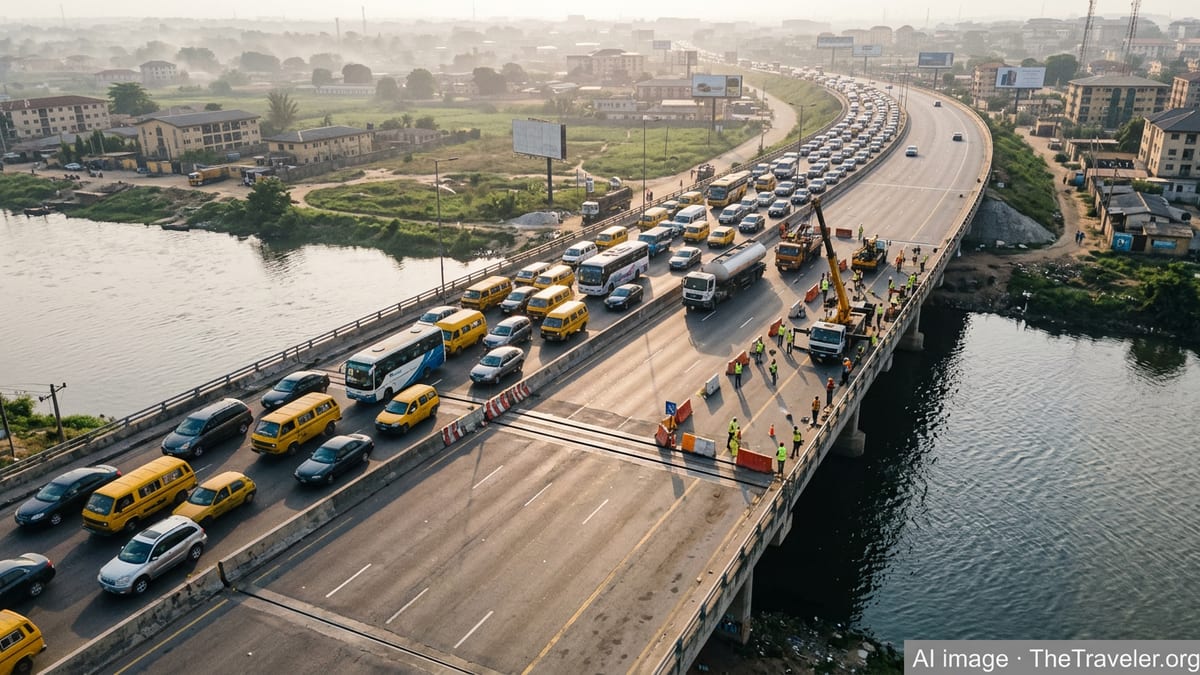
Government Sets Two-Week Repair Window on Key Bridge
The Federal Ministry of Works confirmed that maintenance on damaged expansion joints at Kara Bridge, on the outbound Lagos carriageway of the Lagos-Ibadan Expressway, will begin on Tuesday, March 10, 2026, and is scheduled to run until March 24, 2026. Officials say the work is necessary to address safety concerns on the vital structure spanning the Ogun River and to protect millions of daily commuters who rely on the route.
The ministry’s latest statement, signed by the Federal Controller of Works in Ogun State, Olayiwola Komolafe, follows a February announcement of a broader programme to rehabilitate multiple bridges along the expressway. That programme includes Kara Bridge, Magboro Bridge and Arepo-Punch Bridge, all of which have suffered progressive wear on their expansion joints, raising fears of structural deterioration if not urgently repaired.
Authorities insist that the current intervention is focused and time-bound, contrasting it with earlier phases of the Lagos-Ibadan upgrade that ran for months and drew public criticism. Officials say the two-week window has been carefully planned around contractor readiness, material availability and expected traffic patterns in order to minimise disruption while still allowing work to proceed at pace.
Engineers on the project are expected to phase the joint replacement and associated concrete works, keeping one lane open to traffic in most periods while heavy-duty equipment operates on the closed section. However, they warn that curing times for new concrete and waterproofing layers will inevitably reduce capacity at peak hours.
Travel Advisory Warns of Delays, Urges Early Planning
In its newly released advisory, the Federal Ministry of Works cautions motorists to expect significant delays near the Kara Bridge axis throughout the repair period. Drivers heading out of Lagos towards Mowe, Sagamu, Ibadan and further into Nigeria’s southwest and northern states are strongly encouraged to plan journeys outside traditional rush hours and to allow extra time for gridlock around the construction zone.
The advisory specifically notes that traffic will be diverted away from sections of the outbound carriageway as lanes are progressively closed for work on the expansion joints. Concrete barriers, cones and temporary signage will be deployed to guide motorists toward narrowed lanes and diversion points, with federal and state traffic marshals stationed on site to coordinate flow and respond to breakdowns.
Transport officials say the advisory is aimed not only at private motorists but also at interstate bus operators, haulage firms and fuel tanker drivers, all of whom depend heavily on the Lagos-Ibadan corridor. Logistics companies have been urged to stagger departure times and, where possible, shift bulk movements to off-peak periods or nighttime windows to ease daytime congestion.
Authorities are also appealing directly to commuters and commercial drivers to exercise patience, obey traffic instructions and avoid dangerous manoeuvres such as driving against the flow, mounting medians or making illegal U-turns, which have historically worsened bottlenecks and contributed to crashes around the Kara Bridge stretch.
Alternative Routes Highlighted for Lagos-Area Travelers
To relieve pressure on the main expressway, the government’s advisory outlines several alternative corridors for motorists willing to detour around Kara Bridge. Travelers coming from the Ikorodu axis and heading toward Mowe, Sagamu or Ibadan are being encouraged to route through Shimawa or Mosinmi, using a network of feeder roads that reconnect to the expressway beyond the active construction zone.
For motorists departing from Lagos Island and the Lekki-Epe corridor, the ministry recommends using the Epe route through Ijebu Ode to access Sagamu, Ibadan and Mowe. While substantially longer in distance, this coastal-inland loop is expected to offer a more predictable travel time for long-distance journeys during the height of the works, especially for passenger coaches and higher-value freight.
Local authorities in Ogun State have indicated that some secondary roads feeding into the expressway may receive temporary traffic management measures, including additional signage, roadside clearance and enforcement presence, to cope with the anticipated surge in vehicles diverting from Kara. Drivers are advised to check local traffic updates and be prepared for slower speeds on narrower rural stretches.
Transport planners note that not all alternative routes will be suitable for heavy articulated trucks, particularly on sections with tighter bends, weight restrictions or weaker pavements. Haulage operators are therefore being advised to consult with route managers and, where necessary, retain the main Lagos-Ibadan Expressway but schedule trips during less congested periods.
Long-Running Frustration Over Lagos-Ibadan Disruptions
The latest advisory arrives against a backdrop of years of intermittent closures, diversions and construction activity on the Lagos-Ibadan Expressway, a strategic artery that links Nigeria’s commercial capital to major industrial and agricultural hubs across the southwest and into the country’s interior. Previous phases of the corridor’s expansion and rehabilitation repeatedly drew complaints from commuters and businesses over severe traffic jams, extended travel times and accident risks.
In February, the Federal Government announced a six-week partial closure of sections of the expressway to enable urgent repairs on multiple bridges, including Kara. That phase was designed to restart rehabilitation work on the Lagos-bound side that had earlier been suspended following a public outcry about standing gridlock and safety concerns around work zones.
Road safety advocates say the Kara Bridge segment has been a particular flashpoint, highlighting recurring crashes, stalled vehicles and night-time visibility issues as reasons to support comprehensive structural maintenance even at the cost of fresh congestion. They argue that deferred repairs would ultimately prove more disruptive and dangerous if left to the point of emergency intervention.
For regular users of the highway, however, the renewed diversion plan reinforces a sense of “construction fatigue” as they prepare yet again to adjust commuting patterns, arrival times and logistics schedules around work portals and lane closures. Many passengers and drivers interviewed in Lagos and Ogun have expressed mixed feelings, balancing concerns over short-term hardship with recognition that a safer, more reliable bridge is essential for long-term mobility.
Safety Measures and Advice for Domestic and International Travelers
With the Kara Bridge repairs coinciding with a busy travel period for business, religious gatherings and weekend leisure trips out of Lagos, officials are urging both domestic and international visitors to factor the advisory into their plans. Travelers heading to and from Murtala Muhammed International Airport and continuing by road toward Ogun and Oyo States are being advised to build generous buffers into their itineraries, particularly when catching flights.
Tour operators and corporate travel managers are updating client guidance to reflect expected bottlenecks, recommending earlier departures from city hotels and adjusting meeting times outside the morning and evening peaks. Visitors unfamiliar with the corridor are being encouraged to rely on vetted drivers, reputable transport companies and local contacts who understand alternative backroads and current traffic conditions.
Authorities say additional patrol teams from traffic and road safety agencies will be deployed along the corridor during the two-week window, focusing on quick clearance of broken-down vehicles, strict enforcement against speeding and drunk driving, and better illumination and signage around the active construction zone. Emergency response units are also expected to be on standby for crash or medical incidents exacerbated by congestion and heat.
For many road users, the coming fortnight on the Lagos-Ibadan Expressway will test their patience once more. Government engineers, however, insist that completing the Kara Bridge joint repairs now is a critical step toward a safer, more resilient highway that can support Nigeria’s growing passenger and freight flows in the years ahead.