

More news on this day
New York’s LaGuardia Airport is slowly resuming operations after a deadly collision between an Air Canada regional jet and an airport fire truck forced a rare full shutdown and thrust the strain on U.S. airport safety systems into sharp focus.
Get the latest news straight to your inbox!
A Fatal Night on the Runway
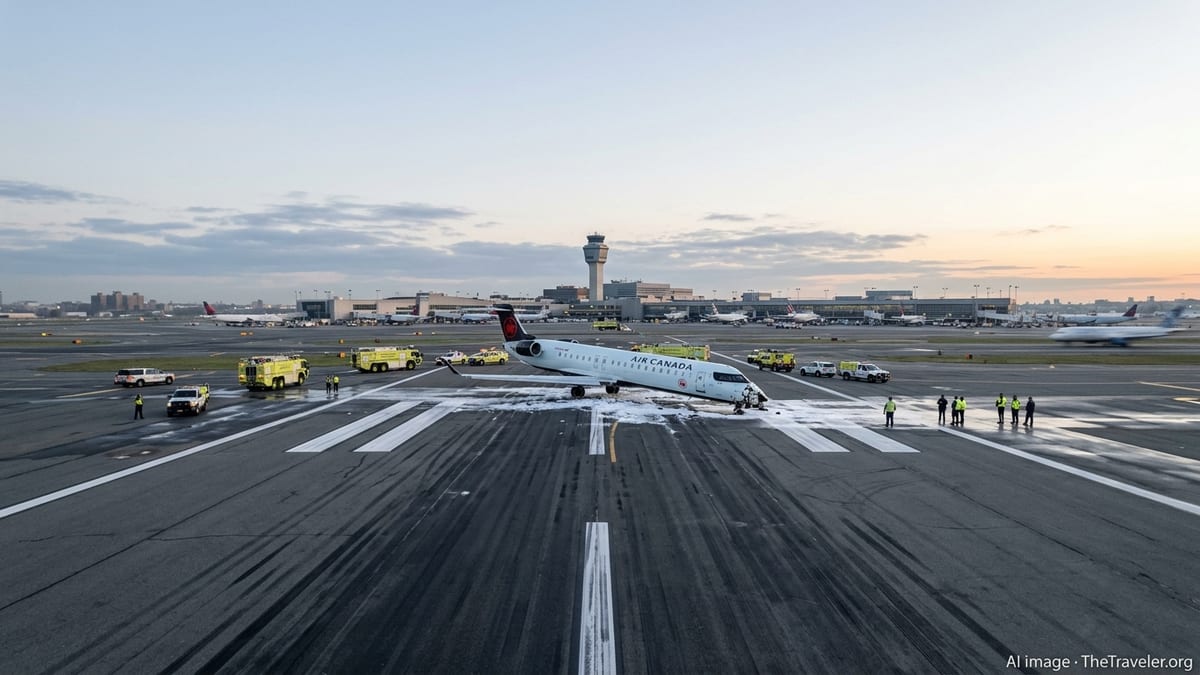
Publicly available reports indicate that the collision occurred late on Sunday, March 22, when Air Canada Express Flight 8646, a Bombardier CRJ900 arriving from Montreal, struck an airport firefighting truck on LaGuardia’s Runway 4. The impact sheared off the aircraft’s cockpit section, killing the pilot and copilot and injuring dozens of people on board and in the vehicle.
Information compiled by aviation outlets and news organizations shows that the truck was crossing the runway to respond to an unrelated incident involving a United Airlines jet that had reported fumes and an unusual odor on the ground. Air traffic control recordings reviewed in published coverage capture a controller clearing “Truck 1 and company” to cross the runway seconds before the regional jet landed.
Subsequent reconstructions of the event suggest that only about 20 seconds elapsed between the clearance for the truck to cross and the collision, leaving little time for either the flight crew or the vehicle’s driver to react. The aircraft’s forward fuselage absorbed the brunt of the impact, while passengers were evacuated from the rear of the cabin amid fire suppression efforts on the tarmac.
According to timelines summarized by major news services, the crash was LaGuardia’s first fatal accident in more than three decades, underscoring the severity of an event that unfolded at an airport already known for tight runway margins and complex ground movements.
Airport Shutdown Ripples Across the Network
In the immediate aftermath, the Federal Aviation Administration ordered a ground stop and suspended all flights into and out of LaGuardia, one of the primary domestic gateways for New York City. Coverage of the shutdown indicates that the closure extended through early afternoon on Monday, March 23, to allow investigators to document the scene and work crews to remove debris from the runway and adjacent taxiways.
With one of LaGuardia’s two runways disabled and large sections of the airfield cordoned off, operations were reduced to a fraction of normal capacity for several days. Flight tracking data cited in news reports showed LaGuardia leading the nation in cancellations and delays through midweek, as airlines diverted traffic to Newark and John F. Kennedy airports and scrambled to rebook stranded travelers.
Published accounts describe long lines at customer service desks, crowded terminal gate areas and mounting frustration as successive waves of cancellations spread across airline networks. The shutdown at LaGuardia not only disrupted local traffic but also affected connecting passengers nationwide, since many LaGuardia flights feed into larger hubs across the United States and Canada.
By Thursday morning, March 26, the Port Authority of New York and New Jersey announced that Runway 4 and its associated infrastructure had been repaired, inspected and cleared for use, allowing the airport to move toward full capacity. Even as both runways reopened, schedules remained unsettled, and travel advisories continued urging passengers to verify flight status before heading to the airport.
Warning Systems Under Scrutiny
The collision has turned attention to the ground safety technologies designed to prevent exactly this kind of incident. Investigative updates summarized in multiple outlets note that LaGuardia is equipped with runway status lights and surface movement radar intended to alert pilots and vehicle operators when a runway is unsafe to enter.
Early findings described in published coverage suggest that the fire truck involved in the crash may not have had the full suite of transponder equipment needed to interface properly with all elements of the airport’s conflict detection systems. Aviation analysts writing about the incident point out that without those signals, automated systems may not reliably recognize a vehicle as an obstacle in time to trigger alerts.
Reports also highlight the role of human workload in the chain of events. At the time of the collision, the same controller was reportedly handling both ground and tower duties during the overnight shift while managing an emergency involving the United flight on the ramp. Commentators in specialist aviation forums and trade publications argue that this level of multitasking at a high-density airport can exacerbate the risk of misjudgment or delayed reactions.
National Transportation Safety Board investigators have emphasized in public briefings that the inquiry is ongoing and that any preliminary observations about equipment, procedures or staffing will be examined alongside flight data recorders, cockpit voice recordings and detailed mapping of vehicle and aircraft movements.
LaGuardia’s Congestion Problem
The crash has also revived debate about LaGuardia’s chronic congestion and physical limitations. Federal aviation planning documents describe the airport as operating near the ceiling of its runway and gate capacity in normal conditions, with tight runway crossings and limited taxiway alternatives when segments of the airfield are closed.
Analyses in transportation media note that LaGuardia lacks a full parallel taxiway system around its primary runways, which often forces aircraft and service vehicles to cross active runways to reach terminals and maintenance areas. This layout can create choke points where aircraft, fuel trucks, baggage carts and emergency vehicles converge in close proximity to landing and departing traffic.
Recent reconstruction and modernization projects have significantly upgraded LaGuardia’s terminals, but official presentations on airport operations show that much of the underlying airfield geometry remains constrained by the surrounding urban environment and waterfront. As a result, incremental improvements to taxiway design and signage must contend with limited space and the need to keep traffic flowing at a major hub.
Travel industry observers point out that these structural constraints can amplify the impact of any disruption. When one runway or a key taxiway segment is taken out of service, delays cascade quickly, affecting travelers far beyond New York City and leaving airlines with few easy options to absorb the shock.
Wider Questions for U.S. Air Travel
Beyond LaGuardia, the collision has sharpened focus on systemic pressures across the U.S. aviation network. Recent years have seen a series of close calls and runway incursions at busy airports, prompting concerns from safety advocates, pilot unions and air traffic controller groups about staffing levels and aging infrastructure.
Policy analysts writing on aviation safety suggest that the LaGuardia crash could influence ongoing debates about federal investment in ground surveillance systems, standardized equipment for airport vehicles and the staffing models used at high-density towers. Some industry commentary has raised the prospect of new guidance on how concurrent emergencies are handled when a single controller is responsible for multiple positions.
For travelers, the event is a stark reminder of how tightly coupled airline schedules have become. A single runway closure at a key airport can disrupt vacations, business trips and family visits across an entire continent within hours. While air travel remains statistically one of the safest forms of transportation, incidents like the LaGuardia collision reinforce the importance of continual upgrades to both technology and procedures.
As investigators continue to piece together the final seconds before impact, airlines, regulators and airport operators face mounting pressure to show that lessons from LaGuardia will translate into tangible changes on the ground, long after the runway has reopened and the news cycle has moved on.