

More news on this day
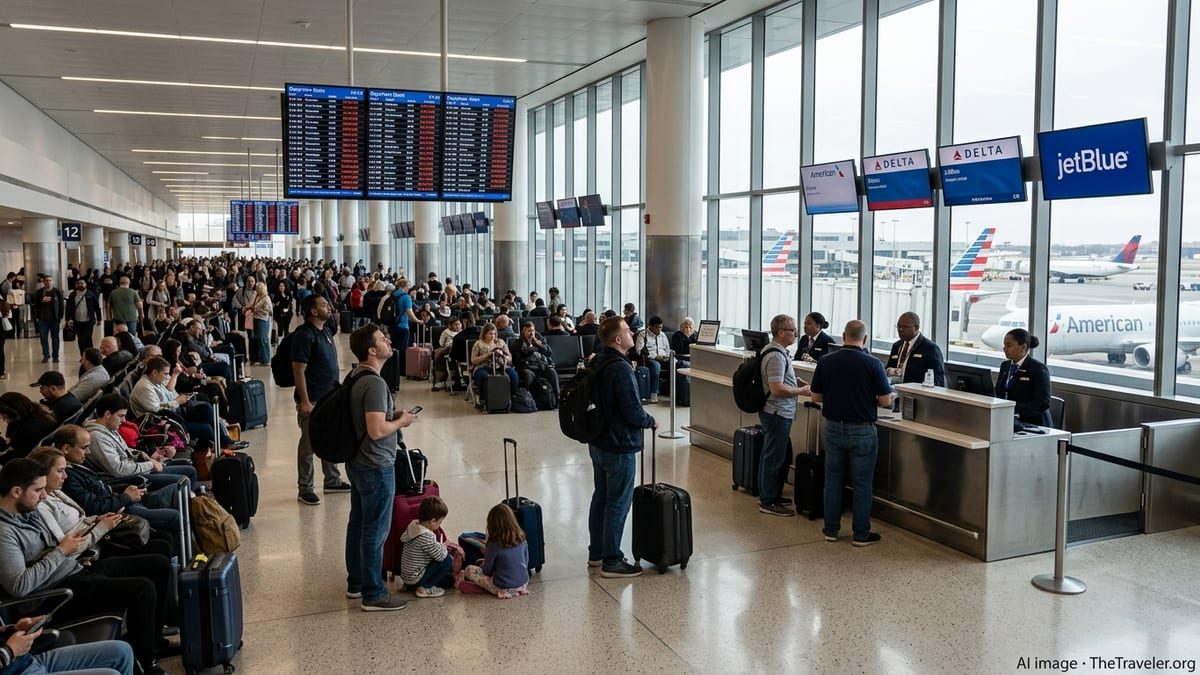
Hundreds of passengers were left stranded at New York’s LaGuardia Airport on March 22, 2026, as publicly available flight tracking data showed 212 delays and eight cancellations, disrupting operations for major U.S. carriers and key routes to Chicago, Miami, Boston and other cities.
Get the latest news straight to your inbox!
Major Carriers Hit as Operations Snarl
Publicly accessible airline and aviation tracking platforms on Sunday showed American Airlines, Delta Air Lines, JetBlue and several smaller carriers experiencing significant disruption at LaGuardia, with departure and arrival boards dominated by late-running services. The delays and cancellations affected a mix of domestic trunk routes and regional connections, compounding congestion across the broader U.S. network.
Flights on busy corridors linking New York to Chicago, Miami and Boston were among those most heavily affected, according to live schedule data. These city pairs are normally among the highest-frequency domestic routes, and disruption on them tends to ripple quickly across airline networks as aircraft and crew struggle to rotate to their next assignments.
The 212 delayed flights at LaGuardia translated into hours of additional waiting for travelers already at the airport or en route, while eight cancellations forced some passengers onto later departures or alternate airports around the New York region. Available information indicated knock-on impacts at Chicago O’Hare and Midway, Boston Logan, and Miami International as inbound and outbound rotations were pushed back.
Airline operations teams were shown reworking schedules in real time, with aircraft swaps and rolling delays evident on tracking services as carriers attempted to reduce congestion at gates and taxiways. The pattern reflected LaGuardia’s limited runway capacity and tightly scheduled banks of flights during peak travel periods.
Routes to Chicago, Miami and Boston Disrupted
LaGuardia’s links to Chicago, Miami and Boston serve as critical pipelines for both business and leisure travelers, and the disruption on March 22 was felt across all three markets. Publicly available timetables showed multiple delayed departures to Chicago O’Hare and Chicago Midway, key hubs that funnel passengers onward to the Midwest, West Coast and smaller regional destinations.
Service to Miami, an important gateway for international and Caribbean connections, also saw extended delays. Late departures from LaGuardia threatened to cause missed onward flights and reduced connection windows at Miami International, making rebooking more complex for passengers with multi-leg itineraries.
Boston Logan, another short-haul but heavily trafficked route from LaGuardia, recorded a cluster of delayed services as aircraft waited for departure slots and turnaround times stretched. Given the relatively short flight time between New York and Boston, even modest delays can disrupt multiple rotations in a single day, contributing to a cascading effect across airline schedules.
Travel industry observers frequently note that congestion on these northeastern corridors has an outsized influence on performance metrics for major U.S. carriers. Sunday’s pattern at LaGuardia echoed this dynamic, with high-frequency shuttles and hub connections bearing the brunt of the disruption.
Passengers Face Long Waits and Scramble for Alternatives
The accumulation of delays at LaGuardia quickly translated into crowded gate areas, longer lines at customer service desks and increased demand for standby seats on later flights. Reports from travelers posting on social media platforms on Sunday described terminal seating filled to capacity and departure boards showing delay increments that steadily increased through the afternoon.
Some passengers were shown seeking same-day alternatives through nearby airports such as John F. Kennedy International and Newark Liberty International, though limited availability and rolling delays across the region constrained options. Others attempted to change their plans entirely, opting for next-day departures or switching to train services on the busy Northeast Corridor for routes such as New York to Boston.
Overnight accommodation and meal arrangements posed an additional challenge for those affected by cancellations, particularly travelers without flexible tickets or travel insurance. Consumer advocates often advise passengers in similar situations to keep all receipts and to review each airline’s published customer service commitments, which outline what assistance is offered during controllable and uncontrollable disruptions.
Families traveling with children and those on tight schedules for events or business meetings were especially exposed to the uncertainty. Travel planners note that when disruption reaches the scale seen at LaGuardia on March 22, even small schedule changes can cascade into missed connections and abandoned itineraries.
Spotlight on LaGuardia’s Chronic Vulnerability to Delays
Transportation analyses and government reviews have long highlighted LaGuardia as one of the U.S. airports most susceptible to delays, citing a mix of factors that include short runways, limited room for expansion, dense surrounding airspace and challenging weather patterns. Data compiled in recent years by federal oversight bodies shows that LaGuardia consistently ranks near the top among major airports for total minutes of delay per passenger.
Despite a multibillion-dollar terminal redevelopment that has modernized passenger facilities and improved gate layouts, capacity constraints in the airfield and regional air traffic system continue to limit the airport’s resilience when problems emerge. Congestion in the New York airspace means that even modest schedule disruptions can quickly result in holding patterns, ground stops and lengthy taxi times.
Comparative studies of U.S. airports point out that LaGuardia’s delay profile often mirrors conditions at other heavily used hubs such as Chicago O’Hare, Miami International and Boston Logan. When disruptions occur in one of these locations, they frequently propagate to others, especially on days with strong demand and tight aircraft utilization.
Industry watchers note that measures such as schedule caps, more efficient air traffic procedures and greater use of larger aircraft on peak routes have mitigated some chronic congestion in recent years. However, the events at LaGuardia on March 22 illustrate that the airport remains highly sensitive to any operational strain, with widespread consequences for airline reliability and traveler experience.
What Travelers Can Do When Disruptions Mount
Travel experts observing Sunday’s disruption at LaGuardia pointed to several practical steps passengers can take when flight delays and cancellations escalate. Checking flight status through official airline channels and reputable tracking services before leaving for the airport remains one of the simplest ways to avoid unnecessary time in terminals.
Same-day schedule changes through airline apps can sometimes secure earlier or more reliable connections when disruption first appears, while keeping carry-on luggage only can make it easier to switch to alternative routes if necessary. For critical journeys, some planners recommend building in longer connection times at hubs like Chicago, Miami and Boston, particularly during busy weekends or seasons prone to weather issues.
Reviewing the terms of airline customer service policies, as well as any protections included with credit card bookings or travel insurance, can help travelers understand what assistance may be available in cases similar to the March 22 LaGuardia disruption. Options can range from rebooking on later flights to limited coverage of meals or accommodation, depending on the cause of the delay.
While Sunday’s conditions at LaGuardia were disruptive for hundreds of passengers and indicative of broader systemic pressures, the episode also underscored the value of flexible planning, real-time information and awareness of passenger rights in navigating an increasingly complex air travel environment.