

More news on this day
Tens of thousands of air travelers faced cascading disruption on Monday after a deadly runway collision at New York’s LaGuardia Airport forced the closure of a key runway, triggering widespread cancellations, rolling delays and mounting frustration for passengers across the United States air network.
Get the latest news straight to your inbox!
Runway Crash Closes LaGuardia and Ripples Across U.S. Flight Network
Published coverage indicates that an Air Canada Express regional jet collided with an airport emergency vehicle late on Sunday, March 23, at LaGuardia Airport in New York, prompting an immediate shutdown of the field to passenger traffic. Initial reports describe the aircraft striking a fire truck while landing, resulting in severe damage to the jet and fatal injuries to its flight crew, while multiple occupants on board and on the ground were transported to area hospitals.
According to live airport status boards and aviation tracking data, the incident led to an extended closure of at least one primary runway at LaGuardia through Monday afternoon, severely constraining operations at one of the nation’s busiest domestic hubs. Airport information channels and airline communications describe a rapidly evolving situation in which safety investigations and recovery operations are taking priority over flight throughput.
With LaGuardia functioning at a fraction of its usual capacity, airlines have been forced to slash schedules, consolidate services and divert aircraft to other New York–area airports, creating a choke point in the Northeast corridor at the height of the spring travel period.
Hundreds of Flights Canceled as Operational Disruptions Mount
Based on data compiled from flight-tracking services and airline advisories on Monday, more than 570 flights linked to LaGuardia were canceled and at least 400 were delayed, with the impact falling heavily on major U.S. carriers that rely on the airport as a key domestic gateway. Publicly available tallies show cancellations and delays affecting departures and arrivals across the day as carriers attempted to reset their schedules once limited operations resumed.
Delta Air Lines, American Airlines and JetBlue Airways, which together operate a large share of LaGuardia’s daily schedule, have issued system-wide travel waivers, allowing customers to change affected itineraries without typical fees. These measures are designed to ease pressure on customer-service channels and give travelers additional options to reroute through John F. Kennedy International Airport, Newark Liberty International Airport or other East Coast hubs.
Even with waivers in place, aircraft and crew imbalances are contributing to knock-on disruptions across the broader U.S. network. Aircraft that were scheduled to overnight at LaGuardia or turn quickly for onward flights are now out of position, causing cancellations and rolling delays on routes to and from cities far beyond New York, from Midwestern business centers to Florida leisure destinations.
Stranded Passengers Face Long Lines, Uncertainty and Limited Options
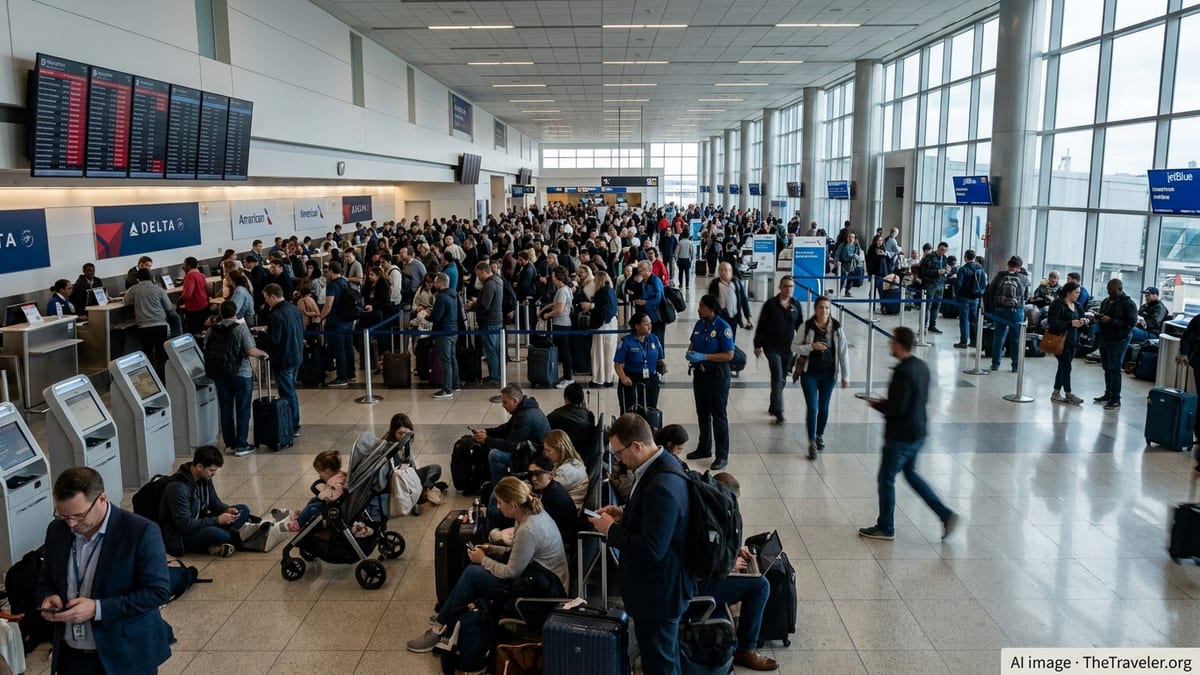
Airline communications and social media posts from travelers describe crowded terminals, long rebooking queues and mounting anxiety among passengers who suddenly find themselves stranded. With an estimated 75,000 or more passengers scheduled to travel through LaGuardia during the affected period, the scale of disruption is straining both physical infrastructure and customer-service capacity.
Reports from the terminal complexes at LaGuardia indicate that many travelers are being rebooked one or more days later, particularly on popular routes where alternative seats are limited. Others are being offered connections through alternate hubs, sometimes involving circuitous routings and extended layovers as airlines work to accommodate demand with a constrained fleet.
Hotel availability near the airport and in central New York City is also tightening as displaced passengers seek overnight accommodation, while some travelers are choosing to switch to rail or intercity bus services to reach destinations along the Northeast Corridor. For many, the combination of uncertainty around runway capacity and the possibility of further schedule adjustments is adding to the stress of already complicated travel plans.
Runway Closure Highlights Vulnerability of Single-Airport Bottlenecks
LaGuardia’s compact airfield layout and dense schedule have long been cited by aviation analysts as factors that leave the airport particularly exposed to disruption when a runway is closed. The collision has once again underscored how a single incident on or near a runway can trigger hours or days of operational instability at a slot-controlled facility with limited room for diversions and ground movements.
Aviation safety specialists note in published analyses that runway incursions and vehicle conflicts, while relatively rare compared with overall traffic volumes, remain a critical focus area for regulators, airport operators and airlines. The LaGuardia event is expected to draw close scrutiny of ground-movement procedures, communications protocols between air traffic control and emergency responders, and the resilience of runway monitoring and alerting systems.
While investigations are still in an early phase, early operational assessments suggest that, even after partial reopening, LaGuardia may need to rely more heavily on its remaining runway for some time. That scenario would likely force a reduced schedule, tighter slot management and continued delays, particularly during peak morning and evening banks.
What Travelers Should Know and How Airlines Are Responding
Publicly accessible airline advisories recommend that anyone booked to travel through LaGuardia over the next several days check their flight status frequently and use digital tools to rebook rather than waiting in terminal lines. Many carriers are expanding the scope of their travel waivers to include nearby airports, giving customers the option to depart from or arrive at alternate New York–area facilities without additional fare differences in certain booking classes.
Travel industry analysts point out that delays may persist even after the damaged runway fully reopens, as airlines work through a backlog of displaced passengers and reposition aircraft and crews. Travelers connecting onward from LaGuardia are being urged, in widely shared guidance, to allow extra buffer time and to avoid tight connections that could be jeopardized by residual delays.
For those still planning trips into or out of New York City, monitoring airport status boards, airline notifications and broader aviation data can provide a clearer picture of evolving conditions. As recovery operations continue and investigators document the circumstances of the collision, LaGuardia’s experience is likely to feed into future discussions about airport resilience, ground safety and the broader fragility of tightly scheduled air travel networks in congested metropolitan regions.