

More news on this day
The deaths of seven Chinese tourists and their Russian driver after a minibus plunged through the ice of Lake Baikal in Siberia are sending shockwaves through the global travel industry, sharpening focus on the growing dangers of winter tourism on frozen lakes and prompting urgent calls for tougher safety rules and enforcement.
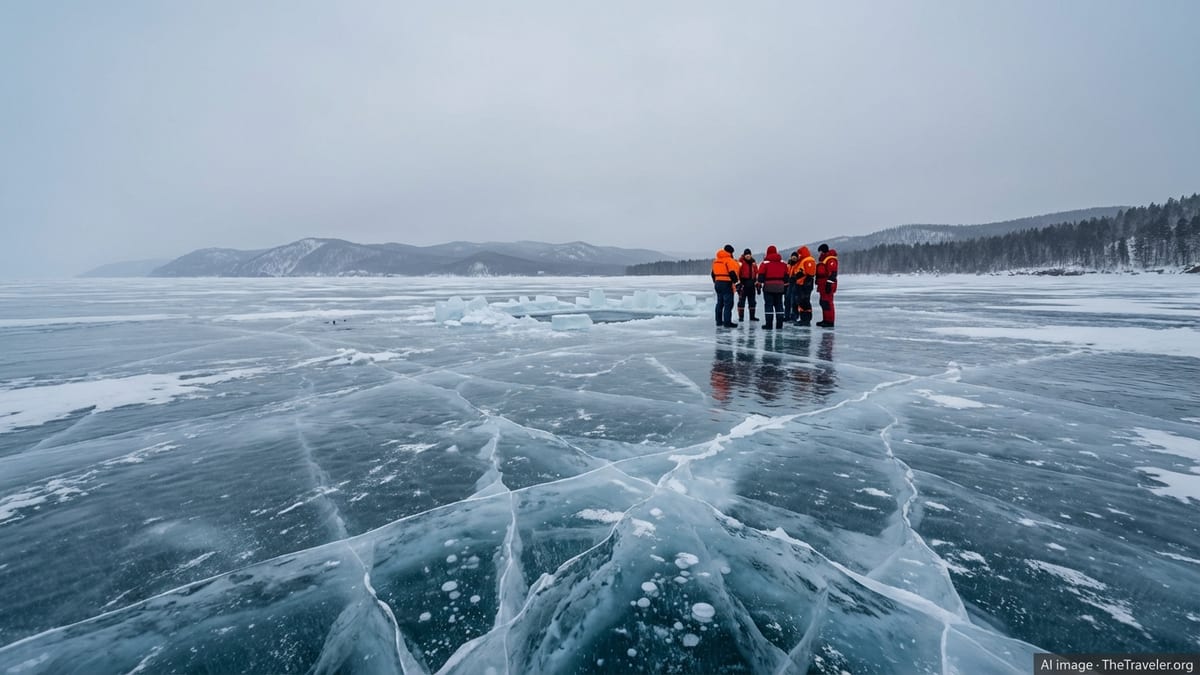
Deadly Excursion on the Ice at a Flagship Siberian Destination
Authorities in Russia’s Irkutsk region say the group of Chinese tourists was traveling in a minibus across the frozen surface of Lake Baikal on Friday, February 20, when the ice suddenly gave way beneath the vehicle. The bus dropped into a three meter wide ice fissure and sank to a depth of around 18 meters, trapping most of those on board.
Regional officials confirmed that seven Chinese tourists and the Russian driver died in the accident, while a single Chinese passenger managed to escape from the vehicle before it went under. Rescuers used underwater cameras and then divers to locate the submerged minibus and recover the bodies in frigid water and air temperatures near minus 10 degrees Celsius.
Lake Baikal, the world’s deepest freshwater lake and a UNESCO listed natural site, has become one of Russia’s most iconic winter destinations, particularly popular with visitors from neighboring China. In recent years it has been heavily promoted on social media and by tour agencies for its glass clear ice, dramatic pressure ridges and ice caves, all of which draw thousands of self organized and package tour groups every peak season.
The Irkutsk regional governor condemned what he described as a flagrant violation of safety rules, noting that travel by vehicle on that section of the lake was officially prohibited at the time. Prosecutors have opened a criminal investigation into the provision of tourism services that failed to meet safety requirements and resulted in multiple deaths.
Unregistered Operator and Banned Route Raise Oversight Questions
Early findings from regional tourism and law enforcement bodies indicate that the excursion was operated by an unregistered company that was not listed in official tourism registries. Local officials said the bus had driven onto the lake in an area where no state monitored ice road had been opened, bypassing designated entry points and ignoring current restrictions.
Russian emergency services and regional authorities emphasized that specific ice roads are only declared open after repeated thickness measurements and continual monitoring. Vehicles are then allowed onto clearly marked corridors under strict limits for weight and speed. Outside those marked corridors, driving on Baikal’s ice is officially banned because of the presence of hidden cracks, thin patches and shifting pressure ridges.
Investigators are now examining how the group booked the tour, what information they were given about risks, and whether the driver had been warned or fined previously for similar trips. Tourism officials in Irkutsk reported that the operator did not hold the licenses required for organized excursions, a finding that has intensified criticism from safety advocates who have long complained about loosely regulated private drivers selling cheap ice tours to foreign visitors.
Legal experts in Russia say the case is likely to focus not only on the conduct of the driver and any intermediaries, but also on the adequacy of current regional regulations and inspections. Questions are mounting about how many unofficial trips are being sold online and through informal networks during the winter season, and whether current penalties are enough to deter rule breaking.
Chinese Visitors at the Center of a Winter Boom and Rising Risk
The victims were part of a surge in Chinese travel to Siberia that has followed a mutual visa free regime between Russia and China and closer political ties between the two countries. Lake Baikal, located just north of Mongolia and relatively accessible from major Chinese cities, has emerged as a showcase destination for short break group tours and independent travelers alike.
Tourism analysts note that Chinese social media platforms are full of images of Baikal’s transparent blue ice, luxury ice camps and off road vehicles parked on the frozen lake, often presented as must do experiences. That online imagery has helped fuel expectations among some visitors that driving or walking far out on the lake is a standard and safe part of any winter itinerary, even when local authorities issue warnings to the contrary.
The Chinese Consulate General in Irkutsk had already issued a safety alert in late January advising Chinese citizens not to drive on unopened ice routes, to avoid unlicensed operators and to consider using hovercraft instead of cars or minibuses to reach popular spots such as Olkhon Island. That alert followed an earlier crash in which another Chinese tourist died and several were injured when a vehicle overturned on Baikal’s ice.
With the latest tragedy, Chinese diplomats and consular officials are now under pressure to further tighten travel advisories and liaise more closely with Russian regional governments, inbound tour agencies and online booking platforms. Families of the victims are expected to seek detailed explanations about how an apparently informal, high risk excursion could proceed despite repeated warnings.
Climate Change and Unpredictable Ice Undermine Old Assumptions
Local rescue services and scientists have been warning for years that warmer winters and erratic freeze up patterns are making Baikal’s ice less predictable than in the past. Wind, underwater currents and temperature swings can cause rapid thinning and the formation of new fractures even in areas that appear solid and uniform to the naked eye.
Residents around Baikal have long used the frozen lake as a seasonal transport route, particularly to remote settlements and islands. However, they traditionally relied on intimate local knowledge, cautious speeds and lightweight vehicles. Today, heavy tourist minibuses and SUVs, often driven by people with less experience of the lake’s quirks, are venturing further from shore and at higher speeds in search of picturesque locations and time saving shortcuts.
Experts on winter travel safety say that climate change has fundamentally altered the risk calculus. Conditions that once supported safe crossings for weeks or months may now only be reliable for a matter of days, and clear ice that photographs well can in fact be dangerously thin. These shifting patterns are challenging long held assumptions among both locals and visitors, while current regulations still largely reflect an earlier climate.
Tourism planners and environmental agencies are calling for more granular, real time ice mapping and for restrictions that better reflect the increasing variability of winter conditions. They argue that even well marked official ice roads may need to be open for shorter periods, while unregulated vehicle excursions far from shore should be considered incompatible with today’s warming climate.
Gaps in Global Standards for Frozen Lake Tourism
The Lake Baikal disaster is being closely watched by travel safety specialists beyond Russia, who see it as part of a broader pattern of accidents on frozen lakes in northern Europe, North America and East Asia. In many destinations the marketing of dramatic ice landscapes has outpaced the development of binding safety standards and cross border best practices for tours conducted on natural ice.
Unlike activities such as skiing or mountaineering, where detailed international guidelines and certification systems exist, frozen lake excursions are often regulated only by local road rules or municipal ordinances. Operators may be required to meet basic vehicle safety and insurance requirements, but not to follow specific protocols for ice thickness checks, emergency planning, passenger briefings or rescue coordination.
Industry insiders say that many travel agencies selling winter packages do not differentiate clearly between approved ice roads and informal routes, especially when contracting local transport providers at short notice during peak demand. That can leave foreign tourists assuming that any excursion offered through recognizable booking platforms must comply with official standards, even when vehicles are in fact operating in prohibited zones.
Advocates for stronger oversight argue that destinations which actively promote their frozen lakes for tourism have a responsibility to publish clear, multilingual safety rules and to require all operators, including subcontractors, to undergo specialized winter driving and ice safety training. Some are now calling for an international code of practice for frozen lake tourism that would apply from Siberia to Scandinavia and Canada.
Renewed Calls for Tougher Rules, Better Enforcement and Clearer Messaging
In the immediate aftermath of the Baikal crash, officials in the Irkutsk region reiterated that going onto the lake’s ice outside designated routes is not only forbidden but “mortally dangerous.” Yet the persistence of illegal trips suggests that warnings alone are not enough to deter operators and visitors attracted by the promise of unique experiences and dramatic photographs.
Regional lawmakers and safety advocates are now pushing for a package of measures that could include higher fines and potential jail terms for organizing unauthorized ice tours, stricter verification of tour company registrations, and real time digital maps showing which routes are open or closed. Some have proposed that rental car agencies and hotels around Baikal be required to display updated safety notices in Russian, Chinese and English.
Travel industry representatives say clearer communication is essential. They argue that brochures, websites and social media promotions must explain that certain iconic shots circulating online were taken under conditions that may no longer exist or were captured by professionals working with special permissions and safety support. Without that context, travelers may misinterpret staged marketing images as an invitation to replicate risky behavior on their own.
There is also debate about whether large tourist vehicles should be allowed onto Baikal’s ice at all, even on monitored roads. Some experts recommend phasing out heavy vans and buses in favor of hovercraft and other specially designed craft that can operate over ice and water, reducing the risk of catastrophic sinkings when cracks appear.
What Tourists and the Industry Can Do Differently This Winter
As investigations continue, travel safety specialists emphasize that both individual travelers and the tourism industry have practical steps they can take immediately to reduce risks on frozen lakes. Prospective visitors are being urged to book only with clearly licensed operators, to verify whether their itinerary involves travel on natural ice, and to ask how ice conditions are assessed on the day of travel.
Experts recommend that tourists refuse any offer to drive on lakes where authorities have not officially opened and marked ice roads, regardless of assurances from informal guides or drivers. They also advise carrying warm layers, waterproof boots and basic emergency items when heading out onto winter landscapes, even on organized tours that may appear routine.
For tour companies, the Baikal tragedy is prompting a reassessment of product design and risk management. Many are reviewing contracts with local transport providers, introducing stricter criteria for winter driving experience, and creating contingency plans that avoid reliance on ice crossings for key sightseeing highlights. Insurers, meanwhile, are expected to take a closer look at the wording of policies that cover lake based excursions.
While Lake Baikal will likely remain a coveted destination for adventurous travelers, the fatal sinking has laid bare the costs of underestimating the power and unpredictability of natural ice. It has also opened a wider conversation across the travel industry about how to balance the allure of extreme winter experiences with the non negotiable priority of keeping visitors safe.