

More news on this day
A Lake Michigan beach has been closed after a migrating sand dune spilled over its crest and buried a key parking lot, surprising visitors and underscoring how quickly the region’s towering coastal dunes can reshape familiar shoreline access points.
Get the latest news straight to your inbox!
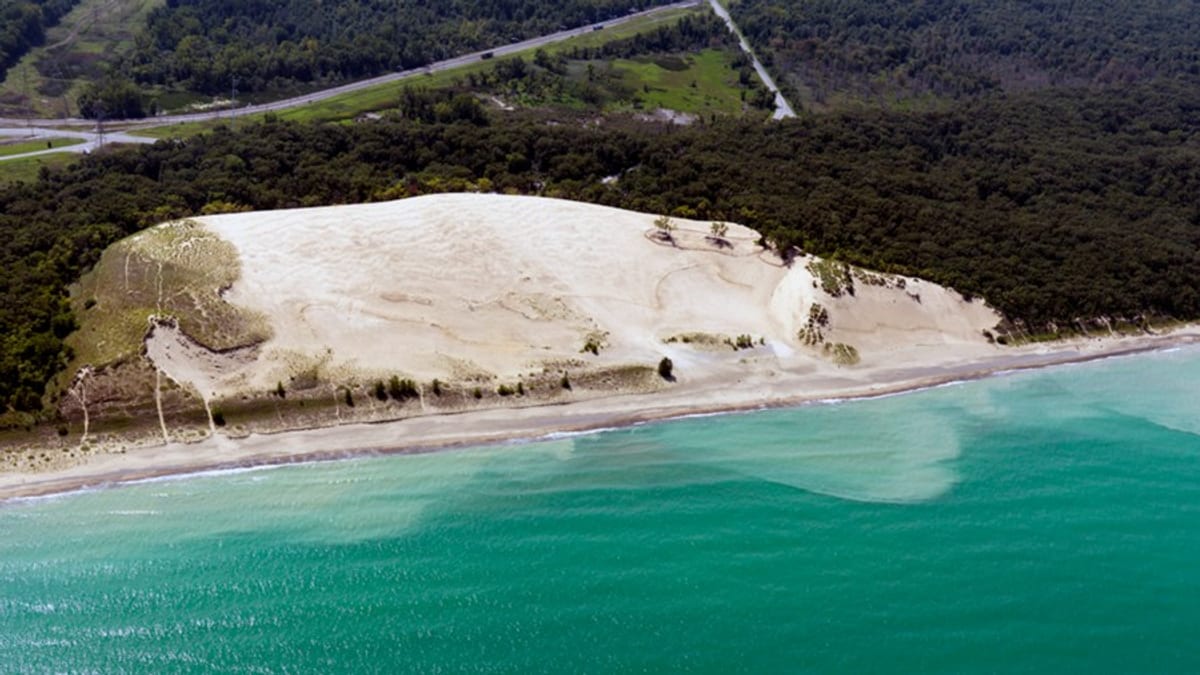
Image by Yahoo
Dune movement shuts down popular beach access
Reports from local coverage in the southern Lake Michigan region indicate that a large, wind-driven dune advanced across a lakeshore access road and into an adjacent parking lot, prompting managers to block vehicle access and close the beach area to the public. Images shared in recent days show drifts of sand filling parking spaces, half-covering vehicles and obscuring curbs and signage, creating conditions described as both unsafe and impractical for day-use recreation.
Publicly available information shows that the affected site sits at the base of an active, or “living,” dune system, where sand is continually pushed inland from the lakeshore. As gusty winds funneled along the shoreline, the exposed face of the dune shed sand that cascaded down toward the low-lying pavement, a process that can accelerate when dune-stabilizing vegetation is thin or damaged. Within a relatively short period, this natural movement transformed a functional lot into what appears more like an extension of the dune field.
Initial responses have focused on securing the area, with barriers and signs set up around the buried parking lot and adjacent walkways. Access to the water’s edge has been curtailed while crews assess how much material has accumulated, what can be safely cleared and whether further dune migration is expected in the coming days and weeks.
Living dunes along Lake Michigan’s shore
The incident reflects a broader pattern documented at several Lake Michigan locations where dunes are not fixed in place. Sites such as Mount Baldy at Indiana Dunes National Park have been closely studied as classic examples of “wandering” dunes that advance inland over time, especially where native grasses that help hold sand in place have been trampled, removed or damaged. In some of those areas, publicly available reports describe sand building up against parking lots and infrastructure, forcing repeated maintenance and partial closures.
Along much of the eastern and southern Lake Michigan shoreline, dunes rise directly behind popular swimming beaches and day-use areas. Under calm conditions, these sandy hills appear stable and unchanging to casual visitors. In reality, they are constantly reshaped by wind, waves and fluctuating water levels. When regional wind patterns shift or storms repeatedly strike from the same direction, exposed dune faces can erode rapidly, sending sand downslope into low-lying developed areas like parking lots, access roads and campgrounds.
Researchers who track Great Lakes coastal change have noted for years that human activity can unintentionally speed up dune movement. Foot traffic, informal trails and the clearing of lake views from parking areas can all thin out deep-rooted grasses and shrubs that normally knit sand together. Once that protective cover is compromised, dunes can respond quickly to strong winds, especially during dry periods when sand grains move more easily.
Visitor plans disrupted at height of beach season
The closure arrives during a period when Lake Michigan beaches typically draw their heaviest crowds, affecting both day-trippers and nearby lodging businesses that promote shoreline access as a key attraction. Travelers arriving to find the parking lot buried and the beach closed have faced detours to alternative access points, some of which are already under pressure from high visitation and limited parking capacity.
Regional tourism bureaus and park information channels have urged visitors to check current conditions before setting out, as some lots and trailheads may be operating at reduced capacity or subject to temporary restrictions. In areas where alternate lots remain open, visitors are being asked to allow extra time for walking to the shoreline from more distant parking, and to be prepared for congestion at remaining access points.
Nearby communities that rely on summer tourism are monitoring the situation closely. While a single closure is unlikely to derail an entire season, business owners and local planners recognize that perceptions of limited access can influence where beachgoers choose to spend their peak-season weekends, especially when other Lake Michigan destinations remain fully open.
Cleanup, engineering options and environmental tradeoffs
Deciding how to respond to a dune that has overrun a parking lot is not straightforward. Publicly available management plans for other Lake Michigan dune parks describe a range of options, from mechanically clearing sand and rebuilding pavement to relocating parking farther inland and allowing dunes to continue their natural migration. Each approach carries its own costs, engineering challenges and environmental implications.
Heavy equipment can remove sand from paved surfaces, but repeated clearing can be expensive and may destabilize the dune face even further if not paired with careful restoration of vegetation. Some Great Lakes parks have experimented with rerouting access roads, closing particularly vulnerable lots and investing in elevated boardwalks that allow dunes to move underneath while keeping people above sensitive habitat.
Any long-term strategy at the closed beach is likely to weigh the desire to restore convenient access against the recognition that active dunes are ecologically significant landforms. Conservation plans for the region often emphasize the importance of letting dunes evolve naturally where possible, as they provide habitat for rare plants and wildlife and form part of the shoreline’s natural defense against storm waves and high water episodes.
What beachgoers should know before visiting
For travelers planning Lake Michigan getaways in the coming weeks, the buried parking lot serves as a reminder that coastal landscapes can change quickly, and that access points taken for granted one season may look very different the next. Trip planners are encouraged to review the latest advisories from park and municipal information channels, as closures, reduced parking and rerouted trails can appear with little advance notice at dune-backed beaches.
Beachgoers are also being asked to help reduce the chances of similar disruptions elsewhere along the shoreline. Staying on designated trails, avoiding the creation of new footpaths up fragile dune faces, and respecting temporary fencing around vegetation can all help maintain the stability of dune systems that sit above parking areas and access roads. Simple steps such as keeping to marked overlooks rather than sliding down steep slopes can make a measurable difference over time.
As cleanup and evaluation continue at the closed beach, the buried parking lot has quickly become a visual symbol of Lake Michigan’s dynamic power. For both local residents and visitors, it highlights how a region long prized for its broad sandy strands and high dunes also demands a flexible, adaptive approach to recreation planning along an ever-shifting freshwater coast.