

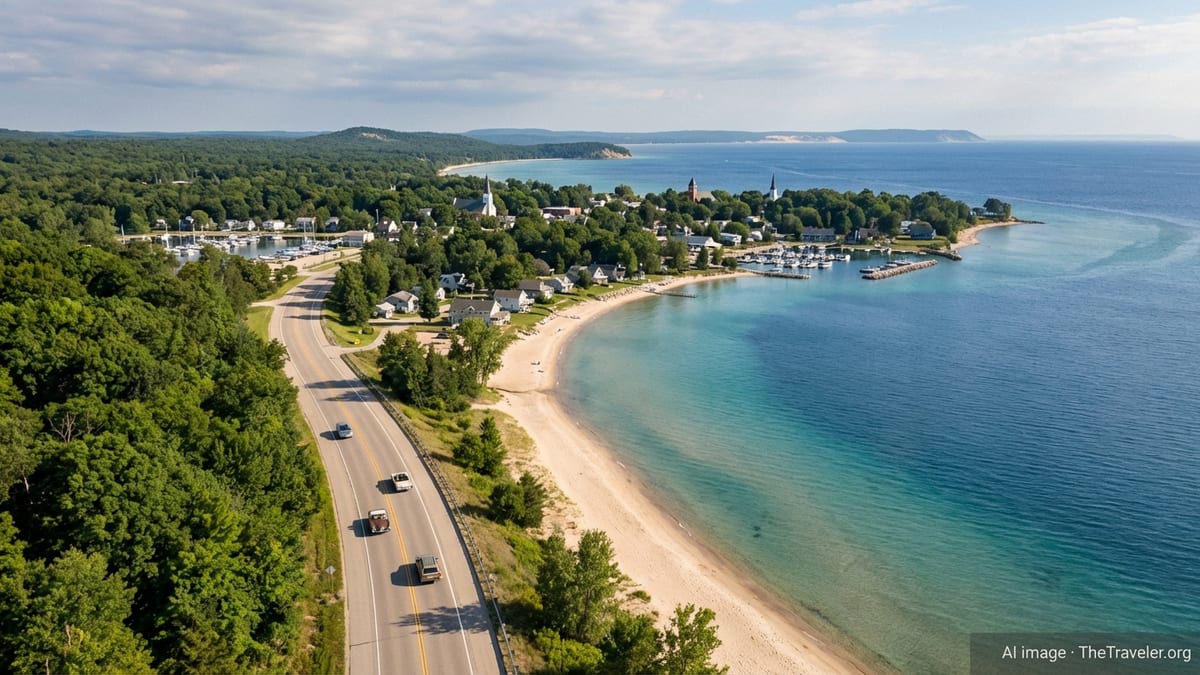
A road trip around Lake Michigan is one of the Midwest’s great classic drives, combining freshwater beaches, historic lighthouses, sand dunes, small-town main streets, and big-city skylines in one sweeping loop. This itinerary follows the spirit of the Lake Michigan Circle Tour, linking Illinois, Indiana, Michigan, and Wisconsin into a scenic circuit that can be completed in about a week, or stretched to 10 days or more if you prefer a slower pace.
How Long to Spend and When to Go
Drivers with limited vacation time can complete a full Lake Michigan loop in seven days, but most travelers find that eight to ten days allows for more relaxed stops, detours, and beach time. The route below assumes roughly a week, with options to linger in favorite places such as Sleeping Bear Dunes, Door County, or Milwaukee. Distances between overnight stops are generally two to four hours of driving, leaving a good share of each day free for hikes, museum visits, or shoreline sunsets.
Summer from late June through August is the most popular time for a Lake Michigan road trip, with reliably warm water for swimming, long daylight hours, and a busy calendar of harbor festivals and outdoor concerts. It is also peak season, so you should expect higher prices and heavier traffic around major gateways like Chicago, Milwaukee, and Traverse City, along with ongoing roadwork that can slow progress near cities and along main highways. Booking lodging several months ahead is recommended for the most sought-after beach towns.
For many road trippers, early fall provides an ideal balance of thinner crowds and colorful scenery. In September and early October, the water still holds summer warmth, but the air is crisp and the maples and birches along coastal byways such as Michigan’s M-22 start to glow with reds and golds. Spring can be a pleasant shoulder season, especially in May and early June, when dune trails are quieter and wildflowers bloom, though the lake remains cold for swimming. Winters around Lake Michigan are beautiful in their own way but bring snow, ice, and occasional closures, so this itinerary is designed primarily with late spring through fall in mind.
Starting in Chicago: Skyline, Beaches, and Lakefront Energy
Chicago is the most common starting point for a Lake Michigan loop, thanks to its major airport and rail connections. If you are flying in, plan at least one full day, preferably two, to enjoy the city before you get behind the wheel. Chicago’s lakefront is lined with parks and beaches, and even a short stroll along the paved Lakefront Trail offers a sense of the lake’s vast scale, with freighters on the horizon and the skyline rising directly from the shore.
For drivers, the route out of Chicago follows the lakeshore south before cutting through the industrial corridor of northwest Indiana. It is not the most glamorous stretch of the trip, but it is part of the authentic story of Lake Michigan, whose steel mills and ports have shaped the region’s history. To keep the day enjoyable, plan a leisurely start in Chicago, then time your departure to avoid peak rush hour. Once you cross into Indiana, aim for Indiana Dunes National Park and Indiana Dunes State Park, where tall dunes, oak savanna, and broad beaches give you an early taste of the natural landscapes that will define the rest of the loop.
Overnight options on this first leg range from staying one more night in Chicago and exploring the dunes as a day trip, to booking lodging in nearby Indiana communities. If you want to maximize your time in Michigan beach towns, you can simply pass through the dunes region for a half-day hike or picnic and continue north toward the state line, stopping in small towns along the southeastern Lake Michigan shore.
Michigan’s Sunset Coast: Harbor Towns and Sleeping Bear Dunes
Once you cross into Michigan, the character of the drive changes quickly from industrial to resort-like, with small lakeside communities strung along the shoreline. Places such as New Buffalo, St. Joseph, and South Haven are classic beach towns, with walkable downtowns, waterfront parks, and piers popular for evening strolls. Depending on your schedule, you might choose one of these as your first overnight stop, giving yourself time for a swim, a local brewery visit, or a sunset from a lakeside bluff.
Continuing north, the coastline remains dotted with state parks, farm stands, and historic lighthouses. Route choices vary, but many drivers favor local highways that hug the lake more closely, sacrificing speed for scenery. Near Muskegon and Ludington, stretches of shoreline forest and dunes invite unhurried exploration, and several state parks offer well-maintained campgrounds for those building camping into their itinerary. It is worth planning your days so you arrive at your overnight stop in time for golden hour, when the lake’s surface often glows copper or rose under a clear sky.
The highlight for many travelers on the Michigan side is Sleeping Bear Dunes National Lakeshore, northwest of Traverse City. Here, massive sand dunes rise dramatically above the water, and a patchwork of forest, inland lakes, and historic farmsteads creates a varied backdrop for hiking, paddling, and scenic driving. The Pierce Stocking Scenic Drive, a roughly seven-mile loop through the park, offers overlooks where you can peer straight down to the turbid blue of the lake far below and see the curve of the shoreline in both directions. Access can be limited by capacity at times in peak season, so arriving earlier in the day often leads to a calmer experience.
Traverse City itself makes an excellent base for two or three nights, especially if you want to slow the pace of your road trip. The city has a busy harbor, a walkable downtown core, and ready access to wineries and orchards that flourish in the moderate lake climate. To the north, driving M-22 around the Leelanau Peninsula rewards you with quiet coves, fishing villages, and more beach access points. It is easy to fill a full day simply meandering from overlook to overlook, stopping for lunch in a harbor town, and finishing with a sunset from a public access beach.
Crossing to Wisconsin: Ferries and Door County’s Peninsula Charm
From the central and northern reaches of Michigan’s Lower Peninsula, the Lake Michigan loop turns west toward Wisconsin. Drivers who want to remain strictly on pavement can continue north to the Straits of Mackinac and then turn west through the Upper Peninsula before descending toward Green Bay, but most travelers seeking a more compact loop either swing southwest toward Ludington or drive down to Muskegon, then continue around the southern end of the lake. One of the most distinctive options is to board the car ferry that crosses between Ludington, Michigan, and Manitowoc, Wisconsin, which has been recognized as part of the wider circle tour system.
The ferry crossing typically takes around four hours and operates on a seasonal schedule, generally from late spring through fall. It provides a relaxed break from driving, with time to sit on deck, watch the horizon, and appreciate just how wide Lake Michigan is at this latitude. Reservations are strongly advised in peak months, particularly if you are traveling with a vehicle or larger group. Weather on the lake can be breezy even in midsummer, so layers are essential.
Once you arrive in Manitowoc, you can begin tracing the Wisconsin shoreline north toward Door County, one of the region’s best-known vacation peninsulas. Driving north, the highway alternates between sweeping rural vistas and detours through waterfront towns like Kewaunee and Algoma. This is dairy country as much as it is shoreline, so expect to see farm fields bordering the road and small creameries and farm markets along the way.
Door County itself projects like a long finger into Lake Michigan, with Green Bay on one side and open lake on the other. Towns such as Sturgeon Bay, Fish Creek, Ephraim, and Sister Bay offer galleries, marinas, and waterfront parks, and there are multiple state parks where you can hike, cycle, or simply sit on rocky beaches listening to the surf. Scenic side roads lead to lighthouses and quiet coves, and in late summer and early fall, roadside stands sell cherries and apples grown in the peninsula’s orchards. Many travelers choose to spend at least two nights here, using one full day to explore the northern reaches and another to visit parks and smaller villages.
South Through Milwaukee and the Wisconsin Shore
From the tip of Door County, the Lake Michigan loop swings south along the Wisconsin side of the lake. The drive from Sister Bay or Fish Creek to Milwaukee can be covered in a day, but building in an extra overnight in a smaller lakeside city such as Sheboygan or Port Washington provides more time to experience the quieter stretch of shoreline. These communities mix working harbors with beaches and offer a slower pace than larger cities, ideal for a peaceful evening by the water.
As you approach Milwaukee, the traffic thickens and the skyline rises ahead, signaling the transition back into a major urban center. Milwaukee’s revitalized lakefront, including parks, an architecturally distinctive art museum, and public beaches, makes it worth at least an overnight stop. The city’s brewing heritage, diverse neighborhoods, and strong restaurant scene offer plenty to fill an afternoon and evening. Many travelers time their loop to coincide with one of Milwaukee’s festivals, which span everything from music and cultural celebrations to large summer events.
Leaving Milwaukee, you continue south through Racine and Kenosha, where public beaches, marinas, and historic districts create attractive stopovers. Even a short pause here for a coffee and a harbor walk provides a welcome break from freeway driving. Depending on what you skipped earlier in the trip, this section of the loop can be either a leisurely meander, with frequent exits to local roads along the lake, or a more direct run back toward the Illinois state line.
Loop Logistics: Route Options, Lodging, and Driving Conditions
The classic Lake Michigan route generally follows a clockwise or counterclockwise circuit, using a mix of interstate highways, state routes, and local scenic byways. Many drivers prefer a clockwise loop starting in Chicago, heading east into Indiana and Michigan, then turning north and west before dropping down the Wisconsin side back toward Illinois. This pattern keeps you closer to the lakeside pull-offs in some segments and can align better with afternoon sunsets over the water on certain days.
Distances are manageable between major stops, but it is important to remember that the same summer weather that makes the lakeshore so inviting also brings road construction. In Michigan in particular, long winters mean much of the resurfacing and bridge work is packed into warm months, which can lead to reduced speeds and occasional detours. Build flexibility into your plan by avoiding tight back-to-back reservations that require you to be in a specific place at a precise time after a long driving day.
Lodging choices around Lake Michigan range from simple motels on the outskirts of towns to boutique inns, family-run resorts, and campgrounds in state parks. Waterfront accommodations often book out first, especially in July and August, so consider reserving those key nights well ahead and leaving more spontaneity for inland overnights where availability is typically better. If you are camping, check state park reservation windows, as many sites can be booked months in advance.
Parking is generally straightforward in smaller towns but can be tighter in popular districts in high season. In Chicago and Milwaukee, hotel parking can carry additional charges, and downtown garages fill during major events. If you are starting or ending your loop in one of these cities, compare the cost of parking your vehicle for multiple nights with the option of renting a car only for the road trip portion, especially if you will not need a vehicle while exploring downtown.
Outdoor Experiences: Beaches, Trails, and Scenic Drives
One of the chief pleasures of a Lake Michigan road trip is the constant interplay between road and water. Nearly every day offers opportunities to step away from the wheel and onto a beach, trail, or overlook. On the Michigan side, state parks and national lakeshore units protect long stretches of dunes and forest, providing a sense of wildness only a short distance from small-town amenities. Simple activities such as climbing a dune staircase, wading into clear shallows, or watching the sky shift color at dusk can become highlights of the trip.
Beyond Sleeping Bear Dunes, popular outdoor stops include the beaches near South Haven and Holland, the lighthouses around Ludington, and the lesser-known stretches of shoreline north of Muskegon. Many towns maintain paved lakeside paths, ideal for cycling or walking, and several marinas offer short sailing or boat excursions for visitors who want to experience the lake from the water rather than the road. Inland, a network of hiking and multiuse trails connects forests and rivers, and in a few places, horseback riding and paddling tours can be arranged with local outfitters.
In Wisconsin, state parks and county preserves line both sides of Door County, with trail networks that wind through hardwood forests to rocky coves and elevated viewpoints. Further south, urban parks in Milwaukee, Racine, and Kenosha provide green space and beach access within sight of downtown skylines. Whatever your level of activity, it is wise to pack footwear suitable for sand and uneven paths, clothing layers for shifting temperatures, and basic gear such as a daypack, reusable water bottle, and sun protection.
The Takeaway
A Lake Michigan road trip combines the convenience of a domestic drive with the feeling of a true journey, as you trace the full curve of a great lake and watch the landscape shift from city to dunes to orchards, peninsulas, and harbor towns. Along the way, you sample different regional flavors, from Chicago’s urban energy to small-town Michigan hospitality and Wisconsin’s lakeshore communities.
With thoughtful planning, this loop can be tailored to many different travel styles. Families might prioritize beach days, playgrounds, and short hikes, while couples could focus on winery visits, farm-to-table dining, and quiet boutique lodgings. Solo travelers often appreciate the combination of scenic solitude on coastal roads and easy camaraderie in cafés, breweries, and campgrounds.
Whatever your priorities, building in time for unplanned stops is one of the best decisions you can make on this journey. A small-town bakery, a roadside farm stand, an unexpected overlook, or a friendly conversation on a pier can become as memorable as the marquee sights. The lake itself is the constant thread, its moods changing with wind and weather yet always drawing you back to the water’s edge as you complete your loop.
FAQ
Q1. How many days do I need for a Lake Michigan road trip loop?
Most travelers find that seven to ten days is ideal for a full loop, allowing time for beaches, cities, and scenic detours without feeling rushed.
Q2. Is it better to drive the loop clockwise or counterclockwise?
Both work well, but many drivers prefer a clockwise route starting in Chicago, heading through Indiana and Michigan first, then returning via Wisconsin.
Q3. What is the best time of year to drive around Lake Michigan?
Late June through early September offers the warmest weather and best swimming, while September and early October bring fall colors with fewer crowds.
Q4. Do I need to reserve the Ludington to Manitowoc ferry in advance?
Reservations are strongly recommended in peak season, especially if you are bringing a vehicle or traveling on weekends when sailings are busier.
Q5. Can I camp along the Lake Michigan Circle route?
Yes, there are numerous state parks, national lakeshore campgrounds, and private campgrounds along the route. Many require advance bookings in summer.
Q6. Is this road trip suitable for families with children?
Yes. Frequent beaches, short hikes, playgrounds, and small-town stops make the loop family-friendly, though planning shorter driving days helps keep kids comfortable.
Q7. How challenging are the roads and driving conditions?
The roads are generally well maintained, but summer construction, occasional heavy rain, and city traffic near Chicago and Milwaukee can slow travel times.
Q8. Do I need a special pass or permit for scenic drives and parks?
Some parks, including national lakeshore areas and certain state parks, require daily or annual entry passes, which can usually be purchased on arrival.
Q9. Can I complete the loop without using a ferry?
Yes. You can drive entirely around the lake, crossing between Michigan and Wisconsin via inland highways instead of taking the ferry between Ludington and Manitowoc.
Q10. Is it possible to do part of the Lake Michigan loop as a shorter trip?
Absolutely. Many travelers focus on one segment, such as Chicago to Traverse City, or a Wisconsin and Door County loop, and save the full circuit for a future visit.