

More news on this day
A powerful landslide and localized tsunami in Alaska’s Tracy Arm fjord in August 2025 are rippling through the cruise industry, with Holland America Line now dropping the high-demand scenic inlet from key Alaska itineraries amid renewed scrutiny of geological risks in narrow glacier-fed waterways.
Get the latest news straight to your inbox!
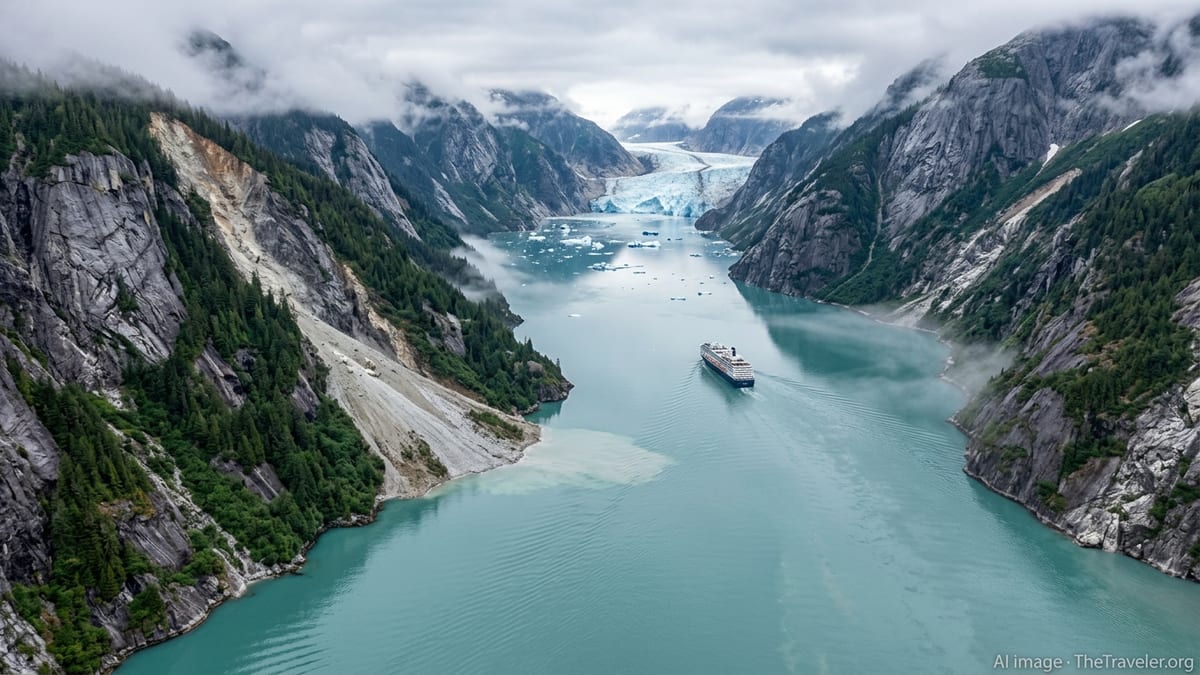
A Fjord Transformed by a Pre-Dawn Collapse
Publicly available scientific updates describe the August 10, 2025 event as one of the largest landslide-generated tsunamis in Alaska in at least a decade. A huge slab of mountainside above South Sawyer Glacier crashed into the head of Tracy Arm in the early morning, sending tens to more than one hundred million cubic meters of rock and ice into the water and displacing a wall of seawater through the fjord.
Analysis from the Alaska Earthquake Center and U.S. Geological Survey indicates that the failure struck around 5:26 a.m. local time, following hours of small earthquakes recorded on regional seismometers. The impact triggered a powerful, localized tsunami, with reports of 10 to 15 foot waves near Harbor Island and evidence of much higher run-up closer to the slide scar. Vegetation scouring and fresh debris fields now mark the once pristine rock faces along parts of the fjord.
Fortunately, the timing of the collapse meant no large cruise vessel or tour boat was positioned in the narrowest reaches of Tracy Arm. Mariners in the wider Endicott Arm area, which connects to the region, later reported unusual wave behavior and fast-moving currents. For geologists and hazard planners, the episode underscored how rapidly conditions can change in steep, glaciated fjord systems as climate-driven ice retreat destabilizes surrounding slopes.
Subsequent surveys documented substantial deposits of rock and ice at the terminus of South Sawyer Glacier and on the fjord floor. Experts note that similar slope systems in Alaska, including Barry Arm and Taan Fjord, have shown the potential for rare but extreme tsunamis when large masses of rock collapse into confined waterways.
Holland America Line Quietly Reworks Alaska Portfolio
Holland America Line has long promoted Tracy Arm as one of its marquee glacier experiences in Alaska, frequently highlighted alongside Glacier Bay, Hubbard Glacier, and College Fjord. Planning materials for recent seasons emphasized the Twin Sawyer Glaciers as a signature attraction for guests seeking dramatic ice and mountain scenery accessible by mid-sized ships and dedicated catamaran excursions.
Following the 2025 landslide and tsunami, however, the company is now reshaping how and where it sends guests into Southeast Alaska’s tightest fjords. Publicly available information and recent guest communications indicate that Holland America has begun cancelling or reassigning Tracy Arm Fjord & Glacier Explorer excursions for the 2026 season, often replacing them with trips into nearby Endicott Arm to view Dawes Glacier instead.
In online cruise forums, travelers booked on 2026 Alaska voyages report receiving emails that their Tracy Arm catamaran tours out of Juneau have been withdrawn or modified. Some describe notices explaining that the local excursion operator is avoiding Tracy Arm this year due to ongoing geologic instability and continued landslide concerns in the area around South Sawyer Glacier.
At the itinerary level, some independent cruise-agency listings and promotional planners still show Tracy Arm as a scenic cruising call on select Holland America sailings in 2026, while others emphasize Endicott Arm or Glacier Bay. The resulting patchwork suggests a transitional period in which excursion offerings are being pulled back faster than marketing materials and third-party schedules can be updated.
Safety, Science and the Challenge of Glacier Guarantees
The changes come just a short time after Holland America introduced a high-profile “glacier guarantee” for Alaska, highlighting the line’s commitment to delivering at least one major glacier viewing experience on every voyage. That pledge has typically rested on a mix of destinations, from the wide basins of Glacier Bay and Hubbard Glacier to narrower corridors such as Tracy Arm.
The 2025 landslide shows the tension between such promises and the dynamic nature of high-latitude landscapes. Scientific briefings explain that decades of rapid glacier retreat have removed key buttresses that once stabilized steep valley walls. As ice thins and shorelines adjust, slopes above fjords can become increasingly prone to sudden collapse, especially after heavy rain, warm spells, or seismic activity.
For cruise operators, this evolving hazard picture complicates route planning and excursion design. Narrow fjords offer some of the most photogenic experiences in Alaska, with towering cliffs, waterfalls and close-up views of tidewater glaciers. Yet they also concentrate wave energy and leave large vessels with little room to maneuver if a slide-generated wave races down the channel.
In this context, the move away from Tracy Arm and toward Endicott Arm or other glacier destinations appears aimed at preserving the promise of glacier viewing while shifting traffic to areas perceived to present lower near-term slope-failure risk. Publicly available statements from cruise lines operating in the region increasingly reference cooperation with scientists and local authorities when describing how itineraries are assessed and adjusted.
Endicott Arm Steps Into the Spotlight
Endicott Arm, a neighboring fjord southeast of Juneau, is emerging as the primary alternative for cruise lines seeking a similar visual impact without venturing into a corridor recently reshaped by a massive landslide. Marketing materials describe Endicott as equally dramatic, with sheer rock walls, dense temperate rainforest and frequent sightings of whales, seals and mountain goats along its length.
The glacier at the head of Endicott Arm, Dawes Glacier, is an active tidewater glacier known for regular calving events. Cruise-focused coverage notes that smaller ships and purpose-built sightseeing catamarans can often approach the ice face closely, weaving among floating bergs in calmer conditions than those sometimes encountered in Tracy Arm after heavy calving or stormy weather.
Recent posts on cruise discussion boards reflect a mix of disappointment and curiosity from guests whose long-planned Tracy Arm excursions have been replaced by Endicott Arm routes. Some travelers report deciding to keep their revised bookings after reading reviews that portray Dawes Glacier as a worthy substitute, particularly when paired with whale watching or hiking experiences from Juneau.
Others emphasize that Glacier Bay remains the standout glacier experience on many Alaska itineraries, suggesting that the loss of Tracy Arm as a routine option is softened when voyages still include a full day among multiple tidewater glaciers inside the national park. For first-time visitors, the distinction between individual fjords may matter less than the assurance of at least one dramatic encounter with creaking ice and towering cliffs.
Long-Term Questions for Alaska Fjord Cruising
The Tracy Arm landslide has broadened the conversation about how climate change and geologic instability may reshape Alaska cruising over the coming decades. Researchers point out that as glaciers retreat, other slopes in Southeast Alaska and Prince William Sound could become similarly vulnerable to large failures that are difficult to predict precisely in time.
Public reports from scientific institutions already highlight Barry Arm, northeast of Whittier, as an area where a massive, slowly moving landslide above a fjord could one day fail catastrophically and send a destructive wave through adjacent inlets and communities. That scenario has prompted ongoing monitoring and contingency planning among local, state and federal entities.
For cruise lines such as Holland America, the current response in Tracy Arm may serve as a template: lean more heavily on wide, better-studied basins like Glacier Bay and Hubbard Glacier, rely on flexible excursion partnerships to pivot away from emerging risk zones, and communicate late-stage changes to guests when local operators or scientific assessments indicate elevated hazards.
As Alaska’s fjord landscapes continue to evolve, the balance between showcasing remote glacial wonders and managing low-probability but high-consequence events will likely remain a central strategic issue. Tracy Arm’s recent transformation from brochure icon to cautionary case study illustrates how rapidly that balance can shift for the cruise industry and its passengers.