

More news on this day
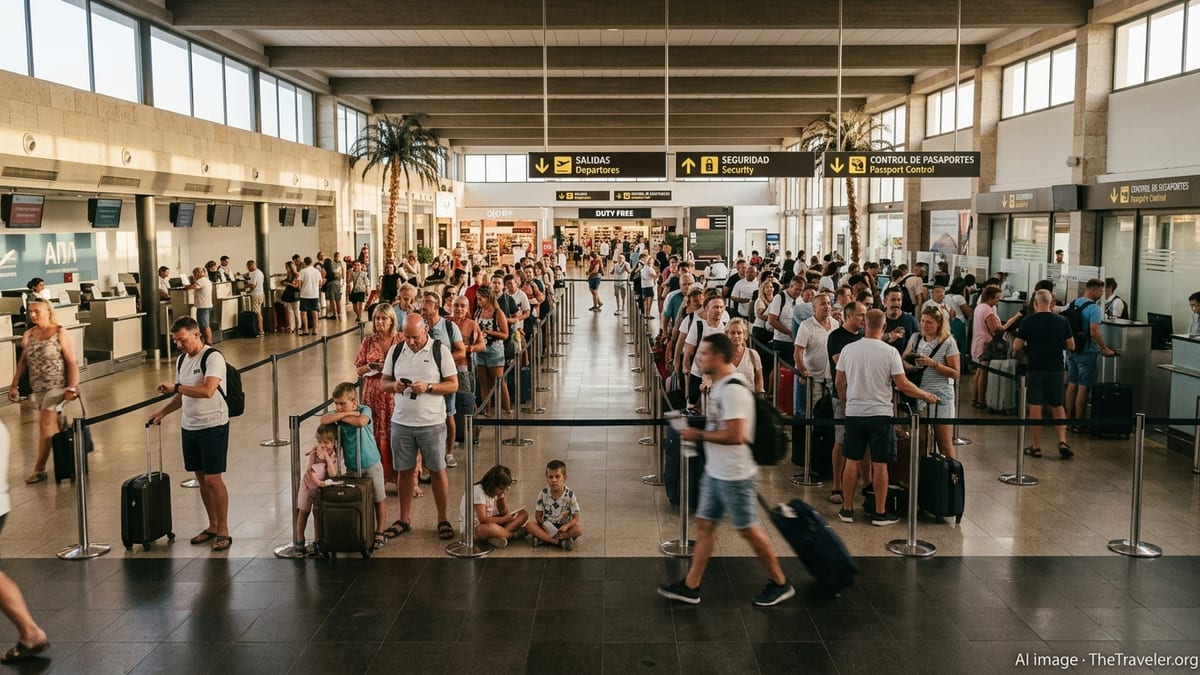
Long queues, missed flights and frayed tempers at Lanzarote’s César Manrique airport are drawing fierce criticism from the island’s tourism leadership, which has branded the situation “unacceptable” as frustration mounts among visitors and residents alike.
Get the latest news straight to your inbox!
Tourism Leader Denounces Growing Airport Chaos
Recent coverage in Spanish and UK media highlights a sharp warning from Lanzarote’s tourism leadership about mounting congestion at César Manrique airport, the island’s principal international gateway. The tourism chief has publicly complained of lengthy lines at security and border controls, describing the experience as chaotic for passengers at peak times and using the term “unacceptable” to characterise current conditions.
Reports indicate that the criticism focuses on repeated scenes of bottlenecks in departure areas, with passengers queuing deep into the terminal at busy periods. Accounts shared by holidaymakers describe slow processing at check in, security and passport control, creating what some travellers have called a stressful and confusing environment that contrasts sharply with Lanzarote’s image as a relaxed sun destination.
The airport, which handles millions of passengers each year, is central to the island’s tourism economy. Publicly available data show that the United Kingdom remains one of Lanzarote’s biggest source markets, adding pressure on the infrastructure at weekends and during school holidays. Local tourism representatives argue that if queues are not brought under control, word of mouth and social media criticism could deter repeat visitors.
According to published commentary from business groups, concerns are not limited to occasional pinch points. Instead, they describe a pattern of repeated overcrowding during peak arrival and departure waves, with some tour operators urging guests to allow significantly more time at the airport than in previous years.
Border Technology and EES Rollout Add to Delays
The escalating complaints coincide with the phased introduction of the European Union’s new Entry/Exit System, known as EES, which requires biometric registration for many non EU travellers. Publicly available information shows that the system became operational at Lanzarote in November, adding fingerprint and facial recognition checks for first time users alongside traditional passport stamping.
Travel forums and recent social media posts suggest that the new procedures have, at times, created additional queues at departure gates when large numbers of passengers need to complete registration at once. Some travellers describe waits of close to two hours at busy periods, with particular congestion around flights to UK airports when multiple departures are scheduled close together.
Comments from passengers indicate that the performance of the new biometric kiosks is inconsistent, with some machines reported as slow or temporarily out of service. In those cases, airport staff have had to fall back on manual document checks, slowing the flow of passengers through the final boarding control and contributing to aircraft delays on the apron.
The tourism leadership’s recent intervention reflects growing concern that the combination of EES formalities and existing infrastructure constraints is placing undue strain on the airport’s operations. Industry observers note that Lanzarote is far from alone in facing challenges with new border technology, but argue that island destinations with limited alternative gateways are especially vulnerable to reputational damage when queues escalate.
Passenger Experiences Highlight Strain at Peak Times
Accounts shared in travel communities over recent weeks offer a mixed but often critical picture of the Lanzarote airport experience. While some visitors report moving through check in and security in under 30 minutes during quieter morning slots, many others describe protracted waits that stretch well beyond an hour when several flights are scheduled within the same window.
Families with young children appear to be particularly affected. Travellers recount being split into separate lanes from adults eligible for automated e gates, only to find the family queues moving much more slowly. Several testimonies describe children standing in line for extended periods with limited seating, adding to stress for parents worried about making their flights.
There are also recurring complaints about limited information in the terminal when queues build rapidly. Passengers report confusion over which lines are intended for EES registration, which are for standard passport control and which are reserved for EU citizens, with signage and public announcements described as unclear or insufficient at busy moments.
Despite the negative reports, not all recent experiences have been problematic. Some passengers passing through on less crowded days describe a largely smooth process, suggesting that the airport can operate efficiently when traffic is spread more evenly. However, critics argue that leisure travellers typically book around specific weekdays and times, making effective management of these predictable peaks a key test for the airport and tourism authorities.
Economic Stakes High for Lanzarote’s Tourism Model
Lanzarote’s dependence on air connectivity means that the airport’s performance is closely tied to the island’s broader economic health. Tourism remains one of the largest employers on the island, supporting hotels, restaurants, excursion providers and a wide network of small businesses that rely on a steady flow of visitors from northern Europe.
According to tourism statistics published by Canary Islands authorities, pre pandemic visitor numbers to Lanzarote had reached several million arrivals per year, with volumes recovering strongly in the past two seasons. Industry analysts note that even modest disruptions at the main airport can have an outsized impact on traveller satisfaction scores, package holiday reviews and future booking decisions.
Business associations on the island have previously raised concerns that infrastructure development has not kept pace with rising demand. They point to crowding not only at the airport but also at taxi ranks and key tourist attractions during peak times. The current focus on airport queues is seen by some local commentators as part of a broader debate about how Lanzarote manages mass tourism while protecting both quality of life for residents and the visitor experience.
There is also a political dimension. Public discussions in recent years have touched on the balance between attracting more visitors and improving the experience for those who already come. The tourism chief’s sharp remarks about the airport queues are being interpreted by local observers as a signal that service quality and on the ground capacity are moving higher up the policy agenda.
Calls for Operational Fixes and Long Term Investment
In response to the mounting criticism, travel industry voices on the island are urging a combination of short term operational measures and longer term investment at César Manrique airport. Commentators suggest that better queue management, clearer signage for EES and non EES passengers and more flexible staffing during peak departure banks could deliver rapid improvements without major construction.
Some observers advocate for closer coordination between airlines, ground handling agents and border police to avoid multiple large aircraft departing within narrow time windows when possible. Staggering schedules, where feasible, is seen as one way to reduce sudden surges of passengers at security and passport control, making use of quieter periods in the daily timetable.
Over the medium term, business groups and tourism representatives have called for upgrades to terminal facilities, including expanded processing areas and more automated systems that can ease pressure on manual checks. Discussions in local media have also highlighted the need to adapt airport design to the realities of post Brexit travel, with a high proportion of non EU passengers now subject to additional border formalities.
For now, travel advisories in tour operator documentation and on airline channels increasingly recommend that passengers allow extra time for departure from Lanzarote, particularly on traditionally busy days such as Thursdays and Sundays. While such guidance may help individual travellers avoid missed flights, critics argue that it does not address the underlying capacity issues that prompted the tourism chief’s stark warning about “unacceptable” queues at the island’s gateway.