

More news on this day
As India reassesses its long-range airlift requirements, attention is turning to the Airbus A400M, a European transport aircraft that sits squarely between the Indian Air Force’s C-130J Super Hercules and C-17 Globemaster III fleets in size, payload and range.
Get the latest news straight to your inbox!
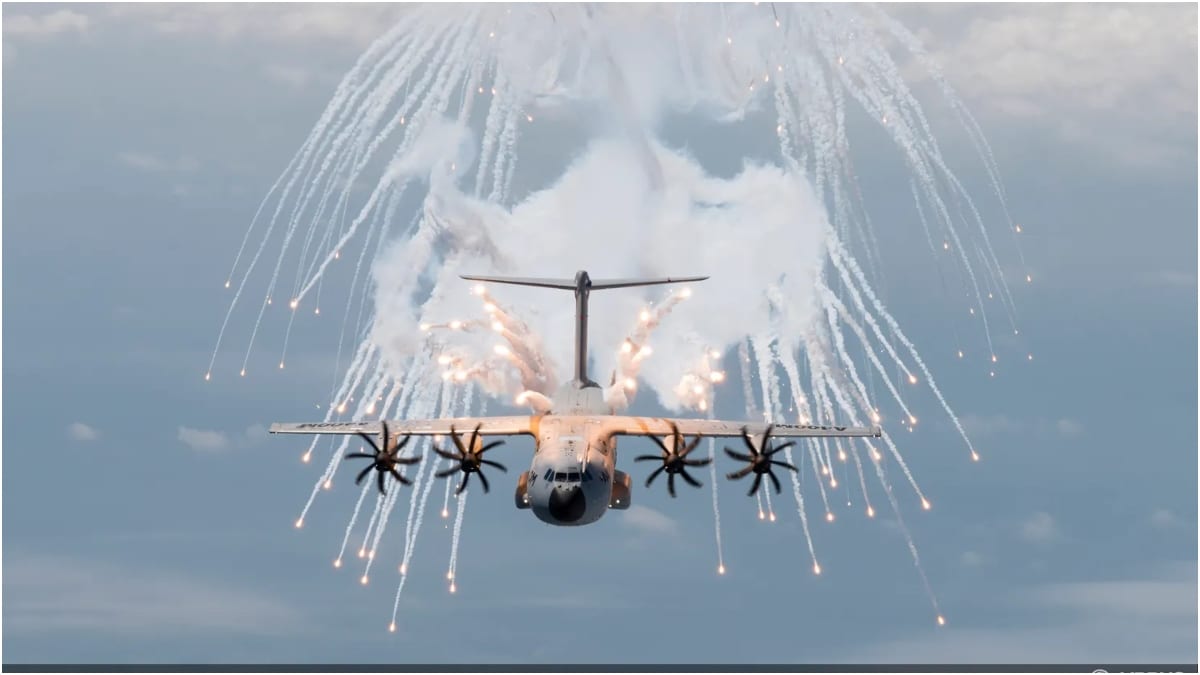
Image by theweek.in
A transport designed to bridge the tactical–strategic gap
The A400M Atlas was conceived from the outset as an intermediate transport, positioned between traditional tactical lifters such as the C-130 family and heavy strategic aircraft like the C-17. Publicly available data shows that the A400M can carry a maximum payload in the region of 37 to 40 tonnes, depending on configuration, compared with roughly 19 to 20 tonnes for the C-130J and more than 75 tonnes for the C-17.
This places the aircraft in a niche segment that has attracted renewed interest as air forces seek to replace legacy platforms such as the Il-76 while retaining the ability to operate from shorter or semi-prepared runways. The A400M’s combination of range, payload and field performance is frequently described in specialist coverage as a bridge between tactical and strategic roles.
For India, which already operates both the C-130J and the C-17, the A400M’s mid-range capabilities could offer an additional tier in the airlift hierarchy, particularly for missions that do not justify deploying a C-17 but exceed the volume or weight envelope of the C-130J.
Dimensions and payload: clearly bigger than a C-130J, well below a C-17
In physical terms, the A400M is markedly larger than the C-130J. The A400M’s cargo hold is about 17.7 metres long, 4 metres wide and around 3.8 metres high, providing enough volume for heavy vehicles, helicopters and outsized pallets that cannot fit inside a Hercules. By contrast, the C-130J’s cabin is narrower and lower, limiting the size of vehicles and containers it can carry in a single lift.
Even so, the Airbus design remains well below the C-17 in overall scale. The C-17’s hold is longer, wider and significantly taller, and its certified payload is more than double that of the A400M. Analysts regularly highlight that this difference allows the C-17 to move main battle tanks and other extremely heavy equipment, a category of cargo that remains outside the A400M’s design envelope.
For typical missions, the A400M is often described as capable of carrying roughly twice the payload of a C-130J over comparable distances, while requiring less infrastructure than a C-17. That balance is central to arguments that it could replace or supplement medium to heavy transports in air forces that no longer have access to new-build C-17s.
Performance: turboprop speed with strategic reach
One of the most visible characteristics of the A400M is its quartet of large turboprop engines with eight-bladed propellers. Despite the traditional appearance, performance figures place the aircraft closer to jet-powered strategic transports than to older propeller designs. Published specifications indicate a cruise speed around Mach 0.72, notably faster than the C-130J and approaching the lower end of jet transport cruise regimes.
Range is another area where the A400M is intended to close the gap with strategic platforms. Open-source comparisons show that with a payload around 30 tonnes, the aircraft can fly well over 4,000 kilometres, extending to significantly more on lighter loads or ferry missions. This allows direct flights from central India to distant island territories or partner bases without refuelling, while still landing on relatively short or semi-prepared runways.
Defence publications also point to the A400M’s certified ability to conduct tactical low-level flight, air-dropping of paratroops and cargo, and aerial refuelling (in tanker configuration). These features align with Indian requirements for rapid reinforcement of border sectors and island outposts, as well as humanitarian and disaster-relief operations across the wider Indian Ocean region.
Rough-field, short-runway and hot-and-high capabilities
Beyond raw payload and range, the A400M has been marketed heavily on its ability to operate from airfields that are shorter, softer or more rudimentary than those normally associated with large transports. Technical literature cites take-off and landing distances that are competitive with or, in some configurations, shorter than those of the C-130J, despite the Airbus aircraft’s larger size and weight.
The A400M’s landing gear, high-lift wing design and turboprop powerplant are all tailored to this role. Turboprops generally deliver strong low-speed thrust and braking efficiency, which is advantageous on unpaved or damaged runways. Coverage in aerospace journals has emphasized demonstration flights to grass and gravel strips, as well as operations from high-altitude and high-temperature airfields that present performance challenges for jet-powered transports.
For the Indian Air Force, which routinely faces hot-and-high conditions in the Himalayas and needs to reach remote Advanced Landing Grounds, this combination of heavy payload and rough-field capability is a central part of the discussion. The aircraft’s ability to move heavier vehicles and engineering equipment into shorter or less developed strips is viewed in some analyses as a potential multiplier for logistics and rapid infrastructure development.
Evolving programme, costs and international uptake
The A400M programme has experienced delays and cost growth since its launch, but recent reporting indicates that key performance milestones have been met and that new technical upgrades are under way. Coverage from defence outlets in 2025 highlighted Airbus plans to increase the certified maximum payload to about 40 tonnes, broadening the range of military and civilian missions the type can undertake.
Several European air forces already operate the aircraft, and additional customers, including states in Asia and the Middle East, have placed orders or taken deliveries. Analysts often note that while the unit cost of an A400M is significantly higher than that of a C-130J, it remains substantially below that of a C-17 where comparable figures are available, reflecting its intermediate size and capabilities.
For India, which has invested heavily in the C-130J and C-17 fleets, the A400M is being discussed in specialist forums as a possible successor for older Il-76 transports and as a complement to existing Western platforms. Any future decision would be shaped by cost, industrial participation, interoperability with existing assets and the balance between strategic reach and tactical flexibility that the A400M is designed to provide.