

More news on this day
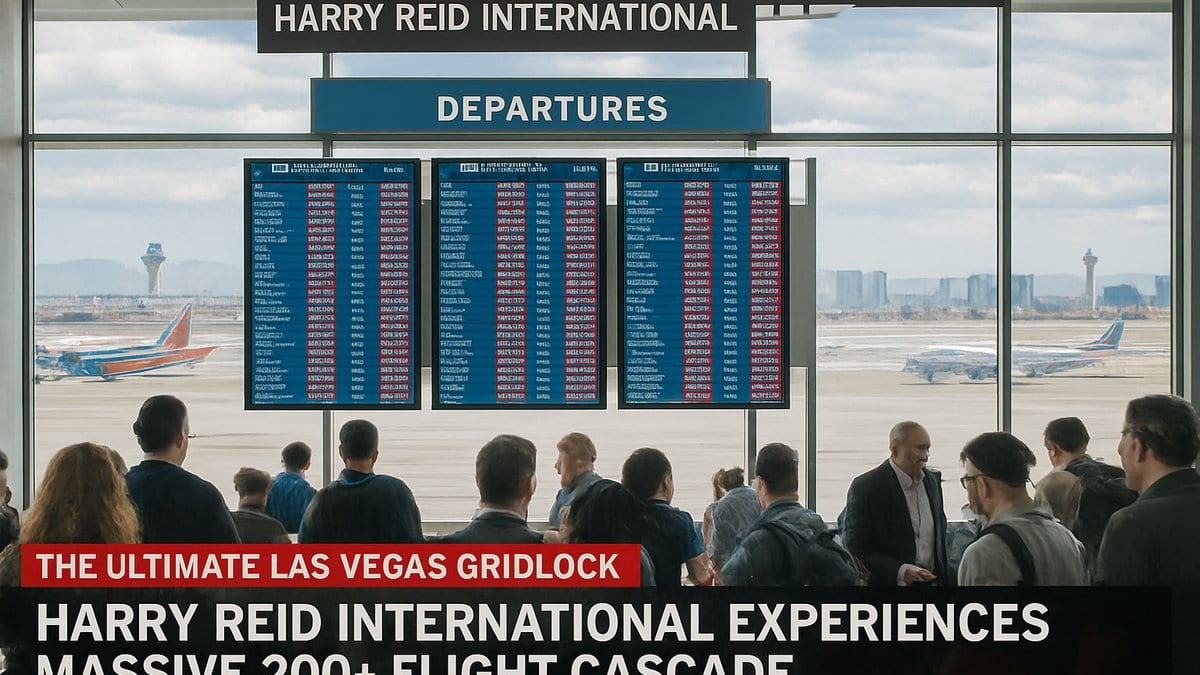
Spring getaway plans for thousands of travelers unraveled at Las Vegas’ Harry Reid International Airport as a cascading operational meltdown disrupted more than 200 flights and rippled across the national air network.
Get the latest news straight to your inbox!
Ground Operations Strain as Delays Stack Up
Publicly available flight-tracking dashboards for early April show Harry Reid International among a cluster of U.S. airports struggling with heavy schedule disruption, with Las Vegas seeing more than 200 combined delays and cancellations in a single turbulent stretch. The slowdown placed the airport near the top tier of domestic trouble spots, alongside major hubs in Texas and the Midwest.
A mix of factors contributed to the gridlock. Weather systems across multiple regions, including storms in Texas and the central United States, slowed departures from key feeder hubs that supply aircraft and crews to Las Vegas. When those early flights slipped behind schedule, the knock-on effect left jets out of position for later rotations into Harry Reid, shrinking available capacity just as afternoon and evening leisure departures built toward their daily peak.
Capacity-management programs designed to keep traffic within safe limits compounded the visible disruption for passengers. Arrival and departure rates into Las Vegas were periodically reduced, stretching taxi-out times, extending waits for gates, and triggering rolling departure holds for flights bound for Nevada from congested airspace sectors. Each incremental delay fed back into the schedule, tightening turnaround windows and eroding buffers airlines rely on to recover from routine hiccups.
Recent federal data on airport performance underline how quickly these situations can deteriorate. Even in typical months, large U.S. facilities can record average delay times approaching or exceeding an hour once a certain threshold of congestion is reached. In the Las Vegas event, the surge in out-of-slot operations and limited runway and gate capacity created near-peak stress conditions over several consecutive hours.
Leisure Hotspot Meets Peak-Season Pressure
The gridlock hit Las Vegas at an especially sensitive moment. Airport statistics released earlier this year show Harry Reid handling close to 55 million passengers annually, reinforcing its position as one of the busiest leisure gateways in the country. Spring break periods amplify that load as vacationers, convention attendees, and major-event visitors converge on the city.
Travel guidance from the airport system ahead of the season urged passengers to review flight status carefully, pack in accordance with security rules, and arrive early for departures. Those recommendations were put to a real-world test as the disruption unfolded, with crowded concourses, long customer service queues, and stretched concession operations reported across the terminal complex.
Unlike some hub airports where business traffic dominates, Las Vegas relies heavily on high-frequency domestic routes, particularly to the West Coast, Texas, and the Midwest. This structure can magnify the impact of even modest schedule changes. When several departure banks experience disruption at once, the result is a visible buildup of passengers waiting at gates and in check-in halls, along with heavier-than-usual pressure on baggage systems as late-arriving flights compress into shorter operating windows.
The timing of the cascade also intersected with broader national turbulence. Separate analyses of early April operations show thousands of delays across U.S. airlines in a single day, with Las Vegas listed among the airports facing significant slowdowns as rolling weather and airspace constraints shifted from region to region.
How a 200-Flight Cascade Unfolds
A disruption of more than 200 flights at a single airport rarely stems from one root cause. Instead, operational specialists point to a series of linked vulnerabilities. When departures from multiple origin cities are held for storms or air traffic control restrictions, aircraft and flight crews destined for Las Vegas fail to arrive on time, creating gaps in the local schedule.
Those gaps quickly affect outbound passengers. An aircraft that lands late may spend extra time waiting for a free gate, especially at a field where many stands are scheduled at or near full utilization in the late afternoon and evening. Ground teams then have a compressed window to unload arriving bags, service the aircraft, and board the next group of travelers. Any additional complication, from a minor maintenance check to slow luggage loading, can tip the flight into a longer delay.
As more departures slip past their planned times, airspace managers may adjust flow rates into and out of the Las Vegas sector to keep traffic manageable. That, in turn, forces airlines to re-time further flights, sometimes preemptively to avoid even worse congestion later in the day. Once the number of affected flights crosses into the low hundreds, options for swapping aircraft or rerouting crews diminish, and carriers may begin canceling select services outright to protect the remainder of the schedule.
The result, as seen during the gridlock at Harry Reid, is a classic cascade: one wave of upstream delays migrates through the system, pulling in flights that were never directly touched by the original problem. Travelers departing on seemingly routine routes may discover that their aircraft is coming from a storm-affected city or a saturated hub, inheriting hours of accumulated disruption before it ever reaches Las Vegas.
Wider National Ripple Effects
The Las Vegas gridlock did not unfold in isolation. Nationally, the same period produced elevated delay counts in several major markets, including Dallas-Fort Worth, Houston, Chicago, Orlando, and Boston. Las Vegas featured prominently in those snapshots as an outbound destination from some of the hardest-hit hubs, creating a feedback loop in which problems at one end of the route pair reinforced those at the other.
Travel-industry tracking shows that when daily U.S. delay totals creep into the five-figure range and cancellations rise into the low thousands, missed connections and overnight strandings become increasingly common. In this context, Harry Reid’s more than 200 disrupted flights contributed to a broader patchwork of travelers sleeping in terminals, scrambling for alternative itineraries, and facing sold-out airport hotels at multiple cities.
Las Vegas’ role as both origin and destination for leisure trips sharpened the impact. Many visitors travel on tightly timed weekend or short-break schedules, leaving limited flexibility for rebooking. When evening departures back to home cities slid into late-night or next-day slots, knock-on effects included missed workdays, lost prepaid reservations at onward destinations, and overcrowded rebooking queues stretching into the following morning.
Published analysis of recent disruption cycles indicates that these ripple effects can linger for several days, even after the weather clears and traffic-management programs ease. Aircraft and crews remain out of their ideal patterns, maintenance intervals need to be recalibrated, and airports must work through backlogs of baggage and delayed passengers before operations can fully normalize.
What Travelers Can Do as Gridlock Becomes More Common
Recent seasons have highlighted how quickly conditions at busy airports such as Harry Reid can swing from smooth to severely congested. Travel advisors and consumer agencies consistently recommend that passengers assume a higher baseline risk of disruption during peak periods, particularly around spring break, major conventions, and large events on the Las Vegas calendar.
Practical steps include monitoring flight status early and often through airline apps and airport information channels, opting for the first departures of the day where possible, and building additional time into connections involving Las Vegas or other known congestion points. Data from previous disruption waves suggest that morning flights are statistically less exposed to inherited delays, giving travelers a better chance of staying close to schedule.
Public guidance on passenger rights also emphasizes understanding refund and rebooking policies before travel. In the United States, travelers are generally entitled to a refund when an airline cancels a flight and the passenger chooses not to travel, regardless of the cause of the cancellation. Some carriers additionally provide meal vouchers, hotel accommodations, or bonus miles in certain circumstances, but such support varies by airline and by whether the disruption is within the carrier’s control.
For Harry Reid International, the latest gridlock episode underscores the challenges of managing a heavy, leisure-focused schedule in an era of frequent weather and airspace volatility. As airlines and airports refine contingency plans, travelers passing through Las Vegas may find that diligent preparation and flexible itineraries are increasingly essential tools for navigating America’s entertainment capital by air.