

More news on this day
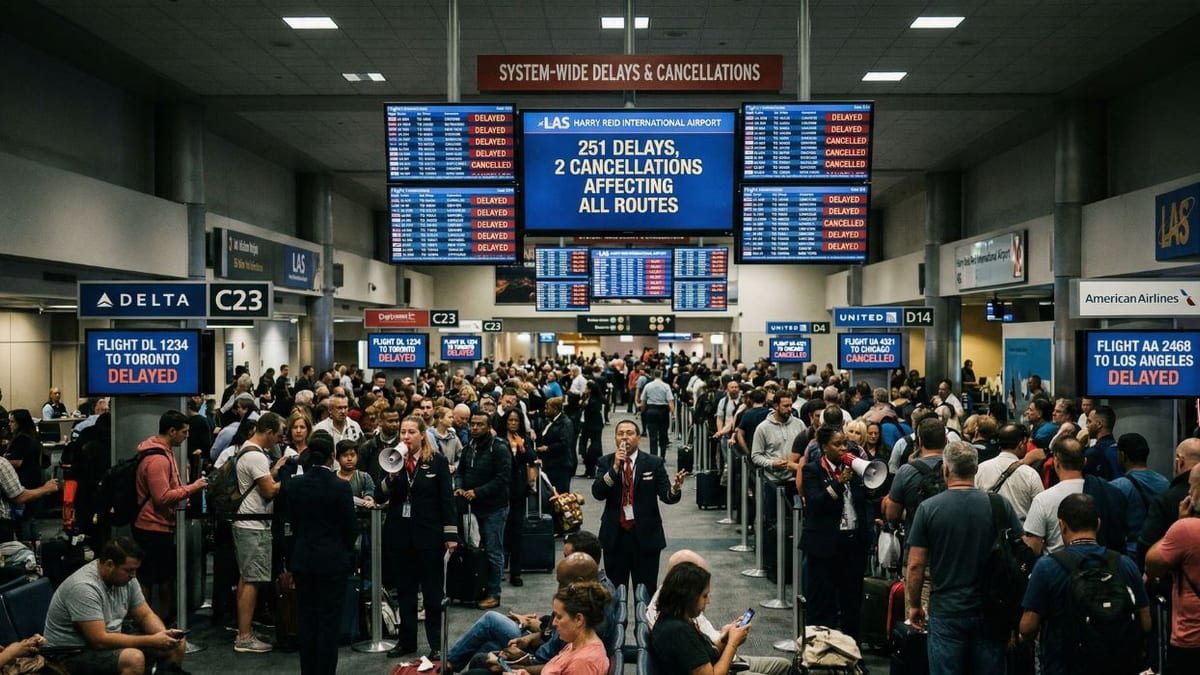
Travelers at Harry Reid International Airport in Las Vegas faced extensive disruption on April 11, 2026, as airport data and published coverage indicated 251 delayed flights and 2 cancellations affecting some of the busiest domestic and international routes across North America.
Get the latest news straight to your inbox!
Major Disruption Across Key U.S. and Canadian Routes
The disruption at Harry Reid International Airport affected a broad mix of carriers, with reports highlighting operational challenges for Delta Air Lines, United Airlines, American Airlines, Southwest Airlines, Spirit Airlines, Frontier Airlines and several regional partners. Many of the impacted flights served some of the most heavily used corridors in the U.S. network, compounding the effect of each delay.
Published coverage indicates that flights between Las Vegas and Los Angeles, Chicago, Denver, and New York were among the hardest hit, with both departures and arrivals experiencing extended holds on the ground or in the air. Connections into Canada, particularly services to Toronto, were also affected, leaving transborder passengers facing missed onward links and long rebooking lines.
The volume of disruption at Harry Reid formed part of a broader pattern of strain across major U.S. hubs in early April, when thousands of flights nationwide either departed late or did not operate. Industry trackers noted that Las Vegas featured prominently among the airports experiencing high levels of knock-on delays as operational schedules were stretched.
Although only two flights at Harry Reid were reported canceled outright in this incident, the far larger number of delayed services created ripple effects across airline networks. Aircraft and crews arriving late into Las Vegas often turned around behind schedule, pushing back subsequent departures and contributing to rolling delays through the day.
Operational Pressures and Weather-Linked Constraints
Airport and aviation data show that the disruption coincided with a period of wider operational pressure on the U.S. air transport system, including weather-related constraints at multiple hubs. National aviation status pages indicated traffic management programs in force at various airports during the same period, slowing arrivals and limiting departure slots.
Analysts note that even when Las Vegas itself is not experiencing severe local weather, restrictions at origin or destination airports can cascade into Harry Reid. Reduced arrival rates at cities such as Denver or Chicago can force airlines to hold departures from Las Vegas, while storms or low visibility along the route may require wider spacing between flights, effectively shrinking the usable capacity of the airspace.
Publicly available information from passenger advocacy groups suggests that the recent wave of delays across U.S. hubs has usually been attributed to a combination of adverse weather, congested airspace and staffing constraints in some parts of the system rather than a single technical failure. In this context, Las Vegas has been one of several major airports where travelers have encountered long waits, missed connections and last minute gate changes.
At Harry Reid, these systemic pressures intersect with the airport’s role as a high-volume leisure and convention gateway. When delays build up during peak travel waves, the concentration of departures within relatively tight windows can lead to crowding at gates, congested taxiways and longer than average turnaround times for aircraft already running late.
Passenger Experience at a Congested Hub
Scenes described in local coverage and traveler accounts depict crowded concourses at Harry Reid as passengers sought updates from airline counters and screens showing long lists of delayed flights. With so many services pushed back, seating near gates quickly filled, leaving many travelers waiting for hours in food courts or along terminal corridors.
Families, business travelers and international visitors all faced the same uncertainty as estimated departure times shifted repeatedly. For some, relatively short initial delays grew into multi hour waits, especially on routes where aircraft and crews were inbound from other disrupted hubs. Connecting passengers found themselves particularly vulnerable, as modest holdups in Las Vegas left too little time to make onward flights at their next stop.
Travel guidance from consumer organizations emphasizes that when delays stretch into several hours, passengers should pay close attention to announcements about meal or hotel vouchers, rebooking options and potential refunds. While U.S. regulations do not guarantee compensation in most weather related events, many carriers have adopted customer service commitments that may offer some relief in cases of extensive disruption.
At Harry Reid, the airport’s recently promoted online tools for monitoring real time security wait times and flight status proved especially important. Travelers with access to mobile devices were able to track evolving departure boards and adjust their movement through the terminal, while those already checked in could at least anticipate whether there was any point in rushing to a gate.
Network Ripple Effects for Airlines and Destinations
The concentration of delays in Las Vegas created challenges not only at Harry Reid but also across the route networks of the affected airlines. Aircraft that left Las Vegas late often arrived behind schedule at destinations such as Los Angeles, Chicago, Denver, Toronto and New York, contributing to secondary delays there and complicating crew scheduling for the rest of the day.
Airline operations planners typically attempt to absorb such shocks by swapping aircraft, adjusting crew pairings or selectively canceling lightly booked flights to protect the rest of the schedule. In this case, with only two outright cancellations reported at Harry Reid, carriers appeared to rely heavily on holding flights rather than cutting them, which preserved capacity but extended passenger waiting times.
Destination airports, meanwhile, saw bunching of arrivals as delayed Las Vegas flights landed in compressed waves. This can create temporary strain at gates, baggage systems and customs or immigration facilities, particularly on international services. Passengers arriving from Las Vegas into Toronto or New York during the affected period may have encountered unusually busy arrival halls as multiple delayed flights arrived within a short window.
Tourism and hospitality businesses in Las Vegas are also sensitive to such operational shocks. Large scale delays can influence check in patterns at hotels, attendance at conventions and even visitor spending, as travelers arriving late have less time to participate in planned activities. Industry observers will be watching subsequent traffic and booking data to see whether this episode has any lasting impact on traveler sentiment toward the city.
What Travelers Can Do During Ongoing Disruptions
The situation at Harry Reid International Airport serves as a reminder of how quickly conditions can deteriorate for air travelers, even when the number of cancellations remains relatively low. Travel experts advise that passengers build extra time into itineraries involving key hubs and consider avoiding tight connections, particularly during busy travel seasons when the system has less resilience.
Public information from airlines and passenger rights groups stresses the importance of monitoring flight status early and often, using official airline applications and airport information channels. Rebooking options are typically more flexible while seats remain available, so travelers facing significant delays at Las Vegas or elsewhere may benefit from acting quickly rather than waiting at the gate for conditions to improve.
For those already caught up in the April 11 disruption in Las Vegas, the priority has been simply getting to their destination. As operations gradually normalize and delayed aircraft and crews return to their planned rotations, schedules are expected to stabilize. Until then, Harry Reid International Airport remains a vivid example of how intertwined modern airline networks are, and how disruption in one place can swiftly spread across a continent.