

Hundreds of passengers were left stranded at Harry Reid International Airport in Las Vegas on Saturday as 176 flights were delayed and 5 canceled, snarling operations for major U.S. and international carriers and disrupting journeys across Los Angeles, New York, San Francisco, Toronto and London.
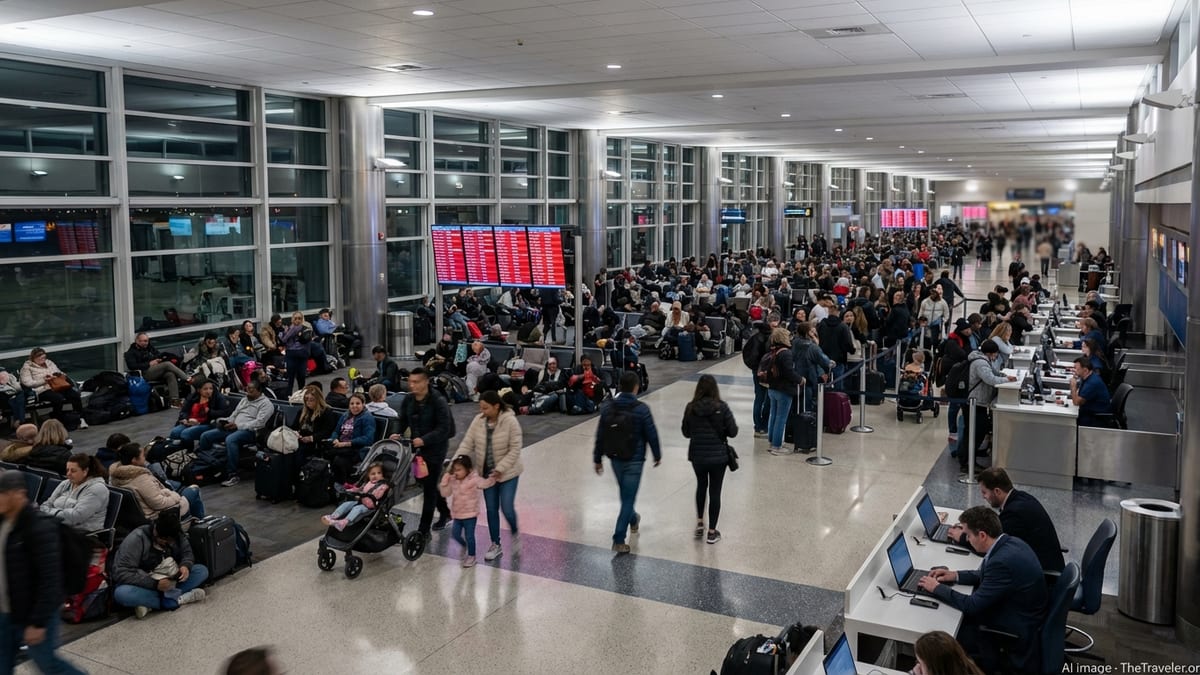
Delays Mount at One of America’s Busiest Desert Hubs
The disruption unfolded through the morning and early afternoon at Harry Reid International Airport, a key gateway for both leisure and convention traffic in the American Southwest. Live flight-tracking data showed delays rippling through departures and arrivals, as aircraft lined up on taxiways and gate holds grew longer across multiple terminals.
While only a handful of flights were outright canceled, the scale of the delays proved far more consequential. Short holdups early in the day grew into rolling disruptions, with some departures pushed back by several hours. Travelers reported departure boards filled with yellow and red status updates, as airlines struggled to re-sequence aircraft and crews.
The timing could hardly have been worse for Las Vegas, which continues to draw strong weekend demand even after a softer year for overall visitor numbers. With almost 55 million passengers moving through Harry Reid in 2025, any operational wobble still translates into hundreds of people suddenly sleeping on terminal floors, queuing at service desks and scrambling to rearrange plans.
Major Airlines Hit: Delta, American, Spirit and Others
The disruption cut across the portfolios of several large carriers operating at Harry Reid, including Delta Air Lines, American Airlines, Spirit Airlines, Southwest Airlines and United Airlines. While some regional and niche carriers also reported schedule issues, the bulk of affected passengers were booked on these large domestic and transborder operators.
Delta and American, which use Las Vegas as a key spoke on their national networks, were hit with a mix of delayed mainline and regional flights. Delays on routes to and from Los Angeles, New York and San Francisco had a particularly strong knock-on effect, given those cities’ roles as onward connection points to the rest of the United States, Europe and Asia.
Spirit Airlines, a budget carrier with a significant leisure footprint in Las Vegas despite recent cutbacks, also faced heavy disruption. Travelers reported full flights held at the gate for extended periods, along with last minute gate changes that forced families and large groups to sprint across the terminal to reboard.
Southwest and United, which together carry millions of passengers a year through Las Vegas, were not spared either. Although their cancellations were limited, rolling delays placed further strain on gate and runway capacity as airlines tried to keep aircraft and crew rotations intact.
Network Shockwaves From Los Angeles to London
The trouble in Las Vegas quickly cascaded beyond Nevada’s borders. Flights linking Harry Reid to Los Angeles International, John F. Kennedy and LaGuardia in New York, San Francisco International, Toronto Pearson and London were among those hit with longer-than-normal delays, according to aviation tracking data and airline updates.
On the U.S. West Coast, passengers reported multiple Las Vegas to Los Angeles and Las Vegas to San Francisco services pushed back repeatedly, compressing connection windows for onward transcontinental and transpacific flights. Travelers bound for early evening departures from California to Asia and Latin America suddenly faced anxiety about missing international connections.
On the East Coast and across the Atlantic, the effects were more subtle but still disruptive. Delayed departures from Las Vegas to New York and Toronto left some passengers hustling through immigration and security for late night and red-eye flights onward to Europe. A smaller but still significant number missed their planned departures to London and had to be rebooked for next day services out of New York or Toronto.
For airlines already grappling with a winter of frequent weather and staffing related disruptions, the latest round of delays added an additional layer of complexity to schedules that remain under strain across North America and the North Atlantic corridor.
Passengers Face Long Lines, Sparse Information and Night in the Terminal
Inside the terminals at Harry Reid, the numbers on the departure board translated into very human frustrations. Passengers described long queues at check in counters and service desks as airlines worked through a growing backlog of rebooking requests, missed connections and seat changes.
Several travelers reported waiting more than an hour to speak with an agent, only to be told that rebooking options were limited due to already full weekend flights. Families traveling with children struggled to find seats together on newly assigned flights, while solo travelers tried to snag the last remaining aisle or window seats on popular routes.
Information flow was a recurring complaint. While airline apps and text alerts provided some updates, many passengers said gate announcements lagged behind real time changes, leading to confusion about whether flights were still boarding or had shifted to a different gate. In some cases, groups learned about gate changes only when they noticed lines forming at a different door across the concourse.
As the day wore on, a subset of travelers resigned themselves to an unplanned night in Las Vegas, not in a hotel on the Strip but on benches and floors in the terminal. With nearby hotels pushing high last minute rates and limited availability, some opted to remain at the airport in the hope of catching early morning departures if aircraft and crews could be repositioned overnight.
Operational and Weather Factors Behind the Disruption
While airlines and airport officials had not yet released a full technical breakdown of the day’s problems, aviation analysts pointed to a familiar combination of factors. Seasonal weather patterns, including winter systems moving across parts of the western and central United States, have already placed pressure on airline reliability this month. Even when Las Vegas itself enjoys clear and cool desert conditions, storms in other parts of the country can disrupt aircraft and crew positioning.
Air traffic control constraints have also loomed large in recent weeks. A nationwide shortage of controllers and pockets of congestion at busy hubs can trigger ground stops or flow restrictions that ripple across the network. When this happens, spoke airports like Las Vegas often feel the effects in the form of rolling departure delays rather than large blocks of cancellations.
At the same time, Harry Reid is operating in an environment of tightening capacity following federal directives to curb flight volumes at certain busy airports during periods of heightened safety concern. Combined with high demand for weekend leisure travel into and out of Las Vegas, these structural constraints can leave little room for error when storms or staffing challenges emerge elsewhere in the system.
Airlines themselves continue to wrestle with crew scheduling complexities that date back to the post pandemic rebuild. Even small disruptions can push cockpit and cabin crews up against duty time limits, forcing last minute swaps or reducing flexibility to recover from earlier delays.
Las Vegas Tourism and Airport Under Renewed Pressure
The latest episode of flight chaos lands at a delicate moment for Las Vegas tourism and for Harry Reid International as an economic engine for southern Nevada. After record passenger volumes in 2024, the airport saw traffic fall by nearly 6 percent in 2025 as visitor numbers cooled and some airlines trimmed capacity.
Budget carrier cutbacks and route adjustments have already reshaped parts of Las Vegas’s air network, particularly on price sensitive leisure routes. Spirit Airlines, for example, has wound down several city pairs to and from Las Vegas amid financial headwinds, while larger players have been more selective about adding new capacity.
For local tourism stakeholders, today’s disruption is an unwelcome reminder of how quickly an airport that lies at the heart of the city’s visitor economy can become a chokepoint. When arriving guests are marooned at distant hubs or spend their first night in Nevada in a departure hall rather than a resort, hotel operators, show producers and convention organizers all feel the impact.
Airport officials have emphasized ongoing investments in terminal upgrades, airfield efficiency and security processing to smooth the flow of passengers. Yet as this latest episode demonstrates, even well running local infrastructure can be overwhelmed by broader national and international strains in the aviation system.
Advice for Affected and Future Travelers
For those caught in Saturday’s disruption, the immediate priority has been to secure confirmed space on a new flight and, where necessary, accommodation or meal support. Passenger rights vary by airline and by whether delays stem from weather, crew or mechanical causes, so travelers have been urged to review carrier policies and contact customer service through multiple channels, including mobile apps and call centers, rather than relying solely on crowded airport desks.
Travel planners suggest that passengers with urgent onward connections, particularly for international flights to destinations such as London or key Canadian hubs like Toronto, should proactively speak with gate agents about backup options if their inbound Las Vegas departure is significantly delayed. In some cases, rerouting through alternative hubs or flying a day earlier can add a margin of safety during periods of widespread disruption.
Looking ahead, travelers bound for or connecting through Las Vegas in the coming weeks may wish to build extra buffer time into itineraries, especially during peak weekend periods. Morning departures and nonstop flights can sometimes be more resilient than late evening or multi stop journeys, though no flights are fully immune when national networks are strained.
Flexible bookings, travel insurance that covers delays and missed connections, and a plan for essentials such as medications, chargers and clothing in carry on bags remain key tools for coping with the now familiar reality that significant disruptions can flare up at short notice, even under clear Nevada skies.
Part of a Wider Winter of Global Flight Disruptions
The troubles at Harry Reid are unfolding against a broader backdrop of severe air travel disruption across North America, Europe and Asia this winter. In recent weeks, major U.S. carriers have recorded thousands of delays and hundreds of cancellations in single days as winter storms, congestion and staffing constraints combined to stretch operations thin.
Across the Atlantic, European hubs from London to Vienna and Tenerife have grappled with weather related cancellations and more than 2,000 delays in a single day, leaving passengers stranded in crowded terminals and scrambling for scarce hotel rooms. Similar scenes have played out at key Asian gateways, where over two thousand delays and scores of cancellations were reported in a recent twenty four hour span.
Taken together, these events highlight how interconnected and fragile global airline networks remain, even several years into the sector’s recovery. For Las Vegas travelers, Saturday’s ordeal is a local manifestation of these wider pressures, underscoring that a problem in one region can quickly reverberate through hubs and spokes thousands of miles away.
As airlines and regulators continue to refine schedules, staffing levels and infrastructure investments, passengers are increasingly factoring resilience into their travel decisions, favoring earlier flights, longer layovers and more flexible booking conditions. For now, however, the departure boards at Harry Reid and at airports linked to Las Vegas tell the same story as those in many other global hubs this winter: crowded concourses, weary travelers and a travel ecosystem still searching for stability.