

More news on this day
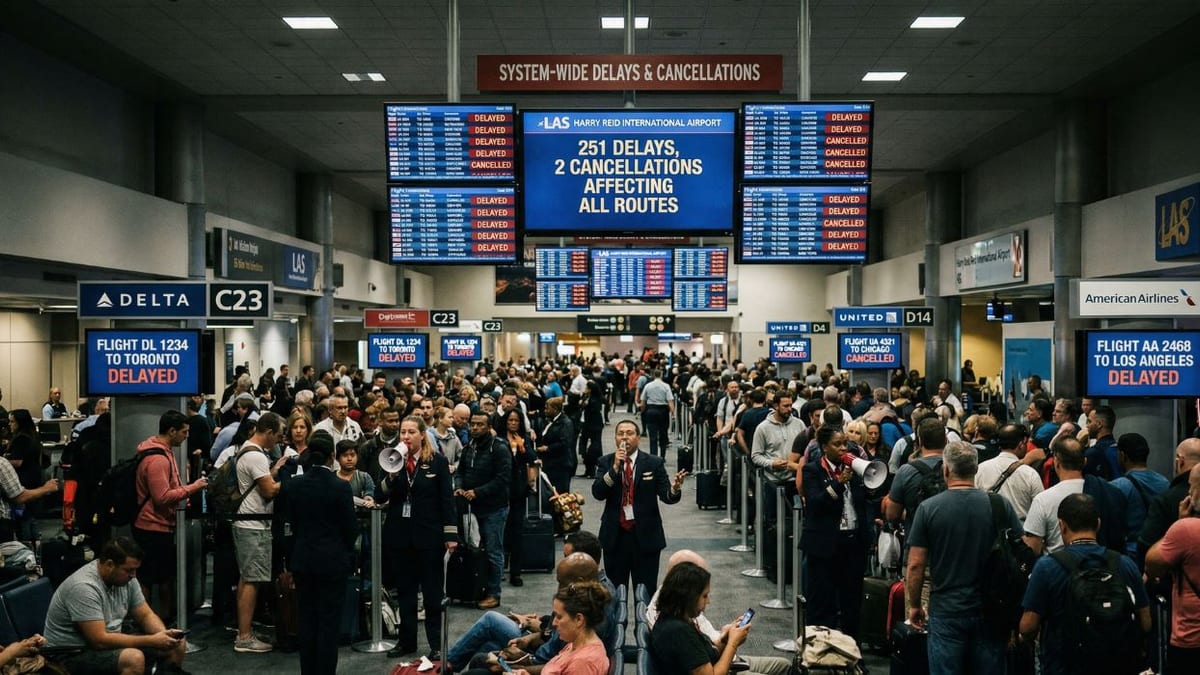
Spring travelers moving through Las Vegas on April 11 faced extensive disruption as 251 flights at Harry Reid International Airport were reported delayed and two canceled, leaving passengers stuck in terminals and scrambling to rebook connections across North America.
Get the latest news straight to your inbox!
Delays Mount Across Major U.S. and Canadian Routes
Publicly available flight-tracking data on April 11 indicated that Harry Reid International Airport recorded 251 delayed departures and arrivals and two cancellations, affecting a wide mix of domestic and international services. The disruption touched some of the airport’s busiest city pairs, including flights to Los Angeles, Chicago, Denver, and New York, as well as cross-border routes to Toronto.
Reports indicate that the delays were spread across multiple large carriers, including Delta Air Lines, United Airlines, American Airlines, Southwest, and several low-cost operators. With Las Vegas functioning as both a destination and a connecting point for transcontinental and regional services, schedule slippages at Harry Reid rapidly cascaded into missed connections and rolling delays at onward hubs.
According to industry monitoring platforms, the delay totals at Las Vegas came on the heels of a wider spike in U.S. disruptions in recent days, during which thousands of flights nationwide were either postponed or canceled. Travel-industry coverage has highlighted the particular vulnerability of busy desert and mountain hubs such as Las Vegas and Denver, where weather changes and air-traffic flow restrictions can quickly reduce capacity across multiple airlines’ schedules.
By late afternoon on April 11, average delays for some departures out of Las Vegas had stretched well beyond typical turnaround buffers, leading to gate holds, aircraft reassignments, and aircraft arriving out of position for their next flights. Passengers reported crowded gate areas and long queues at customer-service counters as they sought alternative routings.
Ripple Effects for Delta, United, American and Other Carriers
The disruption at Harry Reid International Airport translated into operational headaches for the country’s largest carriers. Public data and media coverage show delays affecting flights operated by Delta, United, American, and Southwest, alongside regional affiliates and international partners that rely on Las Vegas for connecting traffic.
Many of the impacted flights were high-demand services linking Las Vegas with major hubs such as Los Angeles International Airport, Chicago O’Hare International Airport, Denver International Airport, and New York’s primary airports. Travel reports indicate that some passengers heading for Toronto Pearson International Airport and other Canadian gateways also encountered missed connections and extended layovers when their departures from Las Vegas departed late.
Because airlines run tightly timed rotations, a late-arriving aircraft in Las Vegas can quickly lead to delays on subsequent legs, even when airports down the line are operating normally. Published analyses of recent U.S. disruption patterns note that this knock-on effect is particularly visible during peak leisure periods, when aircraft utilization is high and spare capacity to absorb irregular operations is limited.
In response, airlines adjusted gate assignments, consolidated some lightly booked departures, and encouraged affected travelers to use mobile apps and self-service tools to rebook. For those stranded overnight or facing missed final connections, options depended on each carrier’s policies and on whether the underlying cause of the delay was categorized as within the airline’s control or related to broader air-traffic or weather constraints.
Weather, Air-Traffic Flow and a Strained Spring Travel Network
The Las Vegas disruption formed part of a broader pattern of spring travel volatility across North America. In the days leading up to April 11, industry summaries documented more than 3,000 delayed flights and over 100 cancellations in a single day across the United States, with bottlenecks at multiple large hubs including Harry Reid International Airport, Denver, Atlanta, Houston, Phoenix, and Washington-area airports.
Analysts point to a combination of factors behind the latest wave of delays, ranging from unsettled spring weather and turbulence forecasts to ongoing air-traffic control staffing challenges in some regions. When visibility drops or strong winds and storms affect busy corridors, the Federal Aviation Administration may apply ground-delay programs that slow the rate of arrivals and departures into airports such as Las Vegas, reducing capacity even if conditions on the ground appear calm.
Travel-rights organizations note that while such constraints are often categorized as outside airlines’ direct control, carriers are still expected to provide rebooking assistance, meal vouchers or hotel options in some cases, and clear communication about evolving departure times. Recent consumer guidance has also emphasized the role of airport tools such as real-time security wait-time trackers, now available at Harry Reid, in helping travelers navigate crowded terminals when disruptions hit.
With Easter and spring-break traffic still pushing volumes higher than at many points last year, the network has had little room to absorb operational shocks. Aviation data from Las Vegas and other hubs show that once on-time performance drops below typical thresholds, even modest additional delays can ripple into dozens of flights over the course of a single day.
Impact on Passengers and Guidance for Stranded Travelers
For travelers caught in the April 11 disruption at Harry Reid International Airport, the most immediate impact was the uncertainty around departure times and connections. Social media posts and on-the-ground reports described long lines at airline counters, crowded seating areas around key gates, and difficulty securing last-minute hotel rooms once it became clear some departures would push into the late evening.
Consumer advocates consistently advise passengers in these situations to check their flight status frequently through airline apps or text alerts rather than relying solely on terminal display boards. When delays exceed several hours, travelers can often rebook onto alternative routings via other hubs, even if that means backtracking through airports such as Los Angeles, Denver, or Dallas to reach their final destination.
Public guidance also encourages passengers to keep all receipts for meals, transportation, and accommodation incurred during severe delays or overnight stays. While eligibility for reimbursement or cash compensation depends on the carrier and the cause of the disruption, documented expenses can support claims for partial reimbursement or travel credits when airlines acknowledge operational responsibility.
At Harry Reid International Airport, the combination of significant flight delays and typical security and check-in peaks meant that passengers were urged, via airport messaging and general travel advisories, to arrive well ahead of their revised departure times. With real-time security wait-time information now accessible via the airport’s official channels, travelers were able to better plan when to move through checkpoints once their new boarding windows were confirmed.
What the Las Vegas Disruption Signals for Upcoming Peak Travel
The scale of delays on April 11 at Harry Reid International Airport offers a preview of potential challenges as the industry heads into the late-spring and summer peak. Aviation analysts have already noted that severe weather systems earlier in 2026, including major winter and early spring storms, generated tens of thousands of cancellations and delays nationwide, testing both airline and airport resilience.
Travel-industry coverage suggests that improvements in airport infrastructure, new digital tools for monitoring security queues, and more proactive schedule adjustments by airlines may mitigate some of the worst effects seen in previous years. Even so, the Las Vegas disruption illustrates how quickly a single day of adverse conditions or constrained air-traffic capacity can spill across multiple hubs and carriers.
Advisers recommend that passengers with upcoming itineraries through Las Vegas, Denver, Houston, Phoenix, or other busy connecting points build longer layover buffers into their plans, particularly when connecting to international flights. Booking earlier departures in the day, traveling with carry-on baggage where possible, and monitoring operational news from key hubs are all strategies highlighted in recent consumer guidance.
As airlines continue to refine schedules for the upcoming summer season, data from events like the Harry Reid delays are likely to inform decisions about block times, spare aircraft positioning, and crew availability. For travelers, the April 11 episode is a reminder that flexibility, contingency planning, and familiarity with passenger rights remain essential parts of navigating an increasingly busy air-travel system.