

More news on this day
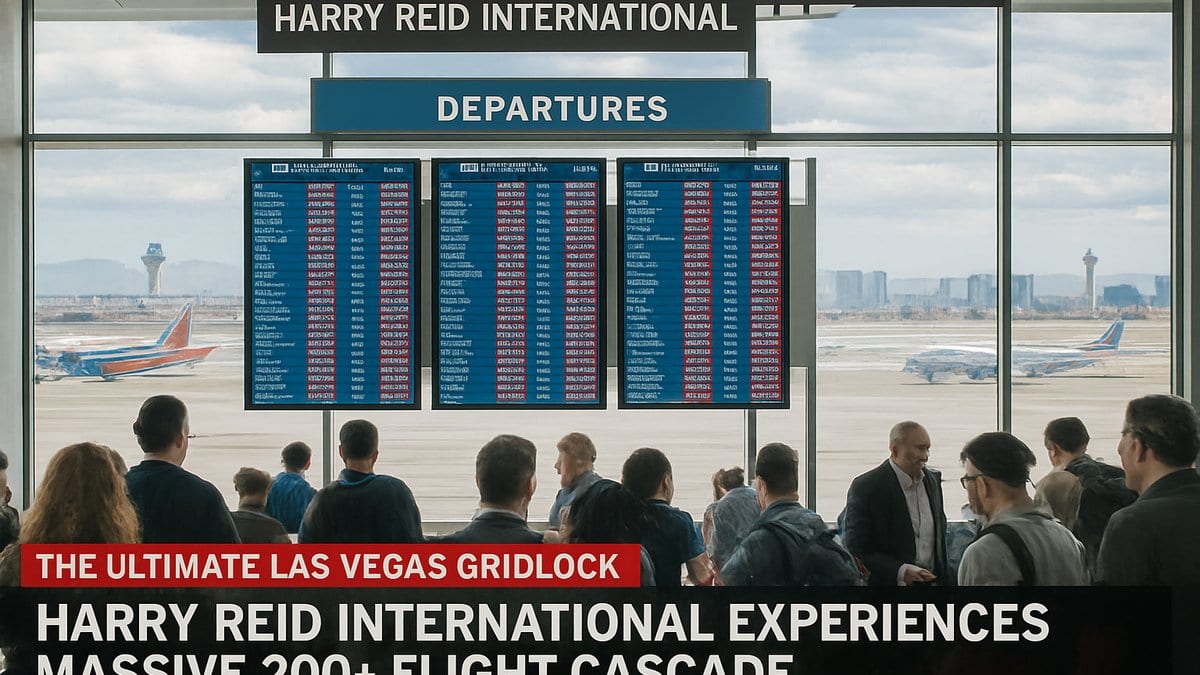
Spring break travelers moving through Las Vegas are facing one of the toughest air travel days of the season as Harry Reid International Airport contends with more than 200 combined flight delays and cancellations, triggering a network-wide cascade that is disrupting itineraries across the United States.
Get the latest news straight to your inbox!
How a Busy Spring Break Day Turned Into a Systemwide Snarl
Publicly available flight-tracking data for early April show Harry Reid International posting more than 200 total disruptions in a single day, with the majority logged as delays and a smaller number as outright cancellations. That volume places Las Vegas among the hardest-hit U.S. hubs during an already fragile spring travel period.
The timing could hardly be worse. March and early April are peak weeks for Southern Nevada, with airport officials having previously warned that local school breaks and major events would push passenger numbers toward record territory. Recent airport passenger statistics indicate Las Vegas handled tens of millions of travelers last year, leaving little margin when operations begin to fray.
Once a critical mass of flights falls behind schedule at a high-volume origin-and-connection point like Las Vegas, later departures are forced into a queue for both gates and airspace. Aircraft and crews that should be cycling through on tightly timed turns are held out of position, feeding a cascading effect that stretches well beyond the Nevada desert.
Industry coverage of this week’s disruptions across multiple U.S. hubs suggests Las Vegas is now firmly embedded in a broader pattern of rolling delays tied to volatile spring weather, high demand and strained airline schedules. The result is a patchwork of missed connections, overnight rebookings and long lines from curbside check-in to security and boarding.
Weather, Winds and a Fragile National Flight Network
While Las Vegas is best known for clear skies, the airport sits in a corridor where high winds, low ceilings and fast-changing conditions can quickly trigger traffic management programs. Local media have recently highlighted episodes in which strong winds prompted ground delays, with departures held and inbound flights metered until conditions stabilized.
At the same time, national coverage shows that major storm systems across the Midwest, Northeast and Texas have repeatedly disrupted traffic flows during late March and early April. When large hubs such as Chicago, New York and Dallas impose ground stops or extended delay programs, aircraft scheduled to route onward to Las Vegas often arrive late or not at all, setting up downstream disruptions at Harry Reid International even when local weather remains manageable.
This interdependence is a defining feature of the modern U.S. air network. An early-morning thunderstorm over one coastal airport can, within hours, contribute to evening gridlock a time zone or two away. The current Las Vegas disruptions appear to follow that familiar pattern, with a combination of regional weather, congested airspace and high seasonal demand converging to push operations beyond their comfort zone.
Analysts tracking this month’s performance note that when delays exceed a certain threshold, cancellations can climb as airlines attempt to “reset” schedules rather than fly badly off-time aircraft deep into the night. The imbalance now visible on departure boards in Las Vegas reflects that trade-off, with a limited number of canceled flights sitting atop a much larger pool of substantial delays.
Ripple Effects for Airlines and Passengers Nationwide
Harry Reid International functions as both a destination and a through-point for carriers such as Southwest, Delta, United and American, which rely on Las Vegas to feed traffic into and out of Western and Midwestern routes. When the airport experiences more than 200 disrupted flights in a day, the impact reaches far beyond Nevada, affecting passengers connecting to cities including Chicago, New York, Los Angeles and smaller regional destinations.
Reports from aviation data services and travel outlets show that carriers already under pressure from earlier spring storms have been juggling aircraft rotations, crew assignments and maintenance slots. A heavy disruption day in Las Vegas adds yet another layer of complexity, especially for point-to-point operators whose aircraft often touch several cities per day with limited slack built into their timetables.
Travel industry coverage indicates that delays in the two-to-three-hour range can quickly erode connection windows at busy hubs. Passengers originating or connecting in Las Vegas are therefore more likely to find themselves rebooked onto later flights, sometimes across different routings or even overnight. That, in turn, drives up demand for last-minute hotel rooms, ride-share trips and airport services, increasing overall strain on the local travel ecosystem.
For airlines, the financial implications are significant. Extended delays translate into higher crew costs, additional fuel burn for rerouted flights and knock-on expenses tied to passenger care. In a competitive market where carriers have been working to recover from earlier operational shocks, another large disruption day centered on a key leisure destination such as Las Vegas represents an unwelcome setback.
On the Ground in Las Vegas: Long Lines, Tight Connections
Although Harry Reid International has been promoting new tools such as real-time security wait-time displays and spring break planning guidance, the latest disruption wave is putting those systems to the test. Social media posts and anecdotal accounts describe periods of heavy crowding in check-in halls and at security checkpoints, even as some travelers report moving quickly during off-peak hours.
The uneven experience reflects how tightly Las Vegas passenger flows are tied to banked departures and arrivals. When multiple morning or evening flights push back simultaneously, queues can swell rapidly, only to recede once a departure wave clears. On a day marked by widespread delays, those banks stretch and overlap, reducing the breathing room that normally allows lines to dissipate between bursts of activity.
Travel commentary from recent days emphasizes the importance of early airport arrival, especially for international departures out of Terminal 3 and for itineraries involving tight connections onward to other U.S. or overseas hubs. With Harry Reid International now facing one of its busiest and most disrupted stretches of the year, the margin for error has narrowed considerably for anyone cutting it close.
Local travelers who are accustomed to relatively smooth security experiences at Las Vegas may find the current conditions surprising. However, with flights backed up and departure times shifting by the hour, even a modest slowdown at check-in or security can be enough to tip a borderline connection into a missed flight.
What Travelers Can Expect in the Coming Days
Travel industry reports suggest that while the immediate spike of more than 200 disruptions at Harry Reid International is acute, its effects could persist for several days as airlines work to reposition aircraft and crews. Residual delays often linger after a major gridlock event, particularly on routes with limited frequency or on carriers with smaller fleets.
Forecasts for early April point to continued unsettled weather across parts of the country, raising the possibility of additional pressure on the national air traffic system. If further storms intersect with already strained schedules, Las Vegas could again find itself dealing with elevated delay totals even without a repeat of the latest spike in disruptions.
Publicly available guidance from airlines and consumer travel outlets continues to stress flexibility as a key strategy. Travelers with upcoming trips through Las Vegas are being encouraged, through published advice, to monitor flight status frequently, make use of mobile rebooking tools where available and consider building in longer connection windows when routing through multiple hubs.
For now, Harry Reid International remains open and operating, but the scale of the latest gridlock underscores how sensitive the modern air travel system has become to shocks at any one of its major nodes. With Las Vegas serving as both a playground for visitors and a crucial spoke in the national network, its current congestion offers an uneasy preview of the challenges that could define the rest of the spring and summer travel season.