

More news on this day
Las Vegas visitors and departing travelers faced a turbulent Saturday as publicly available tracking data indicated 86 combined flight cancellations and significant delays linked to Harry Reid International Airport, with low-cost carriers Southwest and Spirit among the most affected operators.
Get the latest news straight to your inbox!
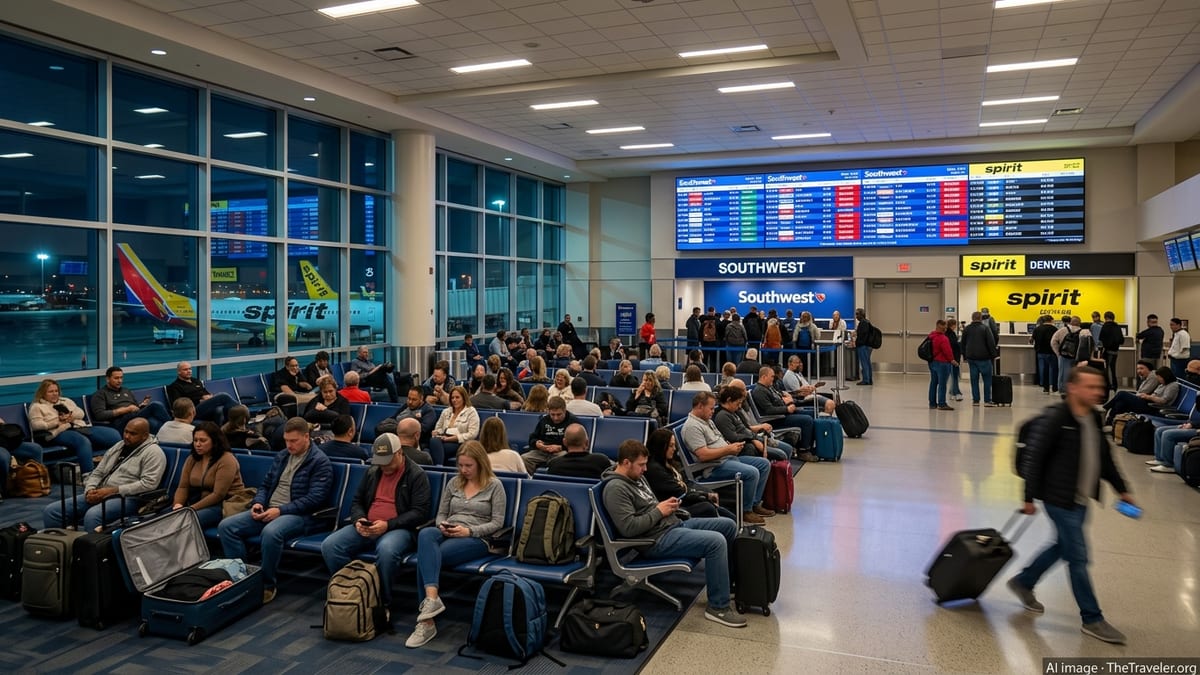
Disruptions Mount at Harry Reid International
Real-time aviation trackers and airport status boards showed a spike in operational problems affecting flights into and out of Las Vegas on March 28, with roughly 86 flights either canceled outright or delayed well beyond their scheduled departure or arrival times. While multiple carriers experienced issues, Southwest Airlines and Spirit Airlines appeared prominently in the disrupted schedules, reflecting their sizable presence in the Las Vegas leisure market.
The disruption pattern suggested a mix of inbound and outbound challenges. Delays to aircraft arriving from other congested hubs translated into late departures from Las Vegas, creating a knock-on effect throughout the day. Some flights were pushed back by several hours, while others dropped from schedules entirely as airlines attempted to reset their operations and reposition crews and aircraft.
Available data pointed to periods where clusters of Las Vegas departures on particular routes, especially high-demand leisure and short-haul services, were delayed in close succession. Travelers reported extended waits at departure gates, last-minute schedule changes and rolling departure times that shifted repeatedly as airlines updated their operational forecasts.
These difficulties arrived at a busy time for Las Vegas, with weekend traffic from across the United States filling hotels and entertainment venues. The combination of concentrated demand, time-sensitive leisure itineraries and tight aircraft utilization left little slack for airlines when early delays began to cascade.
Southwest and Spirit Feel the Strain
Southwest Airlines and Spirit Airlines both feature heavily in Las Vegas operations, and publicly available tracking information showed each carrier absorbing a notable share of today’s cancellations and lengthy delays. Reports from aviation data aggregators in recent days have already highlighted elevated cancellation levels for Spirit on certain routes, and Southwest’s large domestic network means even regional disruptions can echo through Las Vegas-bound flights.
Southwest typically operates a dense schedule of point-to-point flights feeding Las Vegas from regional and midcontinent cities. When an inbound aircraft or crew is held up by weather, air traffic restrictions or congestion elsewhere, subsequent Las Vegas departures can quickly fall behind schedule. Industry data and past operational reviews indicate that such network effects are particularly visible on weekends, when aircraft are scheduled closely to match heavy demand.
Spirit, which leans heavily on price-sensitive leisure travelers, has also drawn attention from passengers in recent weeks for clusters of cancellations and multi-hour delays on select city pairs. Las Vegas features as both an origin and connection point in that network, and published passenger accounts describe abrupt flight cancellations, rebookings onto other carriers at higher fares and long ground journeys to complete disrupted trips when same-day alternatives were scarce.
Although today’s precise breakdown of delays by cause is not yet fully detailed, the pattern of disruptions involving both Southwest and Spirit aligns with a broader environment in which tightly run low-cost operations are vulnerable to any shock, particularly when turnaround times and staffing are optimized for efficiency rather than buffer.
Weather, Air Traffic and Staffing Pressures
Operational observers note that Las Vegas is especially sensitive to a combination of weather and air traffic management constraints. Historical notices from federal air traffic coordination centers show that even moderate wind shifts or high traffic volumes can trigger ground delay programs for Harry Reid International, forcing departures across a wide swath of the national airspace system to hold before taking off for Las Vegas.
When such ground delay programs are in effect, flights departing from distant control centers must be spaced out, often leading to several hours of cumulative delay along affected routes. Past advisories have documented days where much of the arrival stream into Las Vegas, across multiple airlines including Southwest and Spirit, was held or slowed to ease congestion and maintain runway throughput.
In parallel, the broader United States aviation system continues to contend with persistent staffing challenges in air traffic control and airline operations. Public reports from recent months describe en route control centers managing saturation by metering flights, which in turn feeds through to schedule reliability in busy leisure markets. Shortages of qualified controllers and tight airline crew rosters leave limited capacity to recover quickly when one part of the system encounters strain.
Today’s cluster of disruptions appears consistent with that pattern, in which a blend of weather, airspace management and resource constraints interacts with dense weekend schedules. Airlines have adjusted some timetables and reallocated aircraft in response, but each change can create new imbalances until the system stabilizes.
What Passengers Are Experiencing on the Ground
Travelers passing through Las Vegas today reported a familiar cascade of inconveniences: long check-in and security lines, crowded gate areas and frequent app notifications updating departure times in small increments. Published passenger accounts from this and other recent disruption days describe confusion when alternate routings appear without clear explanations, and frustration when cancellations occur only a few hours before departure.
At the same time, experienced travelers have increasingly turned to independent flight-tracking tools to monitor aircraft positions and anticipate likely knock-on delays. By watching inbound aircraft assigned to their routes, some passengers have been able to spot brewing problems before schedule boards reflect them, giving a small advantage in rebooking or securing scarce hotel rooms when overnight delays become inevitable.
Budget-conscious visitors, a core segment for both Southwest and Spirit, can be especially vulnerable when last-minute cancellations force purchases of walk-up fares on other airlines. Publicly shared accounts from recent weeks describe travelers paying several hundred dollars more than their original ticket price to salvage weekend trips after flights on low-cost carriers were removed from schedules.
For many Las Vegas visitors, today’s disruptions will mean shortened vacations, missed show reservations, rescheduled casino or meeting commitments and added travel fatigue. For airport workers and airline staff, the operational stress of managing rolling delays while dealing with increasingly anxious passengers remains high.
Rights, Remedies and What Comes Next
Despite the frustration, passengers caught up in today’s Las Vegas disruptions retain specific rights under United States transportation rules. Public guidance from regulators explains that when a flight is canceled or significantly changed by an airline and a traveler chooses not to fly, the traveler is entitled to a full refund of the unused portion of the ticket, even on nonrefundable fares. Airlines may also provide meal vouchers, hotel accommodations or ground transportation in certain circumstances when disruptions are judged to be within their control.
Southwest and Spirit each publish their own service commitments for controllable disruptions, outlining conditions under which they will arrange hotels, provide meal support or rebook on alternative flights. Travelers are encouraged by consumer advocates to document all receipts and communications, and to seek written confirmation of any cancellation or involuntary schedule change to support later refund or reimbursement requests.
Aviation analysts point out that today’s issues in Las Vegas fit within a broader pattern of strain across the United States air travel system, where demand has rebounded strongly but infrastructure and staffing have struggled to keep pace. Low-cost carriers that rely on high aircraft utilization face particular pressure to absorb irregular operations without eroding their cost advantage.
For now, travelers bound for Las Vegas in the coming days are advised, according to widely shared consumer guidance, to monitor flight status frequently, build additional buffer time into itineraries and consider travel insurance or flexible booking options where possible. As airlines and air traffic managers work to normalize operations after today’s 86 disruptions, it remains to be seen whether schedule adjustments or further operational changes will be required as the busy spring and summer travel periods approach.