

More news on this day
Las Vegas visitors are increasingly finding that the most nerve‑racking part of their trip is not a high‑stakes table on the Strip but the hours spent queuing at Harry Reid International Airport, as congestion, staffing pressures, and shifting travel patterns combine to produce longer waits and fresh headaches for tourists and the city’s famed attractions.
Get the latest news straight to your inbox!
Passenger Swings Expose a System Under Strain
Recent traffic data shows Harry Reid International Airport operating near the limits of an infrastructure designed for a different era of Las Vegas travel. After an all‑time record of 58.4 million passengers in 2024, the airport handled nearly 55 million travelers in 2025, still the third‑busiest year on record despite a notable year‑over‑year decline. Publicly available figures indicate that from late 2023 through 2025, several months topped 5 million passengers, pushing terminals, security checkpoints, and baggage systems into sustained peak‑style operations.
Preliminary numbers for early 2026 suggest the pressure has not fully abated. January 2026 saw more than 4 million passengers, according to airport statistics, while local coverage notes that total traffic fell more than 7 percent from the same month a year earlier. The combination of high absolute volumes and uneven demand from key international markets is leaving the airport with a complex balancing act: fewer overall travelers than the record years, but still crowded facilities at peak times and limited slack to absorb disruptions.
Planned remedies remain long term. Clark County has endorsed a major expansion of Harry Reid International and continues to advance plans for a supplemental airport south of Las Vegas, but those projects are years away. In the meantime, travelers remain dependent on the existing terminals, concourses, and security footprint, which are being asked to handle near‑record crowds with only incremental operational improvements.
Long Security Lines Turn Departures into a Gamble
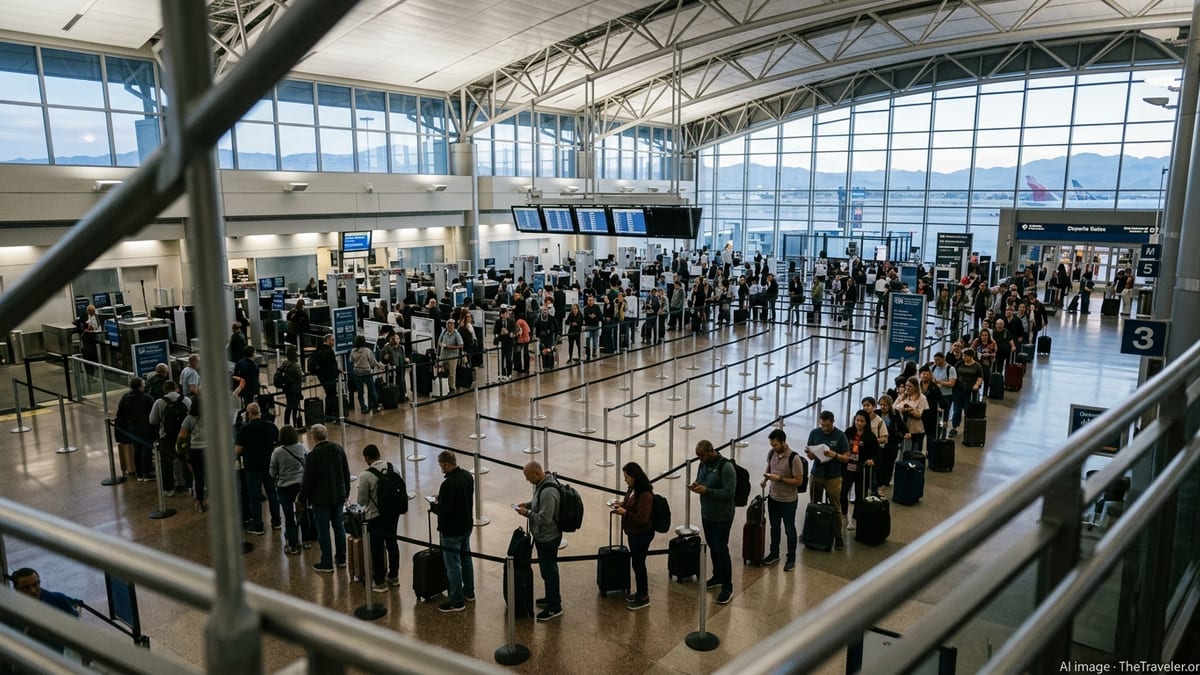
For many visitors, the most visible symptom of the strain is at security checkpoints. Publicly shared wait‑time data and traveler reports in recent weeks describe highly variable queues at Harry Reid International, with some departures moving through screening in minutes while others face waits that stretch beyond an hour. Social media posts and local forums in March 2026 reference security lines snaking toward terminal entrances at busy periods, alongside accounts from other travelers who encountered almost no line at all during off‑peak windows.
The unpredictability has become a source of anxiety. Nationally, recent staffing challenges at airport security checkpoints have triggered multi‑hour waits at several large hubs, and travelers bound for or departing Las Vegas are increasingly building in extra time at Harry Reid International to hedge against similar conditions. The airport’s own guidance of arriving at least two hours before domestic flights and three hours before international departures, once viewed by frequent flyers as conservative, is now being taken more seriously by visitors navigating a congested facility.
Data from aviation and tourism agencies suggests that the weekend crush typical of Las Vegas has intensified around major sports events, concerts, and conventions. Those spikes compress thousands of departures into narrow windows, quickly overwhelming curbside drop‑off lanes, check‑in counters, and security lanes. For tourists trying to squeeze in a final show or a last spin at the slots, the risk of getting caught in an unexpected security bottleneck is starting to feel like an additional wager.
Strip Attractions Feel the Ripple Effects
The turbulence at Harry Reid International is feeding directly into the visitor experience on the Strip and beyond. When arrival flights are delayed or baggage handling is slowed, hotels face late check‑ins and disrupted housekeeping schedules, complicating operations at properties that routinely manage tens of thousands of rooms. Attractions that depend on carefully timed ticket slots, from immersive exhibits to observation wheels, are reporting more last‑minute schedule changes as guests arrive late from the airport or leave early to account for uncertain security waits.
Published tourism data shows that Las Vegas welcomed about 38.5 million visitors in 2025, a complex year marked by shifting international travel patterns and a gradual cooling from the immediate post‑pandemic surge. Even with that moderation, hotel occupancy and event calendars remained robust, meaning that any bottleneck at the airport can still cascade through restaurants, theaters, and casino floors. If arriving passengers spend longer in immigration and baggage halls, they have fewer hours to explore paid attractions; if departing guests head to the airport earlier, they cut short dining and entertainment plans.
Operators along the Strip have been leaning into flexible booking policies and digital reservation systems to blunt the impact. Many shows and experiences now encourage visitors to build wider buffers between checkout and departure times, explicitly acknowledging the possibility of airport delays. The need to plan around the airport’s congestion is subtly reshaping how tourists schedule their final day in Las Vegas, often at the expense of spontaneous last‑minute spending.
Airline Capacity Shifts and International Weakness
Behind the scenes, changes in airline capacity are adding another layer of complexity. Industry briefings to local tourism officials highlight that total airline seats into Las Vegas fell in 2025, with particularly sharp reductions from Canadian cities. Aviation consultants have warned that capacity from Canada ended 2025 down by roughly a third from pre‑pandemic levels, with the potential for further softening in 2026. That has translated into fewer international passengers from some key feeder markets, even as domestic leisure demand remains relatively resilient.
Other international segments have shown similar softness. Trade publications and local business coverage report that 2025 brought a series of month‑over‑month declines in international arrivals at Harry Reid International, with some months posting double‑digit percentage drops. While these declines ease pressure at customs and immigration checkpoints in the short term, they also reduce the mix of higher‑spending foreign visitors that many Strip resorts and attractions traditionally rely on.
At the same time, airlines continue to concentrate flights into popular departure banks, where multiple carriers schedule takeoffs within the same narrow windows to maximize connections and aircraft utilization. For Harry Reid International, those clustered departures mean that even with slightly fewer total passengers, security checkpoints and gate areas can still feel overwhelmed at peak hours. The result is an airport environment where international weakness does not necessarily translate into a smoother experience for domestic tourists.
Short‑Term Fixes as Long‑Term Projects Loom
With major infrastructure expansion years away, Harry Reid International and local stakeholders are focusing on incremental measures that can be implemented more quickly. Publicly available information highlights ongoing efficiency projects at the airport, including upgrades to passenger processing systems and continued work on a future supplemental airport for Southern Nevada. In the near term, however, the most immediate gains are expected to come from better demand management and traveler education rather than new bricks and mortar.
Travel industry guidance increasingly encourages Las Vegas visitors to pay close attention to real‑time security wait tools, airline apps, and local traffic alerts in the days and hours before departure. Adjusting airport arrival times based on day of week, time of day, and major event schedules can significantly reduce the chance of encountering the worst lines. For inbound travelers, choosing flights that avoid the most congested arrival banks may help shorten taxi, baggage, and rideshare waits.
For the city’s tourism economy, the stakes are significant. Las Vegas has long sold itself as a frictionless escape where visitors can move seamlessly from jet bridge to gaming floor or pool deck. As delays at Harry Reid International test that promise, the broader tourism ecosystem is being challenged to adapt, ensuring that the first and last impressions of a Las Vegas vacation do not become the most frustrating part of the journey.