

More news on this day
Travelers bound for and departing from Las Vegas on March 29 faced a bruising day at Harry Reid International Airport, with 86 flight disruptions reported and low-cost carriers Southwest and Spirit absorbing a disproportionate share of cancellations and delays.
Get the latest news straight to your inbox!
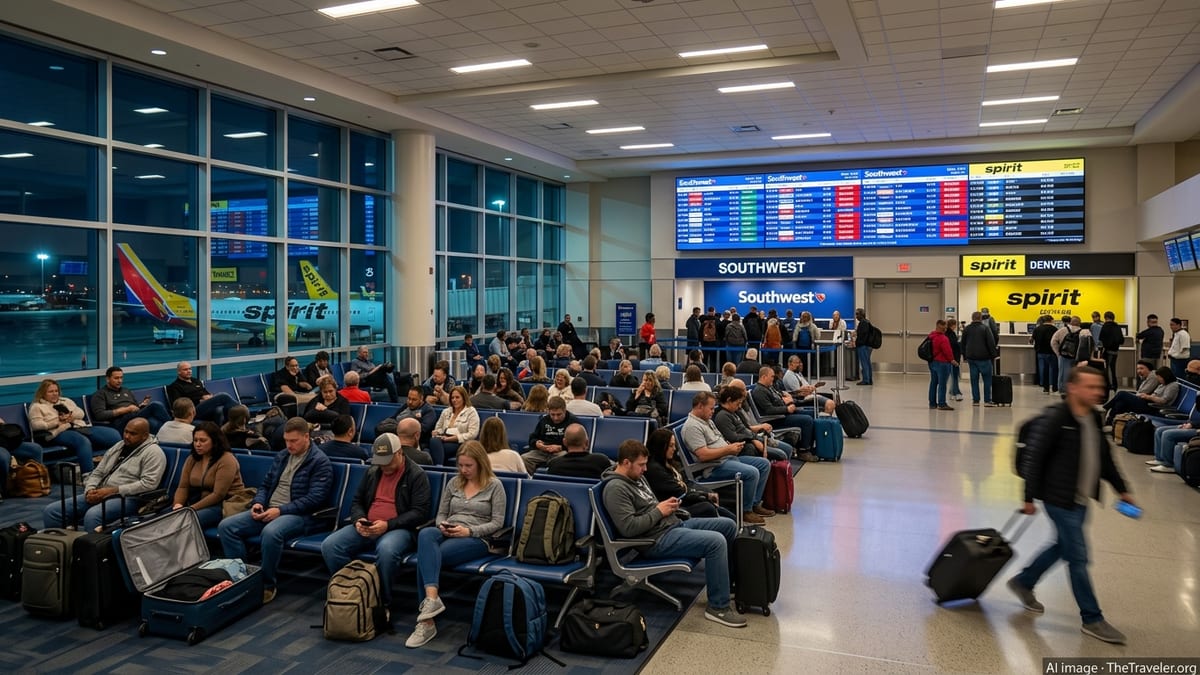
Image by Travel Tourister
Southwest and Spirit Shoulder the Heaviest Disruptions
Publicly available tracking data for March 29 indicates that Las Vegas saw dozens of cancellations and significant delays concentrated on a handful of domestic carriers, led by Southwest and Spirit. While operations continued across most of the schedule, the combined impact added up to 86 disrupted flights, affecting thousands of passengers moving through one of the country’s busiest leisure gateways.
Reports from flight-tracking services show that Southwest, traditionally the single largest carrier at Harry Reid International, accounted for a substantial block of the day’s issues. The airline has been operating a high-frequency schedule into Las Vegas, and even a modest percentage of cancellations can translate into sizeable absolute numbers of affected flights and passengers when disruptions occur.
Spirit, already navigating a protracted restructuring and capacity reset, also appeared prominently in today’s disruption picture. Data and traveler accounts suggest a pattern of scattered cancellations and rolling delays, consistent with the tighter staffing and fleet utilization the airline has adopted as it works to stabilize its finances.
Other carriers serving Las Vegas recorded delays as conditions rippled through the national network, but the clustering of problems at two of the largest low-cost operators made the situation particularly visible for budget-conscious travelers heading to and from the Strip.
Operational Strain Meets a Packed Vegas Travel Calendar
The timing of today’s disruptions in Las Vegas coincides with a typically strong late-March travel period, when a mix of conventions, sporting events and spring leisure trips push seat demand higher. Airport traffic reports for recent years show that Las Vegas consistently ranks near record passenger volumes in peak months, with Southwest and Spirit together carrying a major share of those travelers.
Industry analyses published in recent weeks highlight how densely scheduled operations into high-demand leisure hubs can leave airlines with limited margin when weather elsewhere, crew availability issues or aircraft rotations fall out of alignment. With Las Vegas heavily reliant on point-to-point service from Southwest and dense, cost-sensitive flying from Spirit, disruptions at either carrier can rapidly spill into multiple markets in the same day.
Observers note that in such environments, even localized schedule adjustments can compound as aircraft and crews arrive late from other cities, feeding a cycle of missed connections and revised departure times. For visitors planning quick weekend stays, the loss of a single flight or a lengthy delay can significantly cut into already short itineraries.
Today’s pattern of disruptions illustrates how thin buffers across portions of the domestic network can translate into outsized impacts at destination-heavy airports, particularly when more than one major operator is contending with its own internal constraints.
Southwest’s Network Complexity Amplifies Knock-On Effects
Southwest’s point-to-point model, which connects Las Vegas with cities across the United States without relying on a traditional hub-and-spoke structure, has long been a strength for frequent travelers seeking direct options. However, the same design can magnify operational challenges when irregular operations strike, because aircraft and crew rotations are interwoven across many city pairs.
Recent coverage of Southwest’s performance has pointed to a combination of factors shaping its reliability, including weather volatility, tighter fleet utilization and an evolving cost environment. When irregular operations develop in one part of the network, the impact can cascade into seemingly unrelated routes that share aircraft or crew sequences, with Las Vegas often sitting at the intersection of multiple routes that converge for weekend leisure traffic.
Travel forums and passenger reports from the past several weeks describe a mix of smooth and severely disrupted experiences on Southwest, reinforcing the view that the carrier’s performance can vary widely from day to day and route to route. On heavy Las Vegas days such as March 29, that variability can become more pronounced as gate space, staffing and runway capacity work under near-constant pressure.
For travelers, this means that even when overall cancellation percentages remain relatively low on paper, a bad day in a key market can feel much more acute, especially when flights are fully booked and re-accommodation options are limited.
Spirit’s Restructuring Leaves Little Room for Error
Spirit’s presence in today’s Las Vegas disruption tally comes at a particularly delicate phase for the carrier. The airline has spent more than a year reshaping its network, reducing its fleet, and adjusting its schedule as part of a broader turnaround under court supervision. Public filings and industry briefings describe a plan that leans on higher aircraft utilization on strong days while trimming lower-yield flying.
Analysts have noted that such a strategy can restore financial footing but often leaves limited slack in the operation. When an aircraft goes out of service or crews time out, there may be fewer spare planes and reserve teams available to plug gaps, creating a greater risk that an isolated issue turns into a cancellation rather than a short delay.
Recent media coverage and traveler experiences with Spirit across the United States highlight an uneven reliability picture during the restructuring period, with some days of largely normal operations punctuated by windows of concentrated cancellations. Against that backdrop, Spirit’s disruptions in Las Vegas today appear to reflect the broader fragility of an airline still rebuilding its schedule and staffing around a leaner fleet.
For budget-focused travelers, the trade-off remains stark: Spirit’s fares often undercut competitors on price, particularly on popular leisure routes, but the current phase of its turnaround may mean a higher probability of last-minute schedule changes on some days.
What Today’s Mess Means for Upcoming Vegas Trips
While today’s 86 disruptions mark a difficult day at Harry Reid International, the underlying causes point to systemic pressures rather than a single, isolated failure. Seasonal demand spikes, leaner airline operations and a still-volatile domestic network have combined to make high-volume leisure markets particularly sensitive to routine operational hiccups.
For travelers with bookings to Las Vegas in the coming days, aviation analysts and consumer travel advocates consistently recommend a series of practical steps: monitoring flights closely in the 24 hours before departure, enabling airline app notifications, and building extra time into connections when possible. Early morning departures often see fewer knock-on delays than late-day flights, which can be more exposed to cumulative disruptions.
Those weighing carrier options may also pay closer attention to schedule frequency on their route. On corridors where Southwest operates multiple daily flights, rebooking options can be more plentiful even when one departure is canceled, whereas routes with a single daily Spirit frequency can present tougher choices when problems arise, especially during busy weekends.
Today’s experience in Las Vegas underscores that, in the current environment, the combination of high demand and lean operations leaves little room for error. For visitors planning that next spin of the reels, building flexibility into the journey may be as important as locking in a good hotel rate on the Strip.