

More news on this day
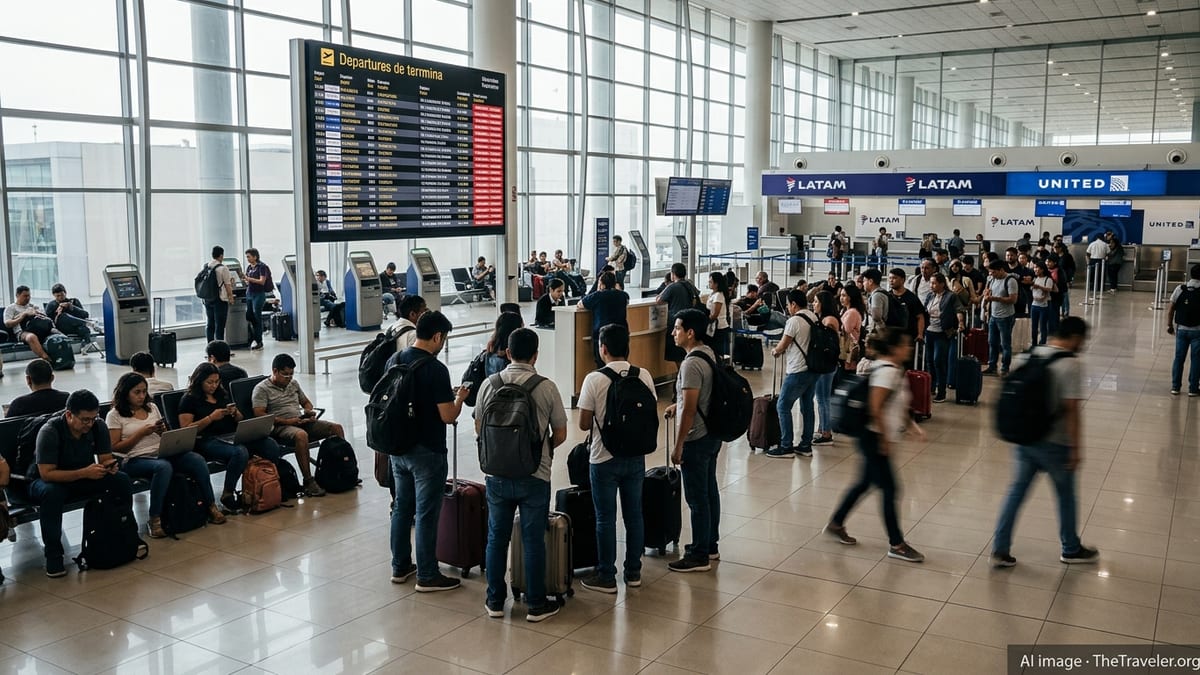
Latam Airlines and United Airlines have canceled more than a dozen flights touching Peru in recent days, disrupting key routes connecting Lima, Cusco, Houston and other regional hubs and leaving many travelers scrambling to rebook at the start of the Southern Hemisphere’s busy autumn travel period.
Get the latest news straight to your inbox!
Wave of Cancellations Hits Lima and Cusco Operations
Publicly available flight-status boards and airline updates show a cluster of cancellations affecting Latam and United services into and out of Peru, with Lima’s Jorge Chávez International Airport at the center of the disruption. Several flights linking the capital with Cusco, as well as long-haul services connecting Lima with North American hubs, have either been scrubbed or rescheduled at short notice.
Latam’s Peru network has seen repeated adjustments this year as the carrier responds to operational and demand shifts. Guidance documents for passengers published by the airline already highlight a period of heightened schedule changes around the Lima hub, noting that services may be canceled or retimed as the carrier manages capacity and infrastructure constraints. Those pressures now appear to be coinciding with fresh disruptions affecting domestic and regional links.
United’s schedule into Peru, centered on its Lima services tied to U.S. hubs, has also come under strain. Information shared through customer advisories and travel-waiver notices indicates that the airline is proactively removing some flights and consolidating others, which is contributing to the tally of cancellations on routes connecting Peru with the United States.
The net effect for travelers is a patchwork of last-minute changes that can be difficult to anticipate. While the absolute number of affected services remains relatively small compared with total daily operations in Lima, the timing and concentration on high-demand routes has magnified the impact on both local passengers and international visitors planning tight connections.
Houston and Other U.S. Hubs Feel the Ripple Effects
United’s cancellations are being felt most clearly on connections between Peru and major U.S. hubs, particularly Houston. Recent flexibility and travel-waiver alerts focused on the Houston area highlight ongoing operational sensitivity there, allowing passengers on certain dates in late March 2026 to change their plans without typical penalties. Those options are crucial for travelers whose itineraries tie Peru to Houston and onward destinations across the United network.
When flights to or from Houston are removed from the schedule, passengers with multi-leg journeys that include Lima often see cascading disruptions. A single canceled transcontinental segment can break a chain of connections, affecting not only U.S.–Peru travel but also onward links to Central and South America routed through both Houston and Lima as intermediate stops.
Other hubs in the United system are also indirectly involved, as itinerary reshuffles push more travelers onto alternative routes through cities like Newark, Chicago or Washington. This can lead to crowding on remaining services and fewer available seats for last-minute changes, especially for those departing from or arriving in Lima on peak days.
For Latam, the knock-on effect extends into its broader South American network. Flights that normally feed long-haul services to or from North America can be disrupted when domestic legs, such as those between Lima and Cusco, are canceled. That dynamic complicates travel plans for visitors who rely on Lima as a gateway to tourist hotspots in the Andes and the Amazon.
Domestic Peru Routes See Short-Notice Schedule Changes
Within Peru, the most visible impact has been on routes linking Lima with Cusco, a critical corridor for both local residents and international tourists bound for Machu Picchu and the Sacred Valley. Tracking tools that draw on airport and airline data show multiple cancellations affecting these city pairs over a short span, with travelers often notified with limited lead time.
Latam’s own public materials about service in Peru underscore that cancellations can result from a mix of factors including weather, air traffic flow restrictions and operational constraints. The airline has previously outlined procedures for passengers whose journeys are affected, such as options to change travel dates or request refunds in certain circumstances, and those provisions are again coming into play as recent cancellations accumulate.
In practice, the disruption is especially challenging for travelers who have tightly choreographed itineraries in Cusco, where tours and train tickets to Machu Picchu are often booked weeks or months in advance. A canceled morning flight from Lima can mean a missed connection to onward ground transport, forcing costly last-minute rearrangements and in some cases shortening the time visitors can spend at high-altitude destinations.
Peru’s broader infrastructure context has also been under strain in 2026, with the country navigating energy and public-health challenges that have tested resilience in several sectors. While there is no single publicly confirmed cause linking these issues directly to the current wave of airline cancellations, the overall environment leaves carriers with less margin to absorb unexpected disruptions and quickly restore normal operations.
What Travelers Can Expect and How to Minimize Disruption
For passengers booked on Latam or United flights touching Peru in the coming days, the most immediate concern is whether their specific flight will operate as planned. Airline guidance consistently urges travelers to check their flight status frequently on official channels and to monitor any email or app notifications that may signal schedule changes or cancellations.
Recent travel-waiver announcements published in airline communications, particularly surrounding Houston for United and key operational windows in Lima for Latam, highlight that some flexibility is being offered. Depending on the fare type and route, affected travelers may be able to change to a different date or routing without additional change fees, though fare differences can still apply when alternative flights are more expensive or nearly full.
Experts who track airline operations generally recommend building in more time for connections when traveling through Lima or U.S. hubs during periods of disruption. Longer layovers can create a buffer if an initial flight is delayed or replaced, and can reduce the risk of misconnecting onto limited daily services between Lima, Cusco and North American gateways such as Houston.
In addition, passengers holding complex itineraries that combine domestic Peru segments with international legs may benefit from consolidating tickets with a single airline or alliance where possible. This approach can make it easier to be reprotected on alternative flights when cancellations occur, as the operating carrier has clearer responsibility for rerouting and can use its full network to find available seats.
Outlook for Peru–U.S. Travel in the Coming Weeks
Looking ahead through late March and into April 2026, schedule data and publicly available advisories suggest that both Latam and United will continue to fine-tune their operations in and out of Peru. While more than a dozen recent cancellations have drawn attention, they remain a small fraction of overall traffic, and airlines historically move to stabilize schedules once acute operational pressures ease.
At the same time, broader patterns within United’s system, including multiple active travel waivers related to weather and geopolitical developments, indicate that U.S. carriers are still operating in a volatile environment where last-minute changes remain possible. Routes that depend on a chain of connections through major hubs such as Houston are likely to feel that volatility more than point-to-point services.
For Latam, Lima’s role as a growing hub continues to evolve alongside infrastructure upgrades and terminal changes that are reshaping how passengers move through the airport. Planning documents for the hub show that periods of transition can temporarily affect flight schedules as airlines adjust to new layouts and procedures, even as longer-term capacity is expected to improve.
Travelers planning trips between Peru and the United States in the coming weeks may therefore want to prioritize flexible bookings, consider travel insurance that covers missed connections, and keep a close eye on developments in both airline networks. While the current disruptions are not on the scale of past systemwide crises, the recent cancellations by Latam and United underscore how quickly conditions can change on some of the region’s most important routes.