

More news on this day
Brazilian air travel faced fresh disruption this weekend after eight flights operated by LATAM, Azul and regional carrier Air Center were cancelled across key domestic routes, affecting connections to São Paulo, Brasília, Florianópolis, Porto Seguro and several secondary cities.
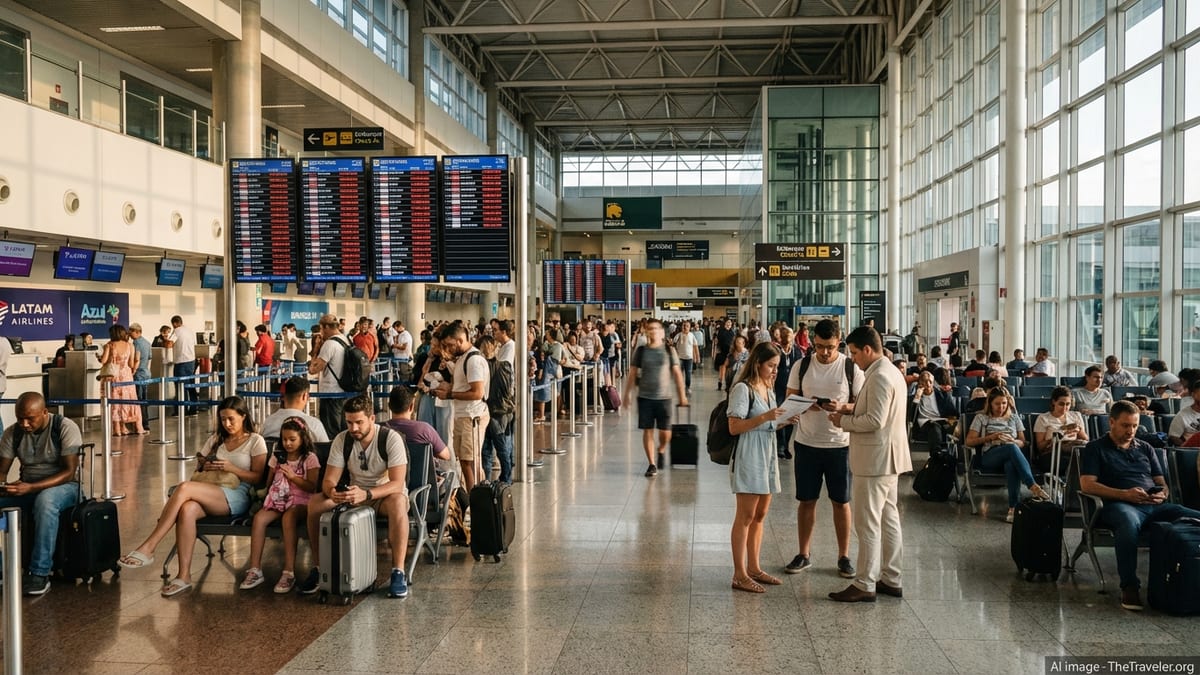
Fresh Wave of Cancellations Hits Key Brazilian Routes
The latest round of cancellations unfolded on February 21, 2026, according to real-time schedule and status data from flight-tracking providers and airport operators. While Brazil’s summer high season is nearing its end, demand on trunk routes such as São Paulo, Brasília and major coastal destinations like Porto Seguro and Florianópolis remains elevated, amplifying the impact of lost seats.
The eight affected flights, split among LATAM Brasil, Azul and Air Center, involved services into and out of São Paulo’s Guarulhos and Congonhas hubs, Brasília International Airport, Florianópolis Hercílio Luz International Airport and Porto Seguro Airport. Several flights were scheduled at peak morning and late afternoon periods, compounding the operational pressure on airlines already managing tight rotations and high load factors.
Initial indications point to a combination of operational constraints, aircraft availability issues and tight turnaround times as key drivers behind the disruptions, rather than a single, widely reported safety incident or severe weather pattern. For passengers, however, the cause matters less than the immediate reality of long queues, rebookings and, in some cases, overnight stays far from their intended destinations.
The cancellations also arrive against a backdrop of increased scrutiny of Brazilian carriers’ punctuality and reliability, after a series of mass disruption days in late 2025 and early 2026 when dozens of flights were cancelled or delayed across the country’s main hubs.
LATAM Flights Scrubbed on High-Demand Leisure and Business Routes
LATAM Brasil, the country’s largest carrier by market share, accounted for several of the cancellations that rippled through Saturday’s schedule. Among the most notable were services connecting São Paulo’s Guarulhos hub with key leisure destinations and secondary business markets, including Porto Seguro, an important gateway to Bahia’s Discovery Coast, and other regional airports that funnel passengers into the country’s largest city.
Airport and tracking data show that selected LATAM services planned between Porto Seguro and São Paulo were withdrawn from the timetable at short notice, forcing affected passengers onto later flights or alternative routings via other hubs. Travelers heading to São Paulo for business meetings, medical appointments or onward international connections were particularly exposed, with some missing tight connection windows or needing to rearrange hotel bookings at their own expense.
LATAM has faced a series of operational headaches in recent months, from weather-related disruption to isolated technical incidents requiring aircraft rotations and unscheduled maintenance. While Saturday’s cancellations did not reach the levels seen during more severe disruption days, they underlined the fragility of high-density domestic schedules, where the removal of just one aircraft from rotation can reverberate through an entire day’s operation.
The airline reiterated in previous statements that it prioritizes safety over schedule integrity and that passengers on cancelled flights are entitled to rebooking, refunds or alternative arrangements according to Brazilian aviation regulations. However, traveler complaints circulating on social platforms suggest that the on-the-ground experience can vary greatly from one airport to another, especially at smaller regional terminals with limited staffing.
Azul Adjusts Operation Amid Post-Restructuring Environment
Azul, which has just formally exited its Chapter 11 bankruptcy proceedings in the United States after a wide-ranging financial restructuring, also featured among the carriers cancelling services on Saturday. The airline scrapped a small number of flights touching key leisure and business markets, including routes feeding São Paulo’s Viracopos hub and connections toward southern Brazil and the northeast coast.
The cancellations affected at least one Azul service linking Campinas Viracopos to coastal destinations popular with domestic vacationers. While the airline has generally maintained strong operational performance on routes such as Campinas to Florianópolis and Campinas to Porto Seguro, the removal of select frequencies on a high-demand weekend created capacity gaps that were difficult to absorb for travelers booking at short notice.
Azul has emerged from its restructuring with a leaner balance sheet and an explicit focus on network efficiency and aircraft utilization. Industry analysts note that such an environment can leave little slack in the system. When an aircraft experiences minor technical issues or crew rotations tighten, airlines with highly optimized schedules may be forced to cancel individual legs rather than risk wider knock-on effects across the network.
For passengers, the net effect is a heightened sense of uncertainty, especially in peak travel periods. Even if the absolute number of Azul cancellations was limited, their concentration on popular leisure routes magnified the disruption, with family groups and holidaymakers scrambling to secure seats on later flights that were already heavily booked.
Regional Carrier Air Center Adds to Nationwide Disruption
Completing the trio of carriers involved, regional operator Air Center cancelled a handful of services that principally connect secondary and mid-sized cities to Brazil’s larger hubs. Though considerably smaller than LATAM and Azul, Air Center plays an important role in linking inland communities to São Paulo and Brasília, and its cancellations can leave passengers with few immediate alternatives.
Saturday’s disruption involved at least one Air Center flight designed to feed passengers from a regional airport into Brasília, one of the country’s main political and administrative centers. Another cancelled service was scheduled to operate toward São Paulo, where travelers often transfer to longer domestic or international flights operated by larger carriers.
In several affected markets served by Air Center, road or bus journeys to the nearest major hub can take anywhere from six to 12 hours, turning a same-day business trip into a multi-day ordeal. Passengers who had planned tight day-return visits for medical appointments, administrative procedures or family emergencies found their schedules upended by the lack of same-day re-accommodation options.
Air Center did not immediately release a detailed public explanation for the cancellations, but regional aviation observers point to the same pressures confronting larger airlines: tight fleet sizes, high utilization and little backup capacity when an aircraft requires unscheduled maintenance or crew scheduling conflicts arise.
São Paulo and Brasília Bear the Brunt at Crowded Hubs
As is often the case in Brazil’s domestic network, the worst of the disruption was felt at the main hubs. São Paulo, split between Guarulhos and Congonhas airports, saw multiple cancellations and subsequent rebookings funnel more passengers into already congested terminals. Long queues formed at airline service counters and self-service kiosks as travelers tried to secure alternative itineraries.
Guarulhos, the country’s main international gateway, experienced additional pressure as domestic cancellations forced some passengers to miss connection windows for long-haul departures to Europe and North America. While many airlines attempted to rebook affected customers on later flights or partner services, the tight capacity typical for a mid-February weekend limited the number of available seats.
Brasília also suffered from the ripple effects, particularly for travelers commuting between the federal capital and São Paulo, as well as those connecting from northern and midwestern states. For political staffers, corporate travelers and civil servants who rely on same-day returns, even a single cancelled rotation can upend carefully planned agendas, pushing meetings and hearings back by days.
At both hubs, airport operators deployed additional staff to manage queues and direct passengers toward airline counters, but there were few quick fixes. Without spare aircraft and empty seats, customer service teams were largely restricted to rebooking on later flights or issuing vouchers and refunds, options that many stranded travelers found inadequate compared with their immediate needs.
Holiday Hotspots Florianópolis and Porto Seguro See Summer Plans Derailed
The impact of the cancellations was particularly acute in Brazil’s coastal holiday destinations, where families and tour groups had scheduled tightly choreographed itineraries around fixed hotel check-in times and package-tour excursions. Florianópolis, the capital of Santa Catarina state and a prime beach destination, saw at least one Azul-linked cancellation disrupt flows via Campinas, while LATAM’s scrapped Porto Seguro services reduced lift into one of Bahia’s marquee resort regions.
Local tourism operators in Florianópolis and Porto Seguro reported last-minute rescheduling of transfers, missed first-night stays and, in some cases, outright trip cancellations as travelers opted to abandon plans rather than accept multi-day delays or convoluted routings. Small guesthouses that rely heavily on Saturday arrivals noted gaps in occupancy for the current weekend, a blow during what is still a lucrative late-summer period.
For passengers already on the ground in these destinations and due to return home on Saturday, the cancellations introduced a different set of headaches. Some were asked to extend their stays by a night or two while waiting for the next available seat, often at their own cost pending negotiations with airlines and insurers. Others chose to purchase new tickets on alternative carriers or nearby airports, hoping to reclaim costs later under Brazil’s passenger-rights framework.
While the scale of disruption was smaller than mass-cancellation events triggered by severe weather or major technical outages, the concentration on popular tourist routes amplified the visibility of the problem, with images of crowded terminal halls and confused holidaymakers circulating widely on social media.
Passengers Navigate Rebooking, Compensation and Legal Rights
As with previous disruption days in Brazil’s aviation sector, Saturday’s wave of cancellations quickly turned into a test of airlines’ customer service systems and passengers’ knowledge of their rights. Under Brazilian aviation rules, carriers are required to provide rebooking options, refunds and, in some cases, material assistance such as meals and accommodation when cancellations are within the airline’s control.
Consumer advocates stress that travelers should document all interactions with airlines, keep receipts for any expenses incurred due to cancellations and request written confirmation of flight disruptions. In practice, however, overwhelmed airport staff and long lines can make it difficult for passengers to secure clear information in real time, especially at smaller regional airports with limited counters or irregular staffing.
The proliferation of mobile apps and online check-in tools has helped some travelers react more quickly, allowing them to see cancellation notices and rebooking options without waiting at a physical counter. Yet passengers without reliable internet access or those unfamiliar with airline digital tools still tend to be at a disadvantage, relying heavily on announcements over loudspeakers and printed notices at the gate.
Legal experts note that growing public awareness of passenger rights in Brazil, combined with recent high-profile disruption episodes, is likely to lead to further claims and complaints filed with consumer protection agencies and small-claims courts. Airlines, for their part, are attempting to balance compliance obligations with the financial realities of a still-recovering sector.
Ongoing Strain Highlights Structural Challenges in Brazil’s Air Network
Beyond the immediate inconvenience to passengers, the latest cancellations highlight deeper structural challenges in Brazil’s domestic aviation system. Carriers such as LATAM and Azul are operating high-utilization fleets in a market where demand has rebounded strongly but margins remain thin and cost pressures, from fuel to leasing, are persistent.
This environment leaves little room for operational slack. When a single aircraft comes out of rotation due to an unscheduled maintenance check, crew duty-time limitations or a minor incident elsewhere in the network, airlines must often choose between delaying several flights or cancelling one entirely to restore stability. For passengers caught on the wrong leg of that calculation, the result can be a missed weekend away, a lost business opportunity or unexpected out-of-pocket costs.
Smaller carriers such as Air Center face their own constraints, including limited spare aircraft and a dependence on feeder traffic into the big hubs. Their cancellations, though numerically fewer, can have outsized effects in regions with few alternative transport options and long overland distances.
As Brazil’s summer travel season enters its final weeks, industry observers warn that similar disruption days remain a strong possibility, particularly on busy Fridays and weekends. Unless airlines can build more resilience into their schedules or regulators incentivize larger capacity buffers, passengers may need to adjust expectations and build extra time into itineraries involving key hubs such as São Paulo, Brasília, Florianópolis and Porto Seguro.