

More news on this day
LATAM Airlines Group has filed its 2025 annual report on Form 20-F with the U.S. Securities and Exchange Commission, outlining a year of record growth, stronger finances and an ambitious roadmap that reinforces South America’s role in the future of global aviation.
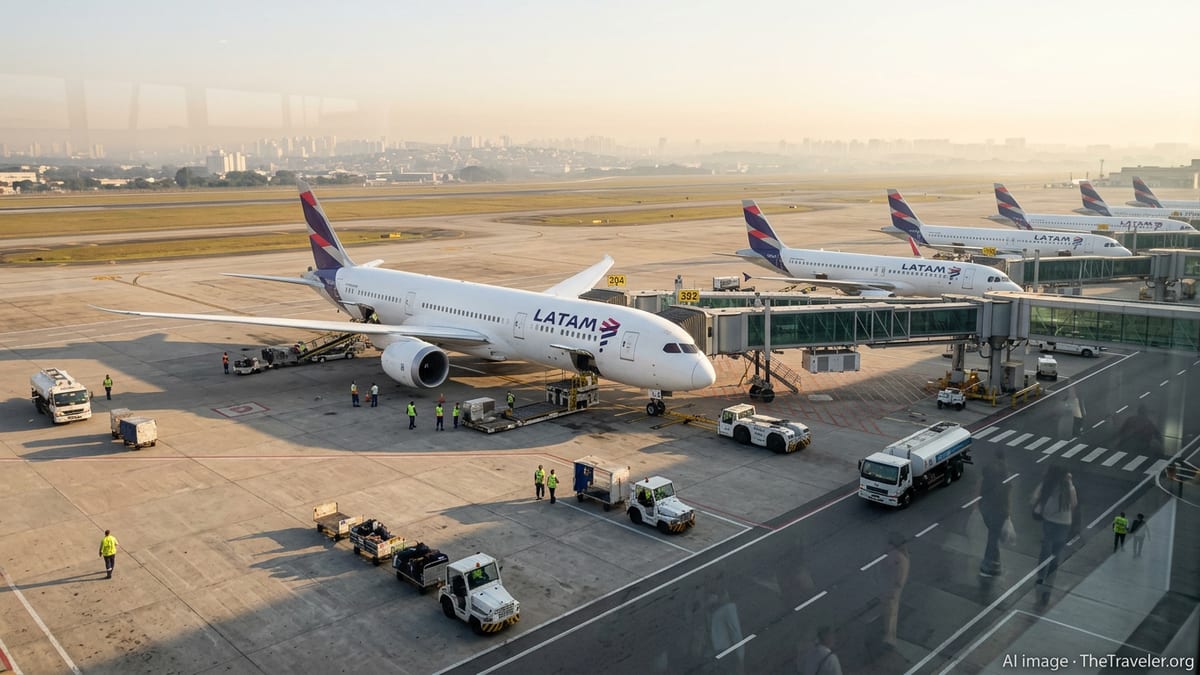
Regulatory Filing Confirms Scale of a Rebuilt Champion
The latest Form 20-F, filed in early 2026 for the fiscal year ended December 31, 2025, formalizes LATAM Airlines Group’s status as the largest carrier in South America by capacity and passengers transported. The report details a consolidated fleet of 371 aircraft at year-end, including 20 dedicated freighters, and a workforce of more than 41,000 employees spread across the region’s main aviation markets.
According to the filing, LATAM transported around 87 million passengers in 2025, cementing leading domestic market positions in Brazil, Chile, Peru and Ecuador, and a strong number-two slot in Colombia. The group also operated the region’s most extensive long-haul network, linking South America to 25 intercontinental destinations across North and Central America, Europe, Oceania and Africa, while serving 134 destinations within South America itself.
For regulators and investors, the 20-F offers a granular look at how the company has consolidated its post-restructuring footprint. The filing confirms that LATAM continues to operate through multiple country affiliates under a single brand, giving it scale advantages in network planning, procurement and fleet deployment that few regional rivals can match.
The document also highlights an active capital structure, with more than 574 billion shares subscribed and paid and a small balance of shares reserved for the conversion of outstanding notes. This framework, inherited from the company’s Chapter 11 exit plan, underpins LATAM’s capacity to fund growth while maintaining regulatory compliance in both Chilean and U.S. markets.
Financial Performance Marks a Record Year
Beyond operational scale, the 2025 annual report underscores a year of strong financial results for LATAM. The group reported record net income and revenue growth, supported by robust travel demand across South America, disciplined capacity management and ongoing cost efficiencies introduced after its restructuring.
Passenger traffic rose across both domestic and international segments, with particularly strong contributions from Brazil, where LATAM projected mid-single-digit growth as early as December 2024. The 2025 outcome suggests that the company delivered on, and in some cases exceeded, those projections, turning expanding demand into healthier yields and improved unit revenues.
Profitability was further supported by ancillary revenues and an increasingly optimized route portfolio. LATAM continued to refine its mix of regional and long-haul services, adding frequencies in high-demand corridors while exiting or resizing underperforming routes. On the cost side, the group benefited from synergies across its country affiliates, streamlined overheads and more efficient aircraft utilization.
The financial narrative in the 20-F reassures investors that LATAM’s post-Chapter 11 strategy is translating into durable earnings power. The company’s commentary signals a focus on sustaining margins in 2026 as it navigates fuel price volatility, currency fluctuations and geopolitical uncertainty that can rapidly affect international aviation flows.
Network Strength and Fleet Strategy Shape the Region’s Future
LATAM’s 2025 filing also provides a window into how its network and fleet decisions could shape the broader aviation landscape in South America. With its 371-aircraft fleet, the group has the flexibility to adjust capacity between domestic, regional and intercontinental markets, allowing it to respond faster than smaller competitors to shifts in demand.
Widebody aircraft remain central to LATAM’s long-haul strategy, supporting links from key hubs such as São Paulo, Santiago and Lima to major cities in North America and Europe. These routes are critical for connecting South America’s growing middle class with global business and leisure destinations, and for bringing inbound tourism and investment to the region.
On the narrowbody side, newer-generation aircraft are being deployed to strengthen domestic and regional connectivity. This supports the development of secondary cities across Brazil, Chile, Peru, Colombia and Ecuador, reducing travel times and improving access for both business travelers and international visitors looking to move beyond traditional gateway hubs.
Freighter capacity, anchored by 20 dedicated cargo aircraft, amplifies South America’s role in global trade lanes. LATAM’s cargo unit, recognized as Cargo Airline of the Year 2025, leverages both freighters and belly capacity on passenger flights to move high-value exports such as perishables, pharmaceuticals and e-commerce goods, reinforcing the region’s integration into global supply chains.
Sustainability and Service Recognitions Bolster Brand Value
The 2025 Form 20-F highlights a series of accolades that strengthen LATAM’s brand positioning at a time when travelers and investors are paying closer attention to sustainability and service quality. In 2025, the group was named South America’s leading airline for the eleventh consecutive year by the World Travel Awards and collected multiple PAX Readership Awards for inflight entertainment, cabin interiors, food service and its flagship lounge in Santiago.
On the environmental front, the filing notes that S&P Global’s Corporate Sustainability Assessment recognized LATAM in early 2026 as one of the most sustainable airline groups worldwide, ranking first in the Americas and among the top performers globally. The group’s inclusion in the Sustainability Yearbook 2026 underscores progress on carbon management, operational efficiency and governance practices.
These recognitions support LATAM’s efforts to differentiate itself in a competitive marketplace that includes both regional full-service rivals and aggressive low-cost carriers. By investing in cabin upgrades, digital services and airport lounges while also advancing sustainability commitments, the airline aims to appeal to corporate accounts, premium leisure travelers and environmentally conscious customers.
The emphasis on sustainability is particularly relevant for South America, where many tourism economies depend on preserving fragile ecosystems while accommodating rising visitor numbers. LATAM’s disclosures on emissions targets, fuel-efficiency initiatives and fleet modernization connect its corporate strategy to broader regional climate goals.
Strategic Outlook for South America’s Aviation Landscape
Looking ahead, the 2025 annual report positions LATAM as a central player in the next phase of South America’s aviation development. The group’s guidance and commentary suggest expectations of continued traffic growth in 2026, driven by expanding middle-class demand, infrastructure investments and the recovery of corporate and long-haul travel.
Alliances and commercial agreements remain a critical tool in this outlook. LATAM’s partnerships with global carriers extend its reach beyond its own metal, giving South American travelers more one-stop options to key markets and improving connectivity for inbound tourism. At the same time, these arrangements help feed traffic into LATAM’s hubs, supporting load factors and revenue quality.
For the region’s aviation future, the combination of a large, modern fleet, deep domestic coverage and a broad long-haul network means LATAM’s decisions on capacity, pricing and sustainability will influence how and where South Americans fly. As regulators and investors digest the 2025 Form 20-F, the filing serves not only as a snapshot of a strong year, but as a roadmap for how the carrier intends to secure South America’s place in global air travel over the rest of the decade.