

More news on this day
Brazil’s record-breaking tourism surge is set for another lift in March 2026, as LATAM’s new direct flights between Amsterdam and São Paulo add the Netherlands to a growing list of countries now feeding a boom in Brazilian travel demand.
Amsterdam Secures a Prime Role in Brazil’s Air Connectivity Push
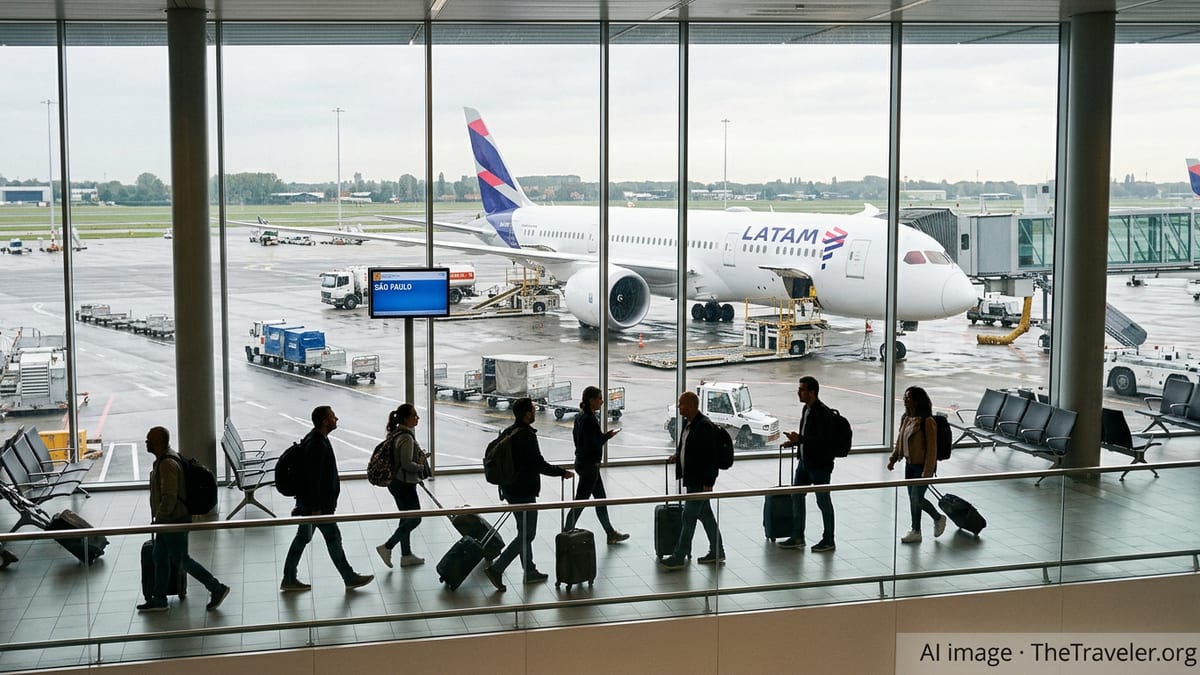
LATAM Airlines will inaugurate its nonstop Amsterdam to São Paulo service on March 30, 2026, operating six times weekly between Schiphol and Guarulhos. The route, announced initially with fewer frequencies and then swiftly upgraded, underscores how quickly demand between northern Europe and Brazil is accelerating. For Dutch travelers, it introduces a rare non-stop link to South America’s largest city at a time when Brazil is breaking its own records for foreign arrivals.
The flights will be operated with Boeing 787-9 aircraft configured with 303 seats, including a modern business cabin and an expanded economy section. That combination of capacity and fuel efficiency is central to LATAM’s strategy of opening new long-haul markets while keeping fares competitive for both leisure and corporate travelers. By launching near the start of Europe’s spring season, the airline also positions the route to capture early-summer bookings and shoulder-season demand.
Amsterdam becomes LATAM’s fifth major European gateway alongside Madrid, Barcelona, Paris and Frankfurt, and its first true northern Europe hub. For Brazil, the addition strengthens an already dense web of transatlantic links that have multiplied since pandemic-era lows. For the Netherlands, it offers a high-profile new long-haul connection aligned with Schiphol’s role as a transfer powerhouse.
The timing dovetails with Brazil’s sustained air-capacity expansion. International operations into the country rose sharply again in 2025, helping push total foreign arrivals above nine million visitors for the first time. Against that backdrop, every new European route is being closely watched by tourism officials and industry analysts eager to understand which markets will drive the next phase of growth.
Brazil’s Tourism Boom Draws Europe and South Africa Closer
Brazil has emerged as South America’s star tourism performer, outpacing regional peers on both recovery and growth. Government data show that the country first set a new all-time record in 2024 with around 6.6 to 6.8 million foreign visitors, then jumped past the nine-million mark in 2025, far exceeding targets set under its current national tourism plan. That surge is increasingly powered by European travelers as new non-stop routes shorten travel times and ease connections beyond São Paulo and Rio de Janeiro.
Italy and Spain, already well served by LATAM and other carriers, have been among the strongest contributors to the latest wave of visitors. Portuguese- and Spanish-speaking markets, along with France, Germany and the United Kingdom, helped deliver well over a million European arrivals, reflecting both cultural links and an appetite for long-haul sun and nature experiences. South Africa, which has developed its own direct air links to Brazil, is also seeing rising two-way tourism flows, helped by growing interest in combined South Atlantic itineraries.
The Netherlands is now poised to join that group of influential source markets. Dutch travelers have traditionally relied on connections via Paris, Frankfurt or Lisbon to reach Brazil. With a non-stop option and coordinated schedules, tour operators expect Brazil to feature more prominently in winter-sun brochures, long-stay remote-work packages and multi-country South America trips originating from Amsterdam.
Industry observers say that beyond raw seat capacity, the psychological effect of a named, daily-style connection between two cities can be just as powerful. When a route appears in booking engines without a change of planes, destinations move higher in travelers’ consideration sets. In Brazil’s case, that visibility is landing at a moment when global travelers are increasingly seeking nature, culture and authenticity rather than short city breaks alone.
Joint Ventures, Hubs and the Power of Seamless Connections
LATAM’s Amsterdam launch is not an isolated play but part of a broader network strategy centered on alliances. Through its joint business agreement with Air France-KLM, the São Paulo to Amsterdam route will plug directly into one of Europe’s largest connecting hubs. Dutch, Scandinavian and Baltic travelers, along with passengers from the UK regions and parts of Eastern Europe, will be able to reach Brazil with a single coordinated connection at Schiphol.
This partnership effect is crucial for unlocking demand beyond the immediate local market. A traveler from Stockholm or Manchester booking through a European or Brazilian portal may see São Paulo, Rio de Janeiro, Fortaleza or Florianópolis offered as near-seamless itineraries via Amsterdam. In turn, Brazilian travelers from secondary cities can use Guarulhos as a springboard into a far wider slice of Europe than point-to-point flights alone would allow.
On the Brazilian side, LATAM is simultaneously investing in additional domestic destinations from São Paulo, expanding links to cities such as Uberaba, Juiz de Fora, Campina Grande and Caldas Novas from 2026. That deeper inland connectivity is vital for ensuring that growth in European arrivals also benefits emerging tourism regions beyond the main coastal capitals.
For tourism boards in Italy, Spain, Belgium, the Netherlands and South Africa, this type of network-driven expansion offers new marketing angles. Instead of selling single-city breaks, they can promote twin-center holidays that pair Brazilian beach or eco-tourism with European culture or wine regions, all within itineraries built on just one or two long-haul sectors. As air links mature, such cross-promotional campaigns are expected to proliferate.
Opportunities and Challenges for Dutch and Brazilian Tourism Stakeholders
Travel trade insiders in both countries see significant upside in the new route, but they also point to operational and sustainability challenges. Schiphol is still balancing capacity constraints, community noise concerns and environmental targets with the commercial pressure to maintain its role as a global hub. LATAM’s decision to use modern, lower-emission 787-9 aircraft on the Amsterdam service is calibrated to address some of those sensitivities while keeping operating costs under control.
On the Brazilian side, officials emphasize that infrastructure must keep pace with visitor growth. São Paulo’s Guarulhos airport has invested in terminals and long-haul handling, yet peak-hour congestion and connection pressures remain. Tourism planners argue that continued upgrades to airport access, immigration processing and domestic transfer flows will be essential to ensuring that the benefits of new long-haul routes are fully realized.
For Dutch tour operators, airlines and agencies, the new link opens opportunities to tailor Brazil product for niche segments that are already strong in the Netherlands, including cycling, birdwatching and design-focused urban travel. São Paulo’s creative neighborhoods, Brazil’s coastal eco-lodges and routes through Atlantic rainforest and savannah landscapes are expected to feature in new packages launched ahead of the first flight.
Price sensitivity, however, remains a factor. Long-haul leisure travelers are watching airfares closely amid broader cost-of-living pressures in Europe. Analysts expect introductory promotions, joint marketing campaigns and competitive pricing in the first year of operation as LATAM and partner carriers work to stimulate demand and establish Amsterdam as a durable pillar in the Brazil-Europe travel corridor.
A New Chapter in Transatlantic Tourism Flows
The addition of the Netherlands to LATAM’s Brazil long-haul map rounds out a striking geographic spread: southern Europe anchored by Spain and Italy, central and western Europe feeding through France and Germany, and now northern Europe routed via Amsterdam. Together with growing connectivity from South Africa, these markets are collectively reshaping how international travelers reach Brazil’s beaches, metropolises and interior landscapes.
For Brazil, the stakes go beyond headline visitor numbers. Tourism is increasingly promoted as a driver of regional development, job creation and cultural exchange, particularly in lesser-known destinations that benefit from improved domestic air links. Every new intercontinental gateway that funnels passengers into São Paulo strengthens that vision by making it easier to disperse travelers onward to secondary cities.
For the Netherlands, the Amsterdam to São Paulo route arrives at a moment when the country is reassessing how it engages with global tourism. After years of managing overtourism in hotspots such as Amsterdam’s historic core, policymakers are keen to support more balanced, higher-value travel that connects Dutch residents and businesses to emerging markets. Brazil’s booming tourism sector, reinforced by the new LATAM flights from March 2026, offers exactly that type of long-haul, culturally rich exchange.
As seats fill and booking patterns stabilize over the months following launch, industry stakeholders will watch closely to see whether Amsterdam can match or surpass the performance of established gateways in Spain, Italy and other European partners. What is already clear is that Brazil’s appeal, and the aviation network underpinning it, is entering a new phase in which the Netherlands is set to play an increasingly visible role.