

More news on this day
Europe’s main low-cost airlines are quietly reshaping cabin bag rules yet again, with new size limits, fees and upcoming EU legislation set to change how much travellers can carry for free.
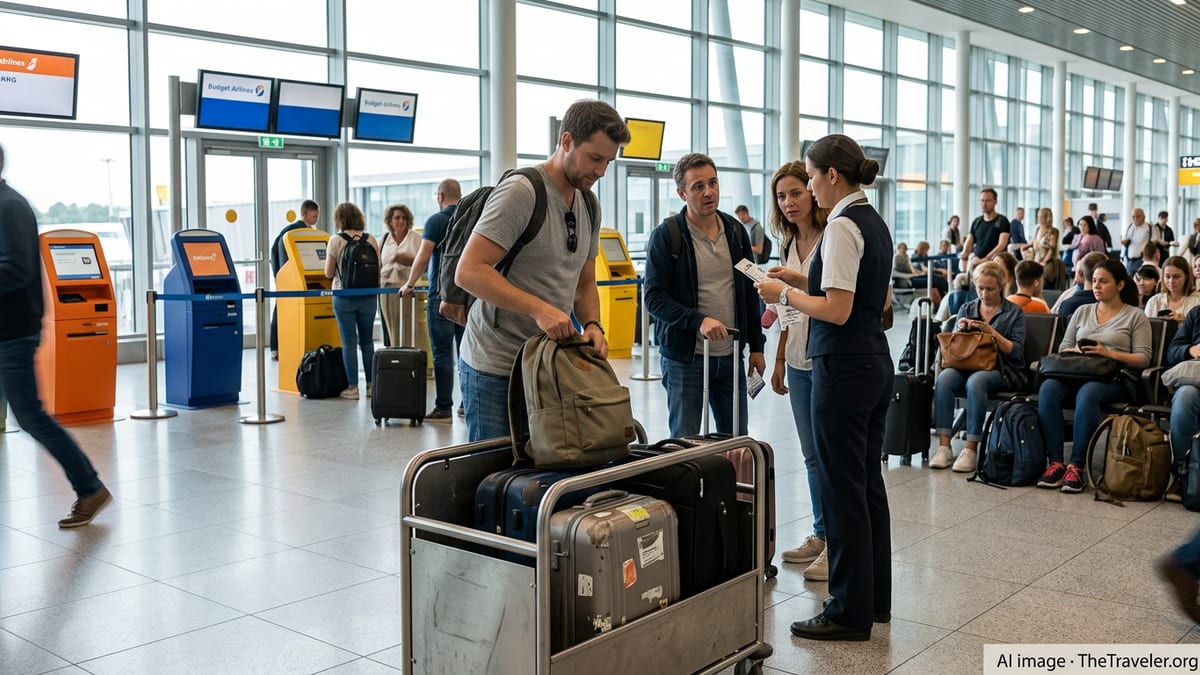
Ryanair: A Bigger Free Bag, But Strict Sizers and Steep Fees
Ryanair’s cabin baggage policy remains among the most closely watched in Europe, not least because misjudging it can be costly. Reports this weekend highlighted a family charged around £400 at the gate after their bags failed to meet the airline’s rules, underlining how aggressively the carrier enforces its limits.
As of early 2026, every Ryanair passenger on a standard fare is entitled to one free “small” cabin bag that must fit under the seat in front. Following a policy change phased in from mid‑2025, that free personal item can now measure up to roughly 40 x 30 x 20 cm, an increase of about 20 percent on the previous allowance and echoed by red stickers added to updated bag sizers at airports.
Anything larger, such as a typical wheelie suitcase up to around 55 x 40 x 20 cm and 10 kg, is treated as a full cabin bag and requires payment, either via a priority boarding-style product or a 10 kg cabin bag add‑on. Space in the overhead lockers is not guaranteed for non‑priority customers, and late payment at the gate remains significantly more expensive than buying in advance, which is why consumer groups continue to urge travellers to check sizes with a tape measure rather than relying on retailer labels.
Ryanair’s policy sits against the backdrop of draft EU rules that would entrench the right to one cabin bag plus a personal item across member states. While those proposals are still moving through the legislative process, the airline’s decision to slightly loosen its free personal-item dimensions is widely seen as a pre‑emptive response that still protects a lucrative stream of baggage revenue.
easyJet: One Free Under‑Seat Bag, With Extra Space for a Price
easyJet has converged on a similar model, granting all passengers one small cabin bag free of charge, to be stowed under the seat. In 2026 that free allowance typically runs to around 45 x 36 x 20 cm, with no weight limit advertised on many routes, provided passengers can lift the bag safely and it fits in the sizer.
Larger cabin bags for the overhead lockers are now firmly part of easyJet’s paid extras. Travellers can secure an additional, bigger cabin case by buying a seat with extra legroom or an “up front” seat, or by adding a separate large cabin bag product to a standard booking. On busy departures, customers without that extra entitlement risk being limited to the under‑seat bag only, an important consideration for weekend city breaks and ski trips where space is tight.
The carrier’s chief executive recently criticised EU proposals that would mandate a free larger cabin bag of up to 7 kg alongside a personal item, arguing the move would drive up fares and complicate boarding. For now, though, easyJet’s own structure clearly incentivises customers to pay for more capacity: package holiday and frequent-flyer products are often bundled with overhead locker access, while basic fares lean heavily on the single under‑seat bag model.
For travellers, the key with easyJet is to distinguish between the universally free under‑seat item and the optional overhead case. Turning up with a mid‑sized wheelie bag but only a standard ticket is likely to trigger either a last‑minute cabin bag fee or forced check‑in at the desk or gate.
Jet2: More Generous Free Allowance Among Leisure Carriers
Jet2 stands out among UK leisure airlines by continuing to offer a comparatively generous free cabin baggage allowance. Each passenger is permitted one piece of hand luggage up to 10 kg with maximum dimensions of 56 x 45 x 25 cm, broadly in line with traditional industry guidelines, as well as one small under‑seat bag such as a handbag or laptop case, typically around 40 x 30 x 20 cm.
This two‑item structure means many holidaymakers can bring both a cabin‑sized wheelie bag for the overhead locker and a compact personal item without incurring extra charges. Unlike some rivals, Jet2 explicitly publishes a weight cap for hand luggage, so travellers are advised to weigh their case at home, not just check its size. Cabin crew and gate staff retain discretion to place compliant bags in the hold on full flights, but there is currently no standard fee when this is done proactively to manage locker space.
The airline also offers an option called “Guaranteed Cabin Luggage” on some routes, allowing customers to pay a modest premium to ensure their 10 kg cabin bag remains with them in the overhead lockers rather than being tagged for the hold. For those connecting on tight schedules or carrying valuables they prefer not to check, this has become a popular middle ground between basic fares and full‑service offerings.
Given Jet2’s focus on package holidays to Mediterranean and Canary Island destinations, its relatively forgiving cabin policy is a selling point in a market where budget rivals steadily trim free allowances. Travel agents booking families on mixed‑carrier itineraries often highlight Jet2 flights as the segment where passengers can relax slightly about bag dimensions.
British Airways and Full‑Service Rivals: Two Pieces Still Standard
At the other end of the market, full‑service airlines such as British Airways have so far resisted the shift to single‑bag cabin rules. On most BA short‑haul and long‑haul tickets, passengers are still entitled to bring one larger cabin bag for the overhead lockers plus one smaller personal item, irrespective of whether they have purchased a hand‑baggage-only fare or a ticket that includes checked luggage.
The main cabin bag typically follows a 56 x 45 x 25 cm template, while the personal item is usually capped at around 40 x 30 x 15 cm. Weight limits vary by route and cabin class, but the combined allowance is often sufficient for short business trips without any checked luggage. Importantly, this two‑piece entitlement applies even in the airline’s most restrictive economy products, with revenue focused more on checked bags than cabin items.
Other European network carriers, including flag airlines based in Germany, France and the Netherlands, follow similar patterns, although subtle differences in weight limits and enforcement can catch out passengers connecting between brands. For travellers combining a low‑cost sector with a traditional carrier on the same journey, the stricter cabin rules of the budget airline usually determine what can be packed.
Frequent‑flyer status and premium cabins continue to offer some relief. Business‑class passengers and top‑tier loyalty members are often allowed extra weight or slightly more flexible interpretation of the rules, though dimensions for any single bag will still be subject to the fixed sizer frames at the gate.
What Travellers Should Watch in 2026
The cabin bag landscape in 2026 is being shaped by three forces: airline revenue needs, airport congestion and looming EU regulation. Bag fees have become a major source of income for low‑cost carriers, but the boarding delays caused by overstuffed lockers and confused passengers have turned cabin allowances into a political issue in Brussels.
The European Parliament has backed proposals that would standardise a minimum free cabin allowance across the bloc, including a personal item and a small roller case of up to 7 kg. Airlines and airports warn this could slow boarding and raise base fares, while passenger groups argue it would restore clarity and fairness to what has become a maze of small print.
Until any law is finalised and implemented, travellers flying with Ryanair, easyJet and Jet2 will continue to face very different realities. One airline offers a relatively roomy free overhead bag, another restricts most customers to an under‑seat item, and a third charges if you want guaranteed overhead space. Full‑service carriers, meanwhile, are holding the line on more generous two‑piece allowances but tightening checked baggage rules.
For now, the safest strategy is to check each airline’s current size and weight limits before booking, measure bags carefully and assume that gate staff will enforce the strictest interpretation of the rules. With cabin bag policies evolving quickly and new regulations on the horizon, what fits for free on one trip may not do so on the next.