

More news on this day
Los Angeles International Airport is confronting another turbulent stretch of operational disruption, with widespread delays rippling across flights operated by Delta Air Lines, United Airlines and American Airlines as the busy spring travel period collides with infrastructure work and ongoing staffing pressures.
Get the latest news straight to your inbox!
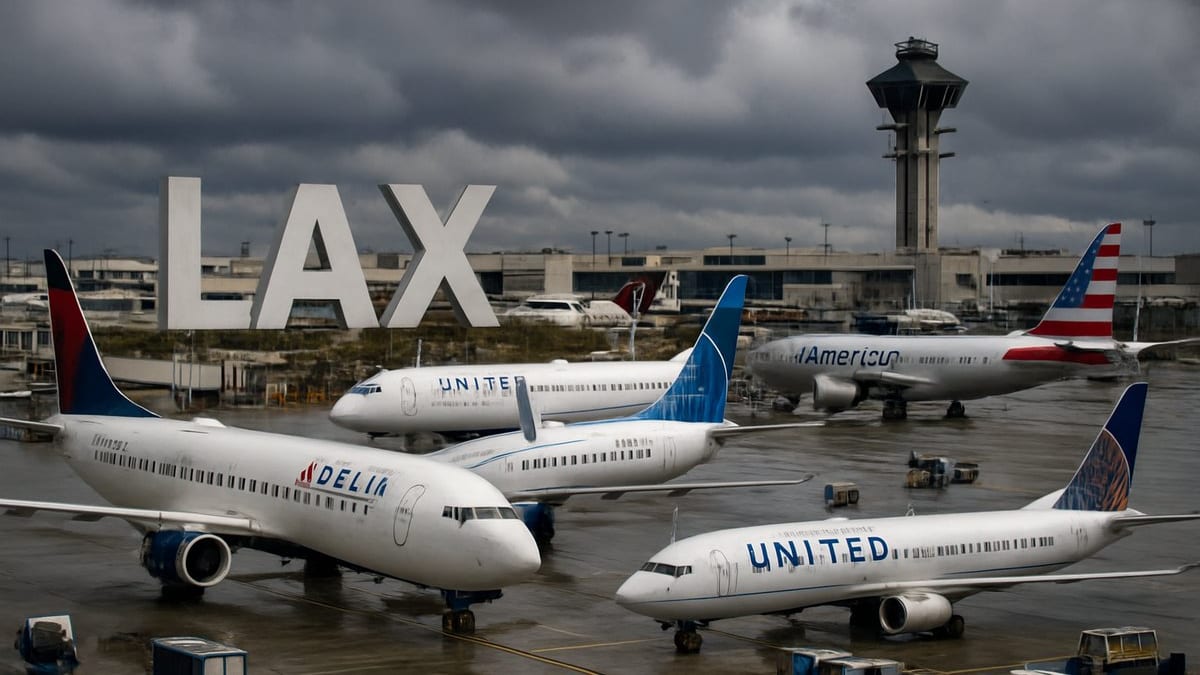
Runway Maintenance and Storms Trigger New Wave of Disruptions
Operational data and local coverage indicate that a combination of scheduled runway maintenance and recent severe weather has sharply reduced flexibility at Los Angeles International Airport in late March and early April 2026. A newly issued advisory from Los Angeles World Airports outlines a 14 hour closure of Runway 6R/24L on April 4 for routine maintenance, limiting arrivals and departures on the south side of the airfield and tightening spacing between flights as traffic builds through the day.
That planned work follows a difficult stretch in February, when LAX implemented a ground stop during a line of strong thunderstorms that moved across the Los Angeles Basin. Local news accounts show that the weather-related restrictions forced dozens of departures to hold at gates or taxiways, while inbound flights diverted or circled in holding patterns, adding to crew timeouts and aircraft repositioning challenges that continued for days.
These constraints have left major hub carriers vulnerable. Delta, United and American rely on tightly timed banks of flights into and out of their LAX operations, and any reduction in available runway capacity or airspace throughput tends to cascade across the schedule. Industry performance trackers show elevated rates of late arrivals and missed connections at LAX through March, particularly on transcontinental and Hawaii routes that have less schedule slack.
Network impacts have been magnified by a broader pattern of national disruption. A historic weather system in late March triggered more than a thousand cancellations and several thousand delays across the United States, according to aviation-focused legal and consumer sites, with LAX consistently noted among the hardest hit West Coast airports.
Big Three Carriers Face Mounting Operational Strain
Within this strained operating environment, Delta Air Lines, United Airlines and American Airlines have all struggled to keep their Los Angeles schedules on time. Travel-industry roundups of recent disruption patterns highlight American logging more than 800 delays in a single day across its network during the early April crunch, with Los Angeles cited among the major hubs affected. Delta and United have also reported elevated delay totals as they work through aircraft and crew imbalances created by earlier storms and air traffic control programs.
On the ground at LAX, publicly available on time performance data compiled by aviation analytics platforms show that some regional and mainline flights operated for the three carriers have experienced average departure delays in the range of 20 to 40 minutes over recent months. Longer hold times are visible on routes where LAX serves as a connecting bridge, such as services to smaller Western markets that depend on inbound aircraft from delayed East Coast or Midwest flights.
The three carriers are simultaneously navigating fleet and staffing transitions that reduce their margin for error. Industry reports point to continued shortages in certain pilot categories and maintenance roles, even as overall employment has recovered from the pandemic lows. When severe weather or a runway closure disrupts the schedule, airlines have fewer reserve crews and aircraft available to absorb the shock, making a local problem at LAX more likely to turn into a day long network challenge.
Some carriers are adding technological tools in an attempt to overcome these constraints. United recently rolled out a real time security checkpoint wait time tracker in its mobile app at key airports, a move described in consumer coverage as a response to longer screening lines during a partial federal government funding dispute that rippled through Transportation Security Administration staffing. However, these measures do little to relieve pressure on airfield capacity when runways, taxiways and terminal gates are already maxed out.
Construction and Ground Access Complicate Passenger Flows
While the flight operation challenges are critical, conditions on the ground at LAX are also contributing to the sense of chaos for travelers using Delta, United and American. A March construction bulletin from Los Angeles World Airports highlights 24 hour lane restrictions throughout the central terminal area, with barricades, equipment staging and utility work narrowing access roads that were already congested during peak hours.
These lane closures coincide with ongoing terminal modernization programs, including multi year work on terminals used by the three carriers and their partners. Aviation construction summaries and local reporting outline a series of overlapping projects, from vertical core expansions to new gate complexes and roadway realignments, that are designed to improve LAX in the long term but are currently removing space from curbside areas, parking facilities and gate holds.
Adding to the complexity, the airport’s highly anticipated Automated People Mover remains delayed. Independent monitoring of the project and transit community discussions indicate that the system, once projected to open by early 2026, is now expected to begin passenger service later in the year at the earliest, leaving travelers dependent on shuttle buses and private vehicles to move between terminals, rental car facilities and transit connections. That shortfall has kept pressure on the very roadways now constrained by construction.
Reports on broader U.S. aviation performance note that such ground access bottlenecks can feed directly into flight delays. Congested curbs and slow moving traffic delay passengers and crew arrivals, complicate aircraft servicing schedules and extend the time needed to turn aircraft at the gate. For high frequency LAX operations by Delta, United and American, even a small increase in turn times can erase planned recovery periods meant to absorb earlier delays.
National System Weaknesses Amplify Local Problems
The difficulties at LAX are emerging within a national aviation network that remains sensitive to shocks. Research published in early 2026 on long term security screening trends across U.S. airports suggests that delays originating at high volume hubs like LAX now propagate more quickly through the system than they did a decade ago, as airlines have optimized schedules and reduced slack to maximize aircraft utilization.
Recent incident and weather patterns have tested that network. A late March storm system forced ground stops and widespread delays at multiple hubs, while separate runway construction and landing restrictions at San Francisco International have already generated significant schedule adjustments and holding patterns in Northern California. As large coastal hubs struggle, LAX often absorbs rerouted traffic or becomes a chokepoint for transpacific and transcontinental flows operated by the three big U.S. carriers.
Consumer travel advisories now routinely recommend longer connection windows when transiting through LAX during the current construction phase, noting that missed connections have increased on certain Delta, United and American itineraries where minimum connection times were already tight. Guidance from legal and passenger rights platforms also emphasizes the importance of monitoring flight status closely and understanding each carrier’s delay and rebooking policies, as schedule instability remains elevated.
With runway work, terminal projects and regional weather risks likely to continue through the busy summer season, operational data and expert analysis suggest that Los Angeles International Airport will remain a pressure point in the national air travel network. For thousands of passengers booked on Delta, United and American flights each day, that means building in extra time, preparing for potential disruptions and navigating an airport that is simultaneously modernizing and straining under heavy demand.