

More news on this day
Travelers passing through Los Angeles International Airport are facing significant disruption as 198 flights are reported delayed and 44 canceled, affecting busy corridors to New York, Chicago, San Francisco and London and stranding passengers across multiple terminals.
Get the latest news straight to your inbox!
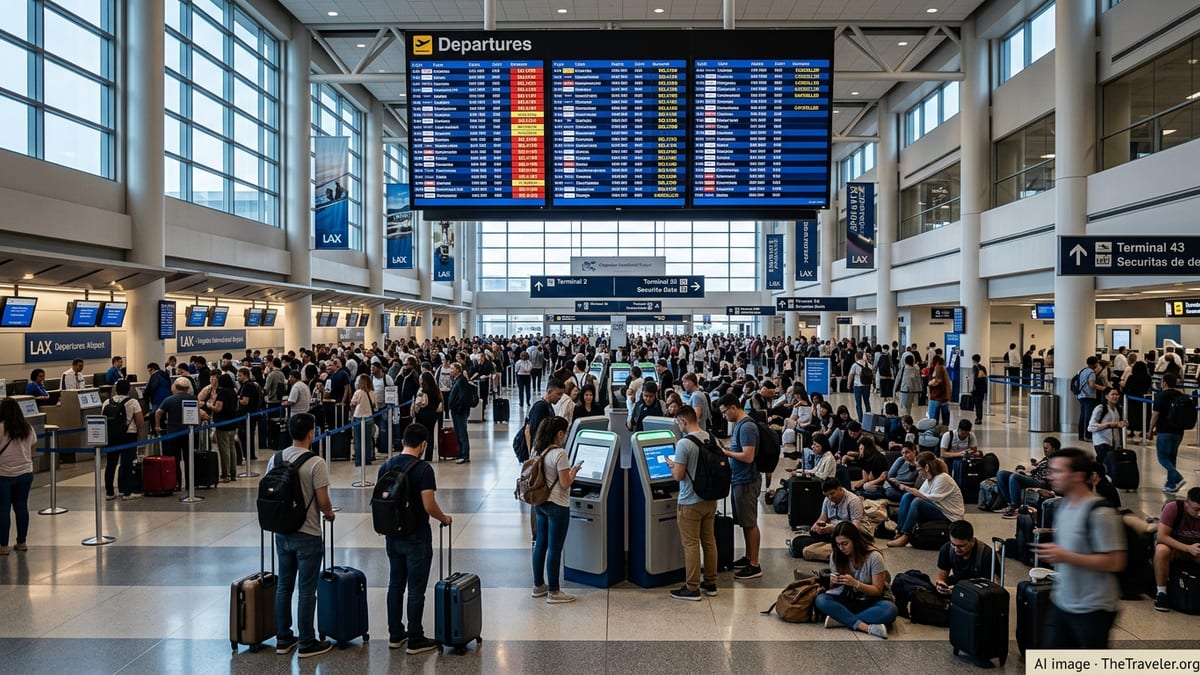
Widespread Disruption Across a Major West Coast Hub
The latest disruption at Los Angeles International Airport is rippling across one of the world’s busiest aviation networks, with flight-tracking data and airport status boards showing severe schedule impacts. The combined total of 198 delayed and 44 canceled services reflects a sizable share of daily movements at the airport, which routinely handles well over a thousand flights per day in peak periods.
Publicly available information indicates that the delays span both domestic and international operations, with some aircraft held at gates, others awaiting departure slots on the taxiways and a number of inbound flights placed into holding patterns before landing. Passengers on affected services are experiencing anything from short schedule slips to multi-hour waits, with some connections no longer viable as the day’s operations compress.
Reports suggest that the disruption is not concentrated in a single terminal or airline, but instead appears across several major carriers and alliances. That pattern is consistent with broader operational or airspace challenges, where congestion, weather in other regions or staffing constraints can quickly cascade through a tightly timed national network built around hubs such as Los Angeles, New York, Chicago and San Francisco.
The scale of irregular operations at Los Angeles also has knock-on implications for other airports because many aircraft and crews are scheduled to operate multiple segments in a single day. When an early rotation is significantly delayed or canceled, subsequent flights may be pushed back or substituted, and in some cases removed from the schedule entirely.
Key Domestic Corridors to New York, Chicago and San Francisco Affected
Among the most visible impacts for travelers are the delays on high-frequency domestic corridors linking Los Angeles with New York, Chicago and San Francisco. These routes are critical for both business and leisure travelers, often carrying a mix of local passengers and those connecting onward to Europe, Latin America and Asia.
Published coverage and schedule data show that services to New York area airports, including John F. Kennedy International and Newark Liberty International, are particularly sensitive to disruption because of the region’s already congested airspace. When irregular operations occur simultaneously at both ends of the route, aircraft and crew rotations can quickly fall out of sync, leading to extended delays or the need to consolidate departures.
Flights between Los Angeles and Chicago O’Hare, another major national hub, are also vulnerable to cascading effects. Chicago’s central role in the U.S. network means that disruption there can amplify delays across multiple time zones, especially on itineraries that rely on tight connections. When westbound or eastbound segments on the Los Angeles–Chicago corridor are pushed back, passengers may miss onward flights to smaller cities in the Midwest, East Coast and South.
On the West Coast, the heavily traveled Los Angeles–San Francisco corridor functions as both a business shuttle and a critical domestic connector. Operational data and historic performance statistics show that San Francisco’s weather and airspace conditions can periodically constrain arrivals and departures, so any added disruption tied to Los Angeles can compound existing challenges and further restrict capacity on this short but strategically important route.
Transatlantic Travel to London Faces Extended Delays
The current disruption at Los Angeles International Airport is also affecting transatlantic travelers bound for London, one of the most important long-haul markets from Southern California. Long-haul flights typically operate on tighter daily cycles, with aircraft scheduled to depart in specific evening windows to arrive in Europe early the following morning, enabling same-day connections onward across the continent.
When departure times from Los Angeles are significantly pushed back, those carefully planned connections can be jeopardized. Travelers arriving late into London may miss onward flights to European destinations, forcing rebookings for later in the day or even the following day, depending on seat availability. This can be especially disruptive during busy travel periods when load factors are already high.
According to operational analyses and prior case studies of long-haul disruption, cancellations on a route such as Los Angeles–London are comparatively rare but highly impactful. Removing a single widebody aircraft rotation from the schedule displaces hundreds of passengers and complicates crew planning, catering, maintenance and slot usage at both airports. Reaccommodating these travelers often requires the use of alternative routings through other hubs or the deployment of larger aircraft on subsequent days.
For passengers currently booked on Los Angeles–London services, publicly available guidance from airlines and regulators underscores the importance of monitoring real-time status, checking for reissued itineraries and allowing additional time for security and boarding. Given the length of the route and the complexity of transatlantic operations, even relatively modest schedule changes can lead to late-night arrivals or unscheduled overnight stays.
Knock-On Effects for Passengers and Airline Operations
The combined tally of nearly 250 delayed or canceled flights at Los Angeles International Airport is creating a range of practical challenges for travelers. Many passengers are reporting extended waits in terminal seating areas and at customer service counters as they seek alternative flights, hotel vouchers or meal accommodations based on each carrier’s policies and the cause of the disruption.
Operational analyses of similar events show that delays of this scale can trigger a chain reaction of aircraft and crew imbalances. Aircraft that were scheduled to overnight at one airport may instead end up out of position, forcing airlines to adjust their plans for the following day’s departures. This can prolong the impact of a single day of disruption, with some passengers experiencing residual delays even after conditions normalize at the original point of failure.
Families and international visitors transiting Los Angeles are particularly exposed when connections involve separate tickets or different carriers. In such cases, missed onward flights are not always automatically protected, and travelers may incur additional costs while rearranging their plans. Travel insurance coverage, where purchased, can help offset some of these expenses, but terms vary widely by policy and jurisdiction.
From a broader system perspective, irregular operations at a large hub underscore the fragility of modern aviation networks, which operate on tight schedules and rely on accurate forecasting of demand, weather and air traffic capacity. When one or more of these variables shifts unexpectedly, the margin for recovery can be slim, especially during peak travel seasons or on already congested routes.
What Travelers Can Do if Their Flight Is Affected
Consumer guidance compiled from regulators, airlines and passenger advocacy groups points to several steps travelers can take when facing delays and cancellations of the sort currently observed at Los Angeles International Airport. The first is to monitor flight status through multiple channels, including airline apps and airport information displays, as updates may appear at slightly different times depending on the data source.
Passengers whose flights are canceled outright typically have stronger options, including rebooking on the next available departure or, in some cases, requesting a refund for the unused portion of the ticket. For delayed flights, available remedies depend heavily on airline policies, the length of the delay and whether the cause is considered within the carrier’s control.
Travelers connecting onward to New York, Chicago, San Francisco, London or other cities may wish to proactively contact their airline once a substantial delay is posted to assess alternative routings. In some situations, adjusting the itinerary through a different hub or accepting a next-day flight can reduce the risk of extended overnight disruption spent in the airport.
Passenger rights frameworks in the United States differ from those in regions such as the European Union, and the level of mandated compensation or assistance varies accordingly. Publicly available resources from consumer agencies and nonprofit travel organizations emphasize reviewing the fine print of ticket conditions and any applicable travel insurance so that travelers understand the support they can reasonably request when disruptions on the scale currently seen at Los Angeles International Airport occur.