

More news on this day
At Los Angeles International Airport, travelers still inch through traffic-clogged roadways and shuttle bottlenecks as the long-promised Automated People Mover remains out of reach, its opening date pushed again into 2026 despite billions poured into transforming the airport’s ground access.
Get the latest news straight to your inbox!
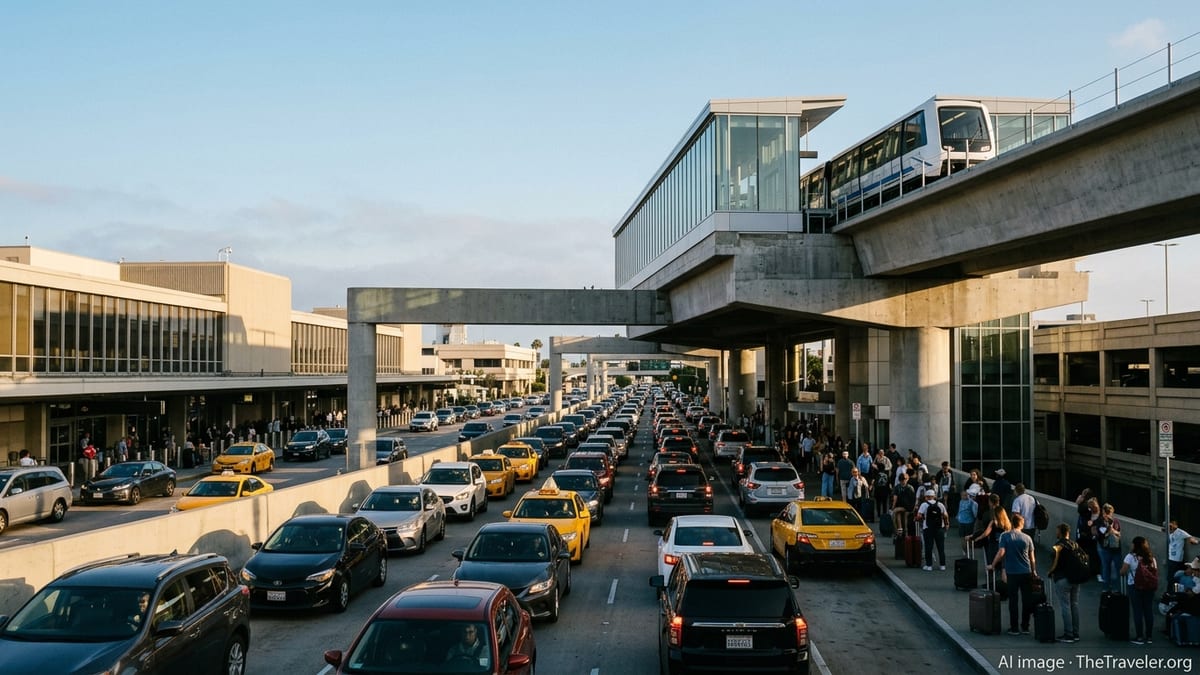
A Train Meant to End Gridlock That Still Is Not Running
The Automated People Mover at Los Angeles International Airport was sold as the signature fix for some of the worst airport traffic in the United States. The 2.25‑mile elevated train is designed to link every terminal with a massive consolidated rental car center, new parking structures and a Metro rail hub, taking tens of thousands of car and shuttle trips off the loop every day. Yet in early 2026, the system is still not carrying passengers.
Publicly available project updates and news coverage show a pattern of shifting timelines. Initial plans called for the train to be operating by 2023, in time to support major events and rapid growth in passenger volumes. Subsequent disclosures from Los Angeles World Airports and bond rating agencies moved the target into 2025, then early 2026, and more recent reporting now points to a service start in the summer or even the second half of 2026. Each revision leaves Angelenos and visitors facing years more of traffic that the project was meant to relieve.
The rolling delays have concrete consequences. LAX handled tens of millions of passengers last year, and the central terminal loop remains choked with ride-hail vehicles, rental car shuttles and private cars. A new consolidated rental car center opened off-site in March 2026, but without the train link it relies heavily on buses, compounding congestion on already strained roads between the 405 freeway and the terminals.
Cost Overruns, Contract Disputes and Missed Milestones
The People Mover’s troubles extend beyond slipping dates. The public record shows a project that has grown markedly more expensive and contentious over time, with disputes between Los Angeles World Airports and the construction consortium contributing to delay. Coverage in regional outlets has detailed contract arbitrations that assigned hundreds of days of delay to the airport owner and awarded tens of millions of dollars in damages to the builders, citing issues such as late integration with airport communications systems.
Oversight bodies have approved several rounds of additional spending. In recent years, Los Angeles airport commissioners and the City Council signed off on hundreds of millions of dollars in extra payments and contract amendments, described in official summaries as necessary to resolve claims and keep the work moving. Those actions pushed the project’s total cost well beyond initial estimates, aligning LAX with a pattern seen at other large U.S. infrastructure efforts where complex contracts, design changes and technology integration challenges translate into higher bills for public agencies.
Credit rating agencies have also taken notice. Reports from firms such as Fitch Ratings have cited the People Mover’s prolonged construction, strained working relationships and repeated schedule extensions as risk factors. The system is now widely described in public disclosures as years late and over budget, with no firm passenger opening date and lingering questions about the pace of remaining testing and safety certifications.
Passengers Caught Between Construction and Congestion
For travelers, the gap between promise and reality is felt curbside. LAX has been operating amid an unprecedented construction program, with terminal remodels, roadway realignments and preparations for the 2026 FIFA World Cup and 2028 Olympic and Paralympic Games all underway. The People Mover is a central pillar of that plan, meant to provide a predictable, rail-based spine from which the rest of the airport’s access system would function.
Instead, visitors still rely on a patchwork of buses, shuttles and ride-hail pick-up zones. Publicly available traffic reports from Los Angeles World Airports describe heavy peak-period congestion around the central terminal loop, even as some roadway improvements have come online. Ride-hail staging areas and the interim “LAXit” lot have helped manage flows, but they add an extra transfer for many passengers, along with time and uncertainty that a rail link was supposed to eliminate.
Airlines and tourism businesses are watching closely. Major global events are expected to bring a surge of international visitors to Southern California, and smooth transfers from plane to city are a critical part of that experience. If the People Mover does not open until late 2026, as some coverage now suggests, the system may miss the World Cup and arrive only after several of the marquee moments that originally justified its accelerated timeline.
A Test Case for Record Federal Airport Spending
The LAX delays unfold against a national backdrop of unprecedented federal investment in airport infrastructure. The Bipartisan Infrastructure Law directs roughly 20 billion dollars to U.S. airports over several years, through a mix of formula funds and competitive grants for terminals, ground access and safety upgrades. Fact sheets from the U.S. Department of Transportation highlight projects from Pittsburgh to smaller regional hubs that are rebuilding concourses, expanding gates and improving passenger circulation.
Supporters argue that this wave of spending will finally tackle chronic bottlenecks, from outdated terminals to crowded curb fronts. Many airports are replacing patchwork shuttle networks with more direct rail links, consolidated rental car facilities and redesigned roadway systems. In theory, projects like the LAX People Mover are exactly what this funding era is meant to deliver: high-capacity, low-emission connections that move travelers swiftly between planes, parking, transit and the surrounding region.
Yet LAX’s experience illustrates how money alone does not guarantee quick relief. Complex governance structures, multi-party contracts and the need to coordinate with separate transit agencies can slow even well-funded schemes. In Los Angeles, the People Mover must integrate with a new Metro rail station, city streets and an evolving terminal footprint, each with its own schedule and technical demands. When any piece lags, the entire system is affected.
Will LAX’s Pain Lead to Smarter Airport Projects?
As the elevated guideway looms over the airport loop, the People Mover has become a visible symbol of both ambition and frustration. To some travelers, the idle train sets seen during testing runs have come to represent promised relief that never quite arrives. For planners and policymakers, the project now serves as a case study in how schedule risk, contract structure and technology integration can shape the real-world impact of big infrastructure investments.
There are signs that lessons are being absorbed. Industry conferences and professional publications increasingly focus on delivery models, risk allocation and contingency planning for airport projects, often pointing to LAX as a cautionary tale. Some newer efforts around the country are emphasizing phased openings, simpler alignments and clearer responsibilities between airport owners, transit agencies and private partners in an effort to avoid similar spirals of delay and dispute.
For now, though, the lived reality at LAX is that the marquee train intended to tame its notorious traffic remains a work in progress. Whether the eventual opening of the Automated People Mover will feel like a turning point for U.S. airport access, or simply a late and costly attempt to catch up, will depend on how smoothly it operates once passengers finally step aboard, and on whether other airports can translate today’s historic spending into projects that open on time and deliver the congestion relief travelers have been promised.