

More news on this day
United Airlines is poised to accelerate fleet growth and deepen its focus on high‑yield travelers, according to a leaked internal strategy deck that outlines an aggressive expansion of widebody aircraft, premium seating and capacity shifts across key U.S. hubs through 2027.
Get the latest news straight to your inbox!
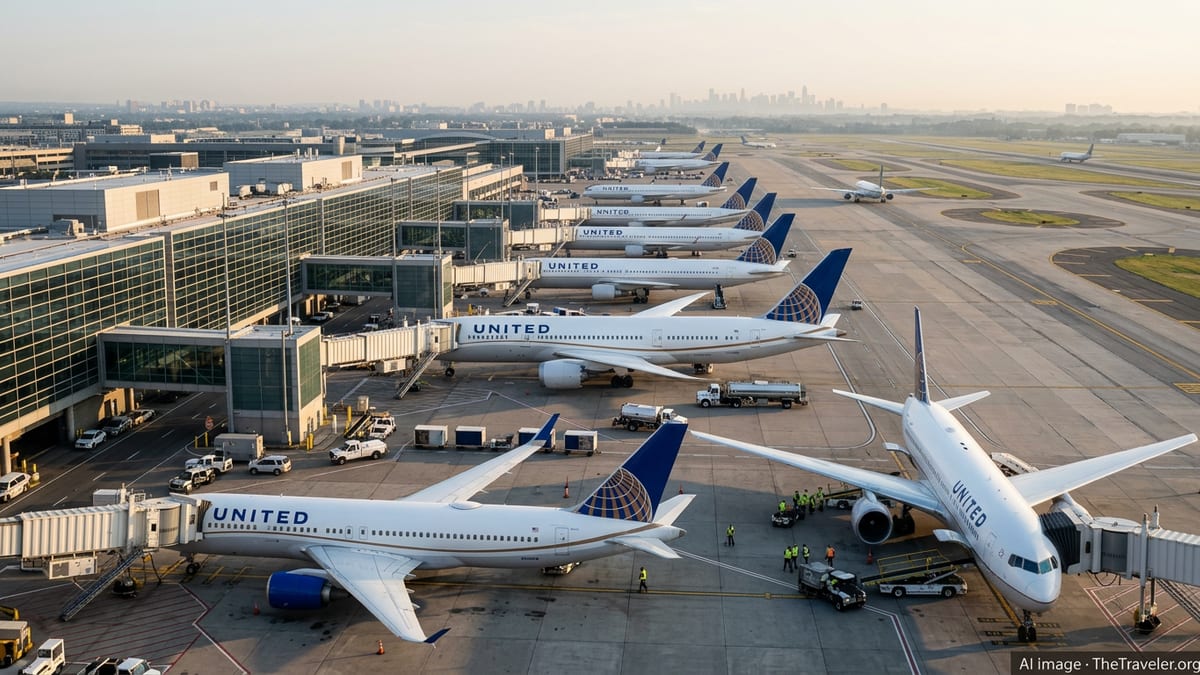
Internal Slides Point to Larger Fleet and Wider Domestic Footprint
The leaked presentation, shared with managers in early 2026, details plans for United to grow its mainline fleet faster than previously signaled, leaning heavily on incoming Boeing 787 deliveries and the redeployment of large 777 widebodies on select U.S. routes. The deck indicates that United expects more than 100 new aircraft to arrive in 2026 alone, a figure that would give the company one of the most aggressive fleet growth profiles in the North American market.
Those aircraft are central to what executives describe in the document as the next phase of the United Next plan. After several years of rebuilding its schedule, the airline intends to shift from simply restoring capacity to actively outgrowing rivals in strategic coastal and midcontinent hubs, particularly San Francisco, Los Angeles, Newark, Chicago and Washington Dulles. The deck highlights that United already operated the largest mainline schedule in its history in 2025 and aims to build on that base with additional flying in 2026 and 2027.
Much of the incremental lift will come from upgauging rather than opening many new stations. The slides emphasize that new widebodies and larger narrowbodies will replace smaller jets in trunk markets, an approach United believes will unlock better unit costs while creating room for a higher share of premium seats. Executives argue in the document that this strategy positions the airline to gain share in business and high-spend leisure segments even if overall domestic demand growth moderates.
Premium Seats at the Center of United’s Revenue Strategy
The leaked deck underscores that premium cabins are no longer a niche but a core revenue pillar for United. Internal figures presented to managers show that in 2025 the airline flew a record number of premium seats and that those products significantly outperformed standard economy in revenue growth. The document states that premium seats accounted for a growing double‑digit share of United’s total capacity and an even larger share of passenger revenue.
Slides summarizing the airline’s performance show premium revenue rising at several times the pace of basic and standard economy. That outperformance underpins United’s push to add more business and premium economy seats to both new and existing aircraft. The strategy deck references internal targets to keep expanding the share of premium seating across the fleet through at least 2027, even as overall capacity continues to climb.
A key component of that push is United Elevated, the new long‑haul interior built around Polaris Studio suites on Boeing 787‑9 aircraft. The deck reiterates previously announced plans for at least 30 787s with the elevated interior to join the fleet by 2027 and adds fresh detail about how those jets will be rotated through premium‑heavy domestic and international routes. For network planners, the goal is clear: make more of the seats on United’s biggest aircraft high-yield and ensure they are flying in markets where travelers are willing to pay for them.
Widebody Jets Move into Domestic Trunk Markets
One of the clearest signals in the leaked materials is United’s intention to keep using its largest widebodies on select long-haul domestic routes. Internal route analyses reproduced in the deck highlight the strong revenue performance of Boeing 777-300ER deployments on high-demand U.S. city pairs, particularly those connecting coastal technology and financial centers.
United has increasingly scheduled these aircraft, typically associated with transoceanic flying, on domestic services where premium demand is deep enough to support a large cabin of business and extra-legroom seats. The internal deck notes that on some of these routes roughly one quarter of passengers sit in seats outside standard economy, a ratio the airline sees as a template for future domestic deployments of both 777s and newly delivered 787s.
According to the strategy slides, this pattern is expected to extend further in 2026 and 2027 as new widebodies arrive. United plans to use them to reinforce key hub‑to‑hub flows and high-frequency business markets, while older widebodies are shuffled into other long‑haul roles or retired. The approach reflects what executives describe in the deck as a premium‑first mindset in domestic scheduling, with aircraft assignments increasingly driven by cabin mix and yield potential rather than just raw seat count.
Hub Growth and Competitive Positioning Across the U.S.
The internal deck places United’s fleet and cabin moves squarely within a broader battle for premium dominance in the U.S. aviation market. Slides comparing the three large network carriers frame the company’s strategy as a bet that there will ultimately be room for only a small number of truly premium U.S. airlines, with United seeking to be among them by concentrating growth in the country’s largest corporate and high-income catchment areas.
Chicago O’Hare, San Francisco, Newark and Houston figure prominently in the document as hubs where United intends to deepen its schedule and leverage improved operational performance. At O’Hare, internal performance metrics cited in the deck highlight industry-leading completion and on-time rates in 2025, which executives see as a foundation for adding more departures in peak summer periods. On the West Coast, San Francisco is positioned as the centerpiece of long-term growth, backed by an extensive terminal modernization program and increased capacity on both domestic and transpacific routes.
The deck also touches on the impact of United’s strategy on low-cost and ultra-low-cost competitors. By pairing larger aircraft with basic economy fares in the back and upgraded products up front, United aims to defend price-sensitive travelers while steering higher-spend customers into premium cabins. The combination, management argues in the slides, allows the airline to pressure budget rivals on price in overlapping markets without sacrificing yield at the top of the cabin.
Risks, Boeing Uncertainty and the Road Ahead
Despite the confident tone of much of the presentation, the leaked deck acknowledges a series of risks that could complicate United’s ambitions. Chief among them are ongoing manufacturing and certification issues at Boeing, particularly around the 737 MAX program, which the slides note could force adjustments to capacity plans or require short-term leases of replacement aircraft at higher cost.
The document also flags broader economic uncertainty, geopolitical tensions and the potential for swings in fuel prices as variables that could pressure margins even as the fleet grows. United’s leadership emphasizes in the deck that the company intends to retain flexibility in its order book and maintain a focus on balance sheet strength, arguing that a solid financial position will be critical if growth needs to be paced differently than currently envisioned.
For now, though, the leaked strategy materials paint a picture of an airline doubling down on scale and premiumization across the U.S. aviation landscape. With more widebodies on order than any of its domestic rivals and a growing share of premium seats built into its fleet, United appears determined to use the next several years to cement its status as a premium-first network carrier, reshaping both its own cabin mix and the competitive dynamics on some of the nation’s most important routes.