

More news on this day
Czech private operator Leo Express has officially launched regular services on Poland’s key Warsaw–Krakow corridor, inaugurating a new open-access rail link that also extends to Prague and intensifies competition on one of the country’s busiest routes.
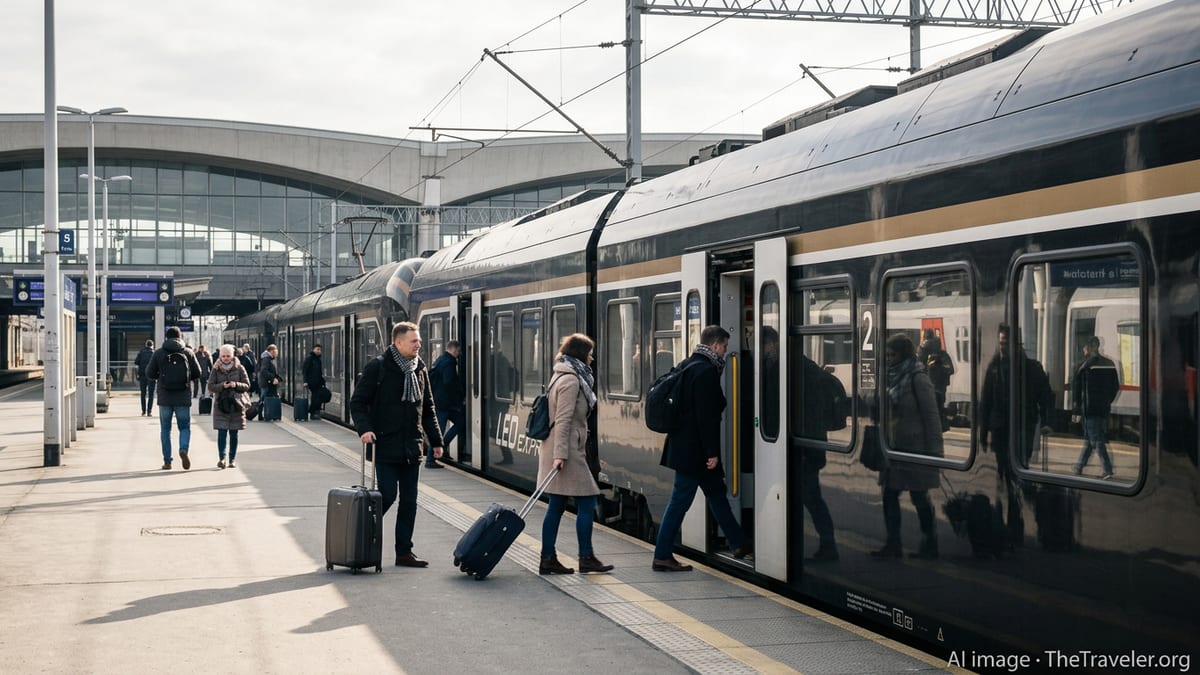
New Domestic Service Connects Poland’s Two Largest Cities
The first Leo Express train on the Warsaw–Krakow route departed on Sunday 1 March 2026 from Warsaw Wschodnia, marking the company’s entry onto Poland’s most strategic domestic rail corridor. The service, which currently operates two round trips per day, runs via Warsaw Centralna and Warszawa Zachodnia before heading south through Opoczno Południe and Włoszczowa Północ to Krakow Główny.
From Krakow, the train continues across the border through Ostrava, Olomouc and Pardubice, providing a through connection to Prague and creating a new international rail axis that links the Polish capital with the Czech capital in around nine hours and twenty minutes. The Warsaw–Krakow segment takes approximately two hours and forty-five minutes, positioning the new trains as a competitive alternative to existing domestic services.
Leo Express is entering a corridor already served by incumbent operator PKP Intercity and, more recently, Czech rival RegioJet. Its management describes the Warsaw–Krakow launch as a key step in a broader push to expand open-access passenger services in Poland and to connect the country more tightly with neighboring Central European markets.
The company has framed the Polish expansion as part of its long-term strategy of offering cross-border services that can compete on both price and onboard experience. By linking Warsaw, Krakow and Prague on a single through train, Leo Express is targeting both point-to-point domestic travelers and international passengers looking for an alternative to air and coach travel.
Timetable, Frequencies and Summer Expansion Plans
In the initial phase, Leo Express is offering two daily frequencies in each direction between Warsaw and Krakow, paired with onward services to and from Prague. Morning departures are timed to allow travelers from the Polish capital to reach Krakow before midday, while evening trains make it possible to complete same-day round trips for business or leisure.
The operator has already outlined plans to ramp up capacity over the coming months. By late June 2026, the number of Warsaw–Krakow services is scheduled to double to four round trips per day in each direction, significantly increasing the number of available seats on the corridor and broadening options for flexible travel throughout the day.
On the international leg, the company is also boosting its Krakow–Prague offer. The long-distance route, which has been part of the Leo Express network for several years, will see up to four daily connections as new services are added and integrated with the Warsaw trains. This should make it easier for passengers to plan short city breaks or longer itineraries spanning multiple Central European capitals.
Industry observers note that the stepped build-up of services reflects both strong demand and the operational complexity of adding new open-access trains to already busy rail infrastructure. The gradual increase in frequencies also gives Leo Express scope to fine-tune its schedule to match passenger flows between Poland and the Czech Republic.
Pricing, Comfort and Onboard Experience
Leo Express is attempting to differentiate its new Polish offer through a mix of aggressive pricing and upgraded onboard amenities. Promotional fares on the Warsaw–Krakow service have appeared from as low as the equivalent of a few euros in economy class, undercutting many conventional long-distance tickets on the route. Average prices remain higher than the most heavily advertised discounts but still compare favorably with standard fares on incumbent operators.
On board, passengers are offered 5G Wi-Fi, at-seat catering and a menu that blends Czech and Polish favorites with international options. Hot and cold snacks, including dishes such as Polish sour rye soup and hot dogs alongside items like sushi, are served directly to passengers’ seats, with pricing aimed at remaining accessible to a broad range of travelers.
The company markets four distinct travel classes, ranging from standard economy to a top-tier Premium Sleeper product. In the highest class, seats can be reclined fully flat, a feature designed primarily for longer overnight journeys on the Prague-bound services but also available to domestic passengers seeking extra comfort and privacy.
Leo Express positions the overall offer as an upgrade over traditional long-distance rolling stock, particularly on routes where older locomotives and carriages remain common. The operator is deploying modern multiple-unit trains with air conditioning, power outlets and low-floor access, seeking to appeal to both frequent business travelers and younger passengers who expect a high level of digital connectivity.
Competitive Pressure on Poland’s Rail Market
The arrival of Leo Express on the Warsaw–Krakow line further intensifies competition in a market that has already seen the entry of another Czech challenger, RegioJet. Since late 2025, the two private operators have been steadily adding services on key Polish corridors, placing pressure on PKP Intercity at a time when demand for long-distance rail travel continues to grow.
Analysts point out that the additional capacity and lower promotional fares are likely to benefit passengers in the short term, particularly on busy weekends and holiday periods when trains on the corridor often sell out. Travelers can now choose between a wider range of departure times, onboard standards and pricing models, including dynamic fares that reward early booking.
The competition also has a strategic dimension. By linking Warsaw and Krakow directly to Prague and, in future, to destinations as far as Frankfurt and the Ukrainian border, Leo Express is positioning itself as a key player in emerging north-south rail corridors across Central Europe. This cross-border focus distinguishes it from some domestic-only services and aligns with broader European ambitions to shift more travelers from planes and cars to rail.
For Poland’s rail sector, the new services raise questions about capacity allocation, pathing on busy main lines and the role of open-access operators alongside state-backed public service contracts. Regulators and infrastructure managers will be closely watching how the added trains affect punctuality and network performance on routes that are already among the most heavily used in the country.
Backed by Renfe, With Bigger European Plans Ahead
Leo Express’s expansion in Poland comes with the backing of Spanish state railway operator Renfe, which acquired a 50 percent stake in the Czech company in 2021. Since then, Leo Express has shifted from losses to profitability and significantly increased both revenues and passenger numbers across its network in the Czech Republic, Slovakia and Poland.
The Warsaw–Krakow launch is part of a wider growth strategy that includes new services between Prague and Bratislava and, from June 2026, a long-distance route linking Frankfurt with Przemyśl on the Polish-Ukrainian border via Krakow and Prague. At more than 1,300 kilometers, that train is expected to be among the longest continuous passenger services in Europe.
In parallel, Leo Express is preparing to introduce new Talgo trainsets on selected routes, offering fully low-floor access and higher capacity. These additions are intended to support both domestic and international expansion and to maintain a consistent onboard standard as the network grows.
For travelers in Poland, the most immediate impact of these broader European plans is the new Warsaw–Krakow service now in operation. If demand holds up as expected and the promised frequency increases materialize later in 2026, Leo Express could quickly become a familiar name on one of the country’s most important rail corridors, adding another layer of choice in a rapidly changing market.