

More news on this day
Private rail operator Leo Express is preparing to introduce a new Prague–Munich service in December 2026, promising a fresh cross-border link between major cities in the Czech Republic and Germany as part of a wider expansion of its Central European network.
Get the latest news straight to your inbox!
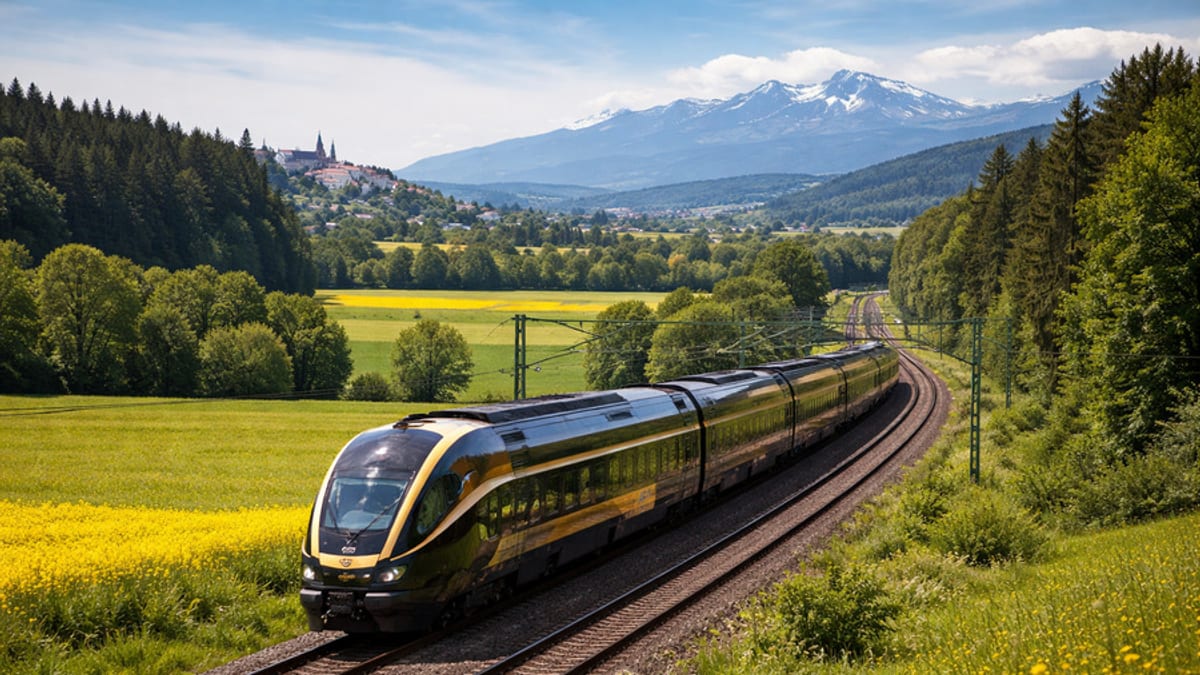
Image by Travel And Tour World
A New Chapter for Prague–Munich Rail Travel
The planned Prague–Munich connection would restore a direct rail option on one of Central Europe’s busiest leisure and business corridors, where passengers have recently faced a mix of construction disruptions and changing operators. Existing services between the two cities often require one or more changes, with sections of the route subject to temporary replacement buses and timetable adjustments.
Publicly available planning documents and industry coverage indicate that Leo Express is positioning the new line as part of a broader push to link major regional hubs with frequent, modern services. The Prague–Munich corridor fits into that strategy by tying together the Czech capital with Bavaria’s largest city and several intermediate regional centers.
While detailed timetables and exact departure times have not yet been released, the target start in December 2026 would align with the annual Europe-wide timetable change that traditionally takes place in mid-December. That timing would make it easier to integrate the new Prague–Munich trains into long-distance and regional connections on both sides of the border.
Reports suggest that the connection is expected to operate daily, giving travelers a new option alongside existing services run by national operators and other private companies. The service would add competitive pressure on the corridor and could encourage upgrades to rolling stock and onboard amenities.
Connecting Key Cities Across Czechia and Germany
The future Prague–Munich trains are likely to mirror the historic rail axis between the two cities, linking Prague with western Bohemia, the Bavarian Forest region and onward to Munich. Intermediate hubs on current routes between the capitals typically include Plzeň in the Czech Republic and Regensburg in Germany, both important junctions in their respective national networks.
Industry analysis notes that Leo Express has been steadily assembling a mesh of cross-border routes that connect Prague with Kraków, Warsaw, Bratislava and, from June 2026, with a long trans-European line between Przemyśl near the Ukrainian border and Frankfurt and Frankfurt Airport. Adding Munich to this map would extend the company’s footprint deeper into southern Germany and offer new one-change itineraries across Central Europe.
For travelers, the new link would create additional options for journeys such as Munich to Kraków or Warsaw with a single change in Prague, and Prague to southern Germany with a single operator across much of the route. It would also improve access between Bavaria and secondary Czech cities connected to the Leo Express network, particularly in Moravia and eastern Bohemia.
The connection is expected to appeal not only to international visitors but also to cross-border commuters, students and business travelers who move regularly between Czechia and Bavaria. Rail remains a popular choice in the region thanks to city-center stations, relatively short travel times and growing awareness of lower-carbon transport.
Fleet, Comfort and Onboard Services
Public information about Leo Express operations on other routes offers a guide to what passengers could expect on the Prague–Munich line. The operator typically deploys modern multiple units with air conditioning, power sockets at seats, free Wi-Fi and a choice of seating classes, including a higher-comfort section on some trains.
On existing international services, ticketing is designed to be dynamic, with promotional fares available for early bookings and higher prices closer to departure. Observers expect a similar model for the Prague–Munich trains, which could make rail competitive with long-distance buses and low-cost airlines on price, especially when factoring in the convenience of city-center arrivals.
Leo Express has highlighted improvements in its wider 2026 timetable, including the use of upgraded or newly refurbished rolling stock on some long-distance links. Travel media coverage of the company’s recent expansion into Germany and Poland notes an emphasis on Wi-Fi connectivity, at-seat service and online booking tools, all features that are likely to be replicated on the Prague–Munich route.
Given the importance of the corridor for international tourism, particularly between Bavaria and Prague, travel industry watchers will be watching closely to see whether the new trains offer additional baggage space, family seating areas or enhanced catering, all of which can be decisive factors for leisure travelers choosing between competing modes.
Tapping Into Tourism and Cross-Border Demand
The Prague–Munich corridor carries a steady flow of visitors in both directions, including city-break tourists, backpackers and organized tour groups. Prague remains one of Europe’s most visited capitals, while Munich is a major gateway to the Alps and home to large-scale events that draw international crowds.
Tourism data and previous transport studies for the region show that demand on this axis is heavily seasonal, with peaks around major holidays, summer travel and events such as festivals and trade fairs in southern Germany. A new December 2026 start would place the service in time for the winter season and the following year’s summer peak, giving the operator an early opportunity to capture travelers planning multi-country trips.
Travel planners point out that a competitive, reliable rail option between Prague and Munich could also divert some passengers from highways and short-haul flights, supporting broader European objectives to shift more journeys to rail. The new connection would join a series of recent and upcoming long-distance routes in Central Europe that aim to make train travel more attractive through improved comfort and direct services.
By integrating Munich into its growing network, Leo Express stands to benefit from through-ticketing and multi-leg itineraries, such as combining a Prague–Munich journey with onward high-speed trains deeper into Germany, Austria or Switzerland. For passengers, that could translate into smoother, predominantly rail-based journeys across several countries.
Part of a Wider 2026 Expansion Strategy
The planned Prague–Munich line sits alongside a raft of other timetable developments for 2026. Published schedules and company communications show that Leo Express is preparing new services from Prague via Olomouc to Bratislava, expanded operations between Kraków and Warsaw and a major trans-European corridor linking Przemyśl, Kraków, Ostrava, Prague, Dresden, Leipzig, Erfurt, Frankfurt and Frankfurt Airport.
These additions mark a notable shift from the company’s early years, when it focused primarily on domestic Czech routes and a limited number of cross-border connections. The emerging network increasingly resembles a web of international corridors that intersect in Prague and extend toward Germany, Poland, Slovakia and, indirectly, Ukraine.
Transport analysts note that the broader liberalization of European passenger rail markets has opened the door for private operators to launch new long-distance services on key corridors. The proposed Prague–Munich route would be another example of this trend, introducing additional competition and potentially spurring further innovation in pricing, onboard service and scheduling.
With the December 2026 launch still ahead, details on journey times, exact stopping patterns and rolling stock for the Prague–Munich trains remain to be finalized. However, the line already appears poised to become an important link in Leo Express’s expanding Central European network, further knitting together some of the region’s most significant urban and economic centers.