

More news on this day
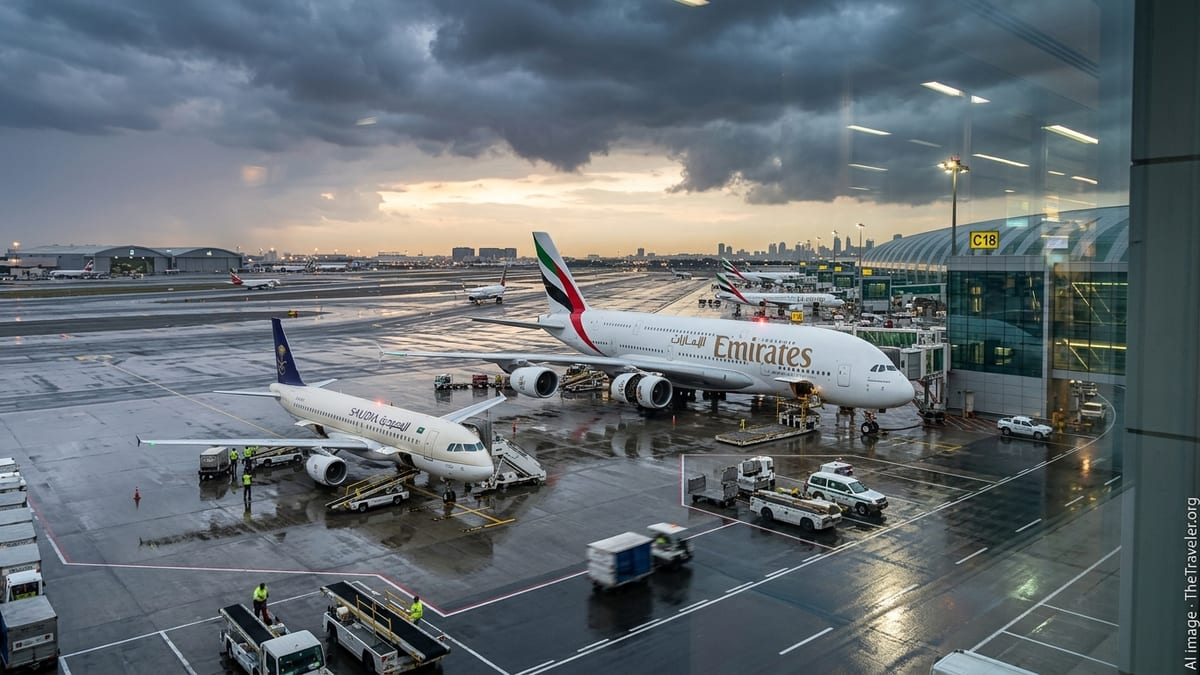
Extensive structural evaluations are reported to be underway on Emirates and Saudia aircraft at Dubai International Airport after lightning strikes during recent severe weather, adding a fresh layer of operational scrutiny at one of the world’s busiest international hubs.
Get the latest news straight to your inbox!
Severe Weather Adds to Operational Strain at Key Gulf Gateway
Dubai International Airport has already been operating under significant stress in recent weeks, with shifting regional security conditions and intermittent flight disruptions affecting passenger flows across the Gulf. Against that backdrop, a bout of intense thunderstorms over the emirate, accompanied by frequent lightning, has added a new operational challenge for carriers based at the airport.
Publicly available information from aviation tracking platforms and regional media coverage indicates that at least one widebody Emirates aircraft and a narrowbody jet operated by Saudia were subjected to suspected lightning impacts while on the ground or during approach and departure phases at Dubai International. The incidents coincided with storm activity over the airport, where towering cumulonimbus cloud formations and rapidly changing wind conditions were recorded.
While lightning encounters are not uncommon in commercial aviation, their occurrence at a time when Gulf airspace and airport operations are already under heightened scrutiny has focused additional attention on how aircraft are assessed and returned to service. The situation at Dubai International, a critical connecting hub linking Asia, Europe and Africa, is being closely watched by airlines, regulators and travelers alike.
Focus on Structural Integrity and Damage Assessment
Reports from aviation analysts and regional transport coverage indicate that both the Emirates and Saudia aircraft involved have been moved into detailed inspection programs concentrating on structural integrity and external skin damage. These evaluations typically involve methodical checks of the fuselage, wings, tail surfaces and control structures for any evidence of arcing, burn marks, or panel deformation associated with high-energy lightning currents.
Industry maintenance references describe how lightning can follow conductive pathways along an airframe, exiting at extremities such as wingtips or the vertical stabilizer. Even when passengers and crew are not directly endangered due to aircraft design, the resulting localized heating can affect composite structures, antenna housings, and fastener lines. As a result, technicians often employ non-destructive testing techniques such as eddy current scanning and ultrasonic inspection to probe beneath the visible surface.
For a large hub carrier such as Emirates, any unexpected removal of widebody aircraft from rotation can have knock-on effects across a global network. In Saudia’s case, the grounding of a narrowbody jet that supports regional connectivity may affect short-haul schedules in and out of the United Arab Emirates and neighboring states. Available fleet and schedule data suggest that both airlines are adjusting equipment allocations and swapping aircraft types on select routes while inspections continue.
Passenger Impact and Operational Adjustments
Passenger accounts on social media and aviation forums describe isolated delays and aircraft changes on flights linked to Dubai International in the wake of the lightning incidents. In several cases, travelers reported last-minute gate changes and equipment substitutions, reflecting how dispatch teams reassign aircraft to maintain schedules while affected jets undergo engineering checks.
Publicly shared operational updates from the wider region show that carriers have already been reworking timetables in response to broader airspace uncertainty and intermittent airport capacity constraints. The addition of weather-related inspections has reinforced a pattern of rolling adjustments, with some long-haul services retimed and regional sectors consolidated where load and slot availability permit.
Despite these challenges, the overall structure of Dubai International’s operations appears to remain resilient. Available data from flight-tracking dashboards indicates that the majority of scheduled departures and arrivals continue to operate, albeit with elevated levels of delay and occasional diversions. Travelers transiting the hub are being advised through public travel advisories and airline notifications to monitor flight status closely and allow additional connection time.
Lightning Risk Management in Modern Commercial Aviation
The reported evaluations of the Emirates and Saudia aircraft at Dubai International highlight established industry procedures for managing lightning exposure in modern fleets. Aircraft manufacturers integrate lightning protection measures into both metallic and composite structures, including conductive meshes, bonding straps and specifically engineered strike points intended to channel current safely around the cabin and critical systems.
Maintenance and engineering manuals set out strict inspection criteria whenever a lightning encounter is suspected. These criteria typically cover radomes, wing leading edges, flap track fairings, APU housings and static discharge wicks, along with avionics antennas and external sensor probes. Even minor cosmetic damage, such as small burn marks in paint or local scorching around fasteners, can trigger follow-up checks to verify that underlying materials have not been compromised.
Industry safety statistics compiled over many years show that commercial airliners routinely withstand lightning strikes without compromising flight safety. However, the combination of high traffic density, complex weather patterns and the concentration of widebody aircraft at hubs such as Dubai International means that operators must maintain particularly robust inspection regimes. The intensified checks on the Emirates and Saudia aircraft fit within that broader framework of risk management.
Implications for Gulf Hubs and Future Travel Planning
The confluence of severe weather, regional tensions and heavy travel demand is reshaping expectations for reliability at Gulf aviation hubs. The structural evaluations now underway on the Emirates and Saudia aircraft serve as a visible reminder that even relatively routine events such as lightning encounters can have outsized operational effects when they occur in an already stressed environment.
For travelers, the evolving situation underscores the value of flexibility and contingency planning when routing through major connection points in the region. Public guidance from travel advisors and airline customer communications increasingly emphasizes booking longer minimum connection times, remaining alert to schedule changes, and considering alternative routings through secondary hubs if itineraries are particularly time-sensitive.
From an infrastructure perspective, the incidents at Dubai International are likely to reinforce ongoing investment in weather monitoring, apron surveillance and stand allocation systems that can respond quickly to both meteorological and security-related disruptions. As Gulf airports continue to expand their roles as global transit nodes, the ability to absorb shocks from lightning impacts, regional conflicts or other external pressures will remain central to their long-term competitiveness in international travel.