

More news on this day
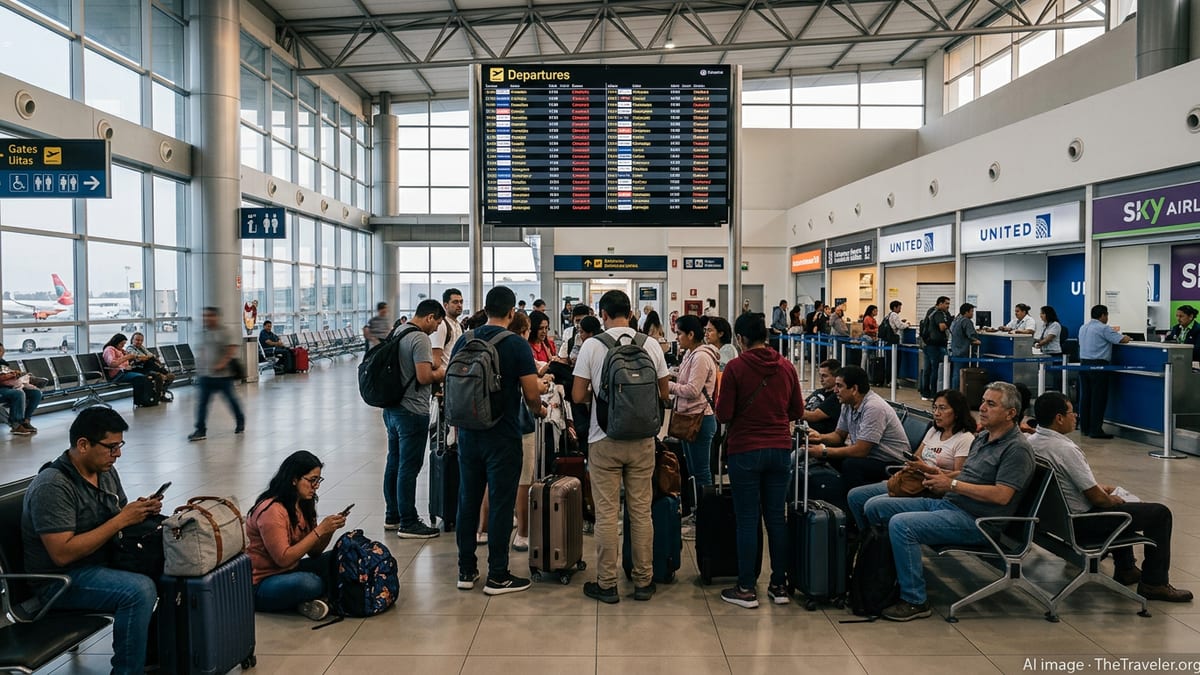
Hundreds of travelers were left scrambling at Lima’s Jorge Chávez International Airport this week after United Airlines and Sky Airline abruptly canceled two key flights, severing a major international link to Houston and a critical domestic route to Arequipa and triggering fresh disruption across Peru’s already strained air network.
Get the latest news straight to your inbox!
Key Houston and Arequipa Links Abruptly Cut
The latest wave of disruption centered on two pivotal services from Lima: United’s nonstop to Houston, a primary gateway for Peruvian travelers connecting to North America, and Sky Airline’s Lima–Arequipa service, which forms part of the low-cost backbone for domestic mobility in southern Peru. Passengers arriving at Jorge Chávez expecting routine departures instead encountered sudden cancellations, long queues and limited information.
United’s Lima–Houston flights are widely used by a mix of business travelers, families visiting relatives in the United States and tourists combining Peru with onward destinations via George Bush Intercontinental Airport. The loss of a single rotation can quickly ripple through connections, as many itineraries are built around that overnight or early-morning segment. Travelers reported rebookings stretched over one or two days as seats on alternative services filled rapidly.
On the domestic front, Sky Airline’s canceled Lima–Arequipa flight cut a crucial link between the capital and one of Peru’s most important tourism and economic hubs. Arequipa, already dealing with recent infrastructure strains and weather-related challenges across the wider region, relies heavily on frequent, competitively priced services from Lima. With one of the main low-cost options suddenly off the board, passengers faced either long wait times for rebooking or expensive last-minute fares on competing carriers.
While other departures from Jorge Chávez continued operating, the twin cancellations underscored how vulnerable Peru’s air network remains to even isolated disruptions, especially when they hit routes that double as major connection points.
Passengers Stranded, From Desert Cities to Andean Hubs
The immediate effect was visible in Lima’s terminals, where lines at airline counters lengthened as travelers sought clarity on rebooking, vouchers and accommodation. But the impact quickly spread beyond the capital, leaving would-be flyers stuck in cities across the country when their onward Lima connections no longer matched available international or domestic departures.
Travelers in southern Peru, including those in Arequipa and nearby desert and Andean towns, reported being forced to extend hotel stays, rearrange tours or undertake overnight bus journeys as a fallback. For some, particularly those connecting from Cusco or Juliaca to reach Lima before heading on to Houston, a missed link meant losing an entire day of travel and incurring unplanned costs for food and lodging.
Tour operators in Arequipa and the Colca Canyon region said late-notice schedule changes were complicating itineraries for international visitors who often have tight windows between trekking, sightseeing and fixed long-haul flights home. With United’s Houston service affected, some North American travelers were re-routed via other hubs such as Bogotá, Panama City or Mexico City, adding extra stops and longer total journey times.
Domestic passengers, including students, medical travelers and small-business owners moving between Lima and regional centers, faced their own setbacks. Many had booked Sky Airline months in advance to secure lower fares, only to confront limited alternatives at short notice, with peak-time departures on other airlines already heavily booked.
Operational Strains and a Changing Airport Landscape
The cancellations have landed at a delicate moment for Jorge Chávez International Airport, which is navigating a complex transition as new infrastructure comes online and airlines adjust to revised operational constraints and costs. Recent changes to airport user fees and the progressive shift of operations toward the new terminal have already prompted several carriers to reassess routes in and out of Lima, trimming marginal services and consolidating capacity.
Industry analysts note that even when headline schedule cuts are modest, day-of-operation disruptions can be amplified by tight fleet utilization, crew positioning issues and air traffic control constraints. A delayed inbound aircraft can cascade into an outbound cancellation, particularly on long-haul and high-demand domestic sectors where spare aircraft or crew are limited.
United Airlines and Sky Airline have not published detailed explanations for these specific cancellations, beyond standard references to operational reasons. However, recent months have seen carriers across South America grappling with everything from adverse weather in the Andes to regulatory shifts and infrastructure works at key airports, all of which can compress buffers in their schedules.
For Lima, which functions both as Peru’s main international gateway and as a central hub for domestic connections, any disruption at a high-traffic bank of flights can quickly expose those structural vulnerabilities, stranding travelers who rely on tight transfer windows to stitch together complex itineraries.
What Affected Travelers Are Being Offered
Passengers booked on the canceled United and Sky Airline flights have been offered standard options including rebooking on later services, refunds or, in some cases, rerouting via third-country hubs. At Jorge Chávez, airline staff have been working through long lists of affected travelers, prioritizing those with imminent long-haul connections or essential travel needs such as medical appointments.
Some United passengers bound for Houston have been moved to later departures or shifted onto services connecting through other North and Central American airports. Where same-day travel proved impossible, travelers reported receiving hotel vouchers and meal coupons, although availability has varied by fare type and travel insurance coverage.
On the domestic side, Sky Airline has been attempting to accommodate Lima–Arequipa passengers on subsequent flights where seats are available, or offering refunds and credit for future travel. Nevertheless, with Arequipa flights often operating near capacity in peak periods, many travelers have had to accept substantial time shifts or look to alternative airlines, which may not honor the original low-cost fare.
Consumer advocates in Peru continue to urge passengers to document all expenses tied to disruptions, from extra nights in hotels to ground transport between airports and city centers, to support later claims with airlines or travel insurers. They also emphasize the importance of understanding local passenger-rights regulations, which can entitle travelers to compensation or assistance depending on the cause and length of disruption.
How to Protect Upcoming Trips Through Lima
For travelers with upcoming plans involving Lima, Houston or Arequipa, recent events are a reminder to build additional flexibility into itineraries. Travel planners recommend allowing longer connection times in Lima, particularly when pairing a domestic arrival with an overnight or early-morning international departure, and avoiding last flights of the day when possible.
Booking through a single airline or alliance for multi-leg journeys can also simplify rebooking when one segment is canceled, as carriers have clearer obligations to move passengers along the entire route. Where mixed tickets are unavoidable, travelers are encouraged to leave broad buffers between separate reservations and to keep key essentials in carry-on luggage in case checked bags go astray during re-routes.
Specialists suggest that, for the coming months, travelers monitor schedule changes closely in the week leading up to departure, using both airline apps and airport notices. Given ongoing adjustments at Jorge Chávez and wider regional volatility, early awareness of any shift in departure times or aircraft type can make the difference between a smooth trip and a last-minute scramble.
Though the latest cancellations by United Airlines and Sky Airline affected only a handful of flights, the outsized disruption they caused for routes to Houston and Arequipa illustrates how finely balanced Peru’s aviation system remains. Until additional resilience is built into schedules and infrastructure, passengers transiting Lima would be wise to plan for contingencies even on seemingly routine routes.