

More news on this day
Thousands of passengers across the United States faced hours-long delays, missed connections and unexpected overnight stays after a wave of disruptions at Boston Logan International Airport spread to major hubs including Orlando, Chicago O’Hare, Washington D.C., and Tampa on February 20, snarling air travel at the peak of a busy winter week.
Logan Disruptions Trigger a Wider U.S. Travel Snarl
Operational data from February 20 show that Boston Logan International Airport recorded 82 delayed flights and 16 cancellations in a single day, a relatively modest number compared with major storm events but enough to trigger a fresh round of disruption for travelers relying on tightly timed connections. The knock-on effects quickly extended beyond New England, highlighting how even localized operational challenges at a major hub can reverberate through the wider U.S. network.
Airports in Washington D.C., Orlando, Chicago O’Hare and Tampa all reported disruptions linked to aircraft and crew out of position, as well as flow-control measures introduced to manage congestion on key routes along the East Coast. Passengers arriving from or traveling to Boston on evening departures reported missed onward flights, overcrowded gate areas and limited rebooking options as schedules tightened into the late-night hours.
While the scale of disruption did not match the historic chaos associated with recent winter storms, the timing compounded frustration. The delays came on the heels of a turbulent winter travel season that has already seen record cancellations tied to severe weather systems in January and early February, putting additional pressure on airlines still working to normalize operations ahead of the spring break surge.
JetBlue, American and Delta Bear the Brunt at Boston
According to flight-status tallies for February 20, JetBlue recorded the largest concentration of delayed services at Boston, with 26 flights running behind schedule. For the carrier, which maintains one of its most important focus-city operations at Logan, the cluster of delays snarled a web of short- and medium-haul routes linking New England with major leisure and business destinations along the East Coast and into Florida.
American Airlines and Delta Air Lines also sustained notable disruption, with American logging one cancellation and 13 delayed flights and Delta reporting 11 delays at Logan. While these numbers are far below the worst performance days seen during major winter events earlier this season, they were significant enough to exhaust slack in daily operations, creating tight turnaround times and contributing to rolling delays into the evening.
Smaller but still consequential impacts were reported among other carriers. United Airlines, Spirit Airlines and regional operator Republic Airways all reported delayed departures from Boston, with Republic alone logging more than a dozen affected flights. International services were not spared either, as long-haul carriers including British Airways, Air Canada, KLM and Korean Air reported isolated delays out of Logan, complicating connections for transatlantic and transpacific travelers.
From Boston to Washington, Orlando, Chicago and Tampa
The focal point of disruption may have been Boston, but its effects were clearly visible along some of the country’s busiest domestic corridors. Key routes between Logan and Washington D.C., particularly services into Reagan National Airport, experienced schedule slippage as aircraft arriving late from Boston forced downstream adjustments. The constrained airspace in and around the nation’s capital left airlines with limited flexibility to recover from even relatively short delays.
Orlando, one of the country’s largest leisure gateways, also felt the ripple. Flights connecting Boston with central Florida ran behind schedule, pushing back turnarounds at Orlando International Airport and tightening crew duty windows for inbound and outbound flights. Families traveling for school breaks and theme-park trips faced long lines at customer service counters and challenges securing same-day alternatives once flights fell significantly behind schedule.
Further north and west, operations at Chicago O’Hare and Tampa were similarly affected. O’Hare, already a complex hub where minor disruptions can cascade through the network, saw Boston-linked services arriving late and forcing aircraft reassignments. Tampa, a key Florida destination during the winter season, dealt with a mix of delayed Logan arrivals and knock-on impacts from earlier disruptions in the northeastern corridor, complicating schedules for carriers shuttling snowbirds and weekend travelers.
Winter Weather, Tight Schedules and a Fragile Network
The latest wave of delays and cancellations did not occur in isolation. The United States has endured an exceptionally challenging winter, marked by an extended cold wave through January and early February and multiple major winter storms that have repeatedly tested airline resilience. In late January, a powerful system swept from Texas to Maine, dumping heavy snow and ice and driving large-scale cancellations across the country. Additional storms and lingering cold followed into early February, particularly in the eastern half of the country.
For airlines, the cumulative effect of repeated disruptions has been a network that is more fragile than usual heading into late February. Equipment is still being repositioned, maintenance schedules have been compressed, and crew rosters remain under pressure after weeks of irregular operations. In that environment, even a localized spike in delays such as the one seen at Boston on February 20 can undermine the broader system, particularly on heavily trafficked corridors linking major hubs and leisure markets.
Air traffic management measures have also played a role. The Federal Aviation Administration has periodically imposed ground delays and flow restrictions at East Coast airports during periods of low visibility, light snow or congestion. While necessary for safety, these measures can further stretch airline schedules that have little built-in slack at peak times, leading to compounding delays over the course of the day.
Passenger Experience: Long Lines, Missed Connections and Limited Options
For travelers, the statistical breakdown of delays and cancellations translated into a familiar set of frustrations at terminals around the country. At Logan, passengers reported long queues at carrier service desks as they scrambled to rebook missed connections to Florida, the Midwest and international destinations. With only 16 flights canceled outright, many travelers eventually departed, but often several hours behind schedule and with rearranged itineraries.
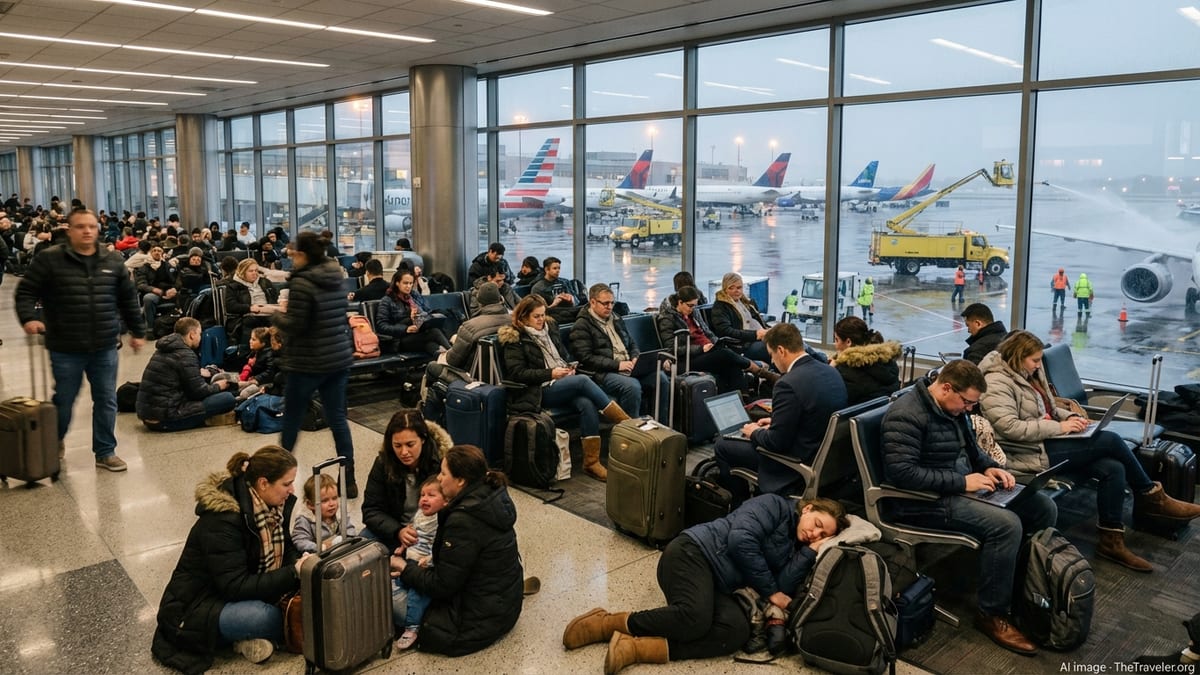
In Orlando and Tampa, stranded travelers arriving from Boston and other affected northeastern cities described congested baggage claim areas and limited hotel availability near the airport as arrival banks bunched together. Families with young children and elderly passengers faced particular challenges, with some forced to bed down in terminal seating areas when outbound flights were delayed into the early morning hours.
At Chicago O’Hare and Washington’s Reagan National, where gate space is at a premium, the ripple from late-arriving Boston flights was amplified by tight connection windows. Some passengers attempting to reach secondary cities in the Midwest and Southeast saw their regional connections depart without them, leaving only standby options on later flights or lengthy reroutes through alternative hubs.
Airlines’ Response and Efforts to Stabilize Operations
Airlines affected by the February 20 disruptions moved to contain the fallout through a combination of rolling rebookings, ticket waivers and operational adjustments. Major carriers offered passengers the ability to shift travel to alternative flights within a limited date window without change fees, particularly on routes where multiple daily frequencies provided at least some flexibility for recovery.
Operational control centers prioritized restoring core trunk routes linking Logan with other major hubs, ensuring that aircraft and crews remained aligned on the most critical connections. Where possible, airlines consolidated lightly booked flights and upgauged aircraft on others to accommodate displaced passengers, a strategy that has become increasingly common during periods of irregular operations.
Nevertheless, the effort to stabilize schedules was constrained by the broader context of an already stretched winter operation. Carriers are still contending with residual effects from earlier weather disruptions, including displaced aircraft and ongoing maintenance backlogs. Crew scheduling remains particularly sensitive, with duty-time limits leaving airlines with little margin to simply extend shifts when delays begin to accumulate late in the day.
Regional and International Knock-On Effects
The disruption radiating from Boston also affected a number of smaller regional airports in New England and beyond. Destinations such as Martha’s Vineyard and Hancock County–Bar Harbor saw cancellations and schedule adjustments as regional operators struggled to maintain feeder services into Logan. For these communities, even a handful of canceled flights can represent a significant reduction in daily connectivity, particularly outside the peak summer season.
Internationally, scattered delays on long-haul routes connected to Boston added complexity for travelers transferring through major European and Asian hubs. Late departures from Logan to London, Amsterdam and other key gateways compressed connection times for onward flights and, in some cases, forced rebookings onto later services. While the number of affected flights remained limited, the consequences were amplified for passengers undertaking multi-leg itineraries across continents.
Airports and airlines abroad monitored the situation closely, mindful of the broader pattern of U.S. winter disruptions in recent weeks. European carriers in particular have been working to buffer schedules into major American hubs to account for potential weather or air traffic management issues in the northeastern United States during the peak winter travel period.
What Travelers Can Expect in the Coming Days
With no major new storm system immediately bearing down on the East Coast, airlines and airports are cautiously optimistic that they can gradually work through the latest round of disruptions and return operations closer to normal heading into the final week of February. However, residual delays are likely to persist in the short term on select routes where aircraft and crews remain slightly out of position.
Travelers with upcoming itineraries touching Boston Logan, Washington D.C., Chicago O’Hare, Orlando or Tampa are being advised to monitor flight status closely, especially for early-morning and late-evening departures where schedules remain tighter. Industry observers also recommend that passengers build in additional buffer time for connections and consider traveling with carry-on luggage where possible to simplify rebooking if plans change at short notice.
The events of February 20 serve as another reminder of the heightened sensitivity of the U.S. air travel network during a volatile winter season. Even a relatively contained spike in delays and cancellations at a single major airport can ripple outward across the country, stranding thousands and underscoring the precarious balance airlines must maintain between efficient scheduling and operational resilience.