

More news on this day
Regional carrier Loganair is reshaping short‑haul travel from the Channel Islands, unveiling four new direct routes from Jersey to Paris, Dublin, Norwich and East Midlands that promise to tighten links between the UK and mainland Europe from summer 2026.
A Strategic Shift in Jersey’s Air Links
The announcement of new Loganair services from Jersey to Paris Charles de Gaulle, Dublin, Norwich and East Midlands marks a decisive expansion of the island’s air network at a pivotal time for regional connectivity. Following the collapse of local operator Blue Islands in 2025, Jersey’s government and tourism authorities have been under pressure to rebuild routes that support both resident travel needs and the visitor economy.
Loganair, already embedded in Jersey with services to UK regional airports, is positioning the island as a compact hub where UK and Irish travellers can access the Channel Islands and, for the first time with the airline, a major European gateway in Paris. The move also deepens the airline’s role in backfilling lost capacity and restoring consumer confidence in Jersey’s air services after a volatile period for smaller carriers.
By targeting a blend of domestic UK links and a high‑profile continental destination, Loganair is betting that demand for short breaks, visiting‑friends‑and‑relatives trips and business travel has enough momentum to sustain a more ambitious summer schedule in 2026.
New Routes in Detail: Paris, Dublin, Norwich and East Midlands
The new programme will roll out from May and June 2026, with all four routes operating as seasonal services through the main summer travel period. Flights from Jersey to Norwich are scheduled to run on Saturdays between 9 May and 19 September, aimed squarely at holidaymakers from East Anglia seeking easy access to the Channel Islands, as well as Jersey residents visiting family or connecting into the wider network at Norwich.
The Jersey to East Midlands route is set to operate daily from 31 May until the end of the summer season, creating a high‑frequency link into the heart of England. With lead‑in fares from the mid‑£80 range one way, the service targets both leisure traffic to and from Derbyshire, Nottinghamshire and Leicestershire and business travellers who currently face longer overland journeys or connecting flights via London.
From 31 May, Loganair will also begin flights between Jersey and Paris Charles de Gaulle three times a week, on Tuesdays, Thursdays and Sundays, running to late October. This will be the first time Loganair has offered a direct route to mainland France from Jersey, bringing the island into one of Europe’s busiest long‑haul and short‑haul hubs and opening new possibilities for onward connections across the continent and beyond.
Rounding out the schedule, a Jersey to Dublin service will launch on 1 June, with flights on Mondays and Fridays through the summer period. Timed to capture long weekend breaks and corporate trips, the route also dovetails with Dublin’s growing role as a transatlantic gateway, giving Jersey passengers a new one‑stop option to North America via Irish flag carriers and other long‑haul operators.
Pricing, Aircraft and the Passenger Experience
Loganair is pitching the new routes at price points designed to be competitive with both rival airlines and ferry services. Indicative lead‑in one‑way fares start at just under £85 to East Midlands, around £90 to Dublin and the mid‑£90 range to Paris Charles de Gaulle, while Norwich sits slightly higher at just under £100. While these are headline entry prices that will fluctuate with demand, they signal a deliberate strategy to make direct flights accessible to a broad leisure market rather than a premium niche.
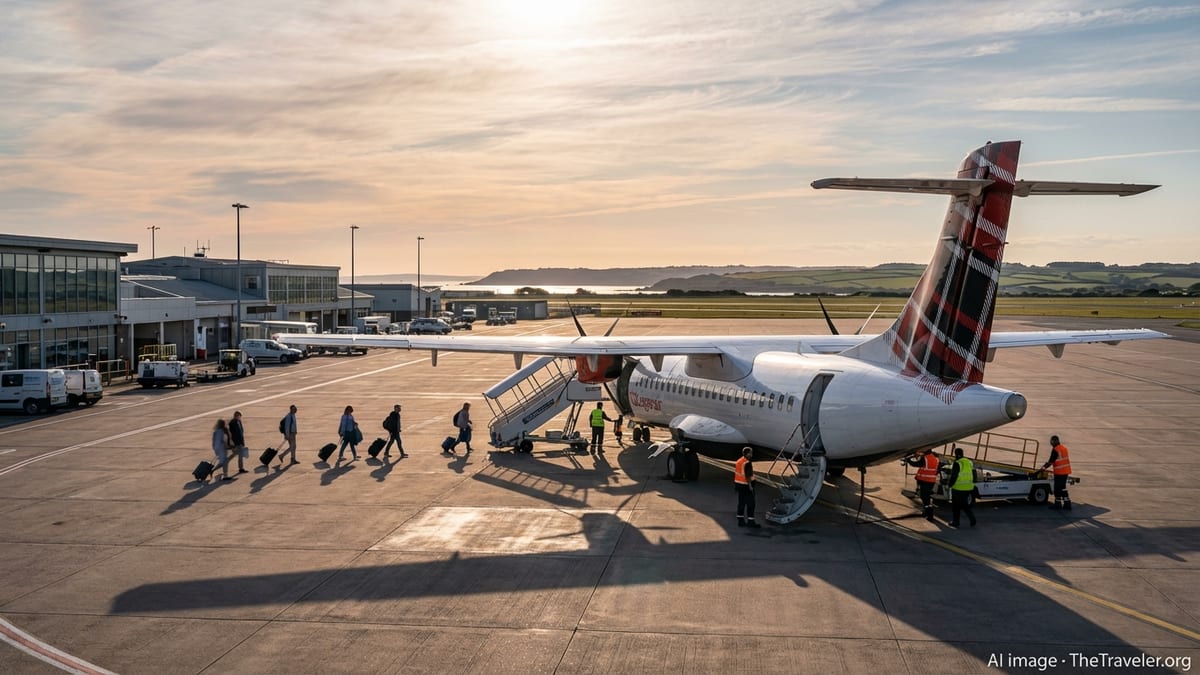
The services will be operated primarily with ATR turboprop aircraft, notably the ATR 72 on routes such as Jersey to Norwich, offering a balance of fuel efficiency, relatively low operating costs and a cabin size suited to regional traffic. The aircraft type is familiar to many UK regional travellers, with a two‑by‑two seating layout and hold baggage capacity that supports holidaymakers travelling with checked luggage rather than strictly hand baggage only.
Loganair typically includes a generous checked baggage allowance in its fares on many routes, a key differentiator in a market where some low‑cost rivals charge for almost every extra. For families and longer‑stay visitors heading to Jersey or using the island as a jumping‑off point for trips to France and Ireland, this packaging of pricing and baggage could make the new flights particularly attractive compared with multi‑leg itineraries via larger hubs.
Flight timings, which are still being fine‑tuned ahead of the summer 2026 start, are expected to emphasise convenient morning and daytime departures to allow same‑day hotel check‑ins, meetings or onward transfers, rather than awkward red‑eye or late‑night arrivals that can deter short‑stay travel.
Boost for Jersey’s Tourism and Business Communities
For Jersey, the new Loganair routes are more than just additional lines on an airport departures board. They come after a year in which overall visitor numbers slipped compared with 2024, prompting concern among hoteliers, hospitality operators and retail businesses that depend heavily on seasonal footfall. Local tourism bodies have explicitly identified France as a growth priority, seeking to rebuild and expand inbound travel after a weaker 2025.
The Paris Charles de Gaulle link is particularly significant in that context. By connecting directly into a major French and international hub, Jersey is far better placed to tap into source markets across France, the Benelux countries and even long‑haul destinations where travellers might add a Channel Islands stay to a broader European itinerary. A three‑times‑weekly schedule gives sufficient frequency to attract tour operators and package providers who need reliable, regular lift to programme the destination.
The UK regional routes, meanwhile, reinforce key domestic visitor markets that Jersey has historically relied upon. East Midlands, with its strong catchment around Nottingham, Derby and Leicester, is home to a large population of potential short‑break travellers, while Norwich serves not only Norfolk but a wider East Anglian region where surface journeys to the south coast are comparatively lengthy.
Local business leaders have also welcomed additional direct flights as a means of reducing travel friction for meetings, conferences and inward investment visits. For professional services, finance and digital firms that maintain links with partners in England, Ireland and continental Europe, more direct options can make Jersey more competitive as a base of operations.
Strengthening Loganair’s Position as a UK Regional Specialist
The Jersey expansion underscores Loganair’s broader strategy to cement its role as the UK’s leading regional airline, focused on short‑haul connectivity between secondary cities, islands and key hubs. In recent years the carrier has invested in bases and routes that fill gaps left by legacy airlines withdrawing from unprofitable regional sectors, as well as by the failure of smaller competitors.
By moving swiftly to establish a permanent operating base in Jersey, Loganair signalled early that it saw long‑term potential in Channel Islands services. The 2026 route additions build on existing flights from the island to UK cities such as Bristol, Exeter and Southampton, and accompany capacity increases on established lines including Jersey to Bristol, where additional frequencies are being added during the summer peak.
This multi‑route presence gives Loganair economies of scale in crew, maintenance and marketing in the Channel Islands market, which in turn can support more resilient schedules and reduce the risk of sudden route withdrawals. It also complements the airline’s longer‑standing network in Scotland, northern England and the Isle of Man, where it has positioned itself as a lifeline carrier for many remote communities.
Industry observers note that by branching out from its traditional heartlands and adding high‑profile routes like Paris, Loganair is testing the boundaries of its regional model without straying into the hyper‑competitive territory of larger low‑cost carriers. Success in Jersey could encourage similar ventures from other regional airports where local authorities are keen to restore lost connectivity.
Connecting to Wider European and Transatlantic Networks
While the new flights are marketed as point‑to‑point services, their real value for many travellers may lie in the onward connections they enable. Paris Charles de Gaulle is a major hub for continental and long‑haul services, and even without a formal codeshare, travellers from Jersey will be able to purchase separate onward tickets to destinations across Europe, Africa, Asia and the Americas.
Dublin offers a different but equally strategic set of opportunities. With a growing transatlantic portfolio from Irish and international carriers, alongside the ability to clear United States immigration and customs pre‑departure, Dublin has emerged as an increasingly popular alternative to Heathrow for travellers bound for North America. Jersey residents using the new Loganair route will be able to reach US and Canadian cities with a single connection, cutting journey times compared with ferry and overland combinations.
The East Midlands and Norwich flights, meanwhile, plug Jersey more directly into the UK’s own domestic flight network. Passengers from the Midlands and East Anglia can access long‑haul services from their local airports or via easy connections to Manchester, Birmingham or London airports, while still enjoying the convenience of a non‑stop sector to and from Jersey.
For inbound travellers, especially those from Europe who may be unfamiliar with the Channel Islands, the presence of services from major hubs like Paris also serves as a form of marketing in itself. A direct flight on the departures board can nudge travellers to consider a short stay in Jersey when planning summer itineraries that already include the UK or northern France.
Competitive Landscape and Consumer Choices
Loganair’s expansion arrives in a marketplace that has become more fragmented for regional travellers. Larger low‑cost carriers continue to prioritise high‑volume leisure routes from major airports, while legacy airlines have trimmed many thinner regional services in favour of feeding long‑haul hubs. That has left space for focused regional operators to step in, particularly where local governments and airports are willing to support new links.
From the consumer perspective, the new flights give travellers in Jersey and the connected cities more choice in how they plan trips. Direct services reduce the need to route via London or rely on ferries combined with lengthy rail journeys, potentially saving significant time, especially for weekend breaks and business day trips. However, competition from other modes remains relevant, particularly for price‑sensitive travellers or those carrying cars, for whom ferry operators will continue to play a central role.
Industry analysts will be watching closely to see how fare levels and capacity evolve once the routes bed in. If demand proves strong, Loganair may look at extending the operating season, adding frequencies or even considering additional European points from Jersey. Conversely, the airline will also need to manage yield carefully on routes like Paris and Dublin, where larger carriers already operate dense networks from nearby mainland airports.
For now, the announcement signals renewed confidence in regional air travel’s ability to adapt and grow after several years of disruption. With tickets already on sale and the first services due to take off in May and June 2026, travellers in Jersey, the UK and Ireland will soon find out whether the promise of easier access to Parisian boulevards, Dublin’s city streets and England’s heartland resonates strongly enough to keep the new routes in the skies.