

More news on this day
As African aviation heads toward a projected surge in passenger capacity in 2026, Lomé is moving into focus as a strategic platform for decisions that could redefine how travelers move across the continent and how tourism develops around a new era of liberalized African skies.
Get the latest news straight to your inbox!
Lomé’s New Role in Africa’s Air Transport Calendar
The Togolese capital is set to host a high-level gathering on African air transport in June 2026, according to recent reporting from African Union documentation on sector priorities. The meeting is framed around the ongoing rollout of the Single African Air Transport Market, the flagship initiative intended to open Africa’s skies to greater competition and seamless intra-continental travel.
Publicly available African Union reports indicate that the Lomé event will bring together policymakers and industry stakeholders at a pivotal moment, when African air traffic is rebounding and moving into sustained growth. The discussions are expected to focus on safety, infrastructure, market liberalization and regulatory harmonization, all issues that directly shape the cost and convenience of flying within Africa.
The 2026 timeline matters because it aligns with a wider aviation and tourism acceleration across the continent. Recent white papers from sector bodies such as the African Travel and Tourism Association highlight double-digit growth in international seat capacity into African markets in 2026, underscoring how decisions taken in Lomé may influence where new routes are deployed and how tourism demand is served.
For Lomé, being chosen as a venue signals the city’s growing profile as an aviation and logistics node in West Africa. It also places Togo at the center of debates about how air connectivity can be used to support tourism, trade and regional integration over the rest of the decade.
Driving Down Costs and Opening Skies in West Africa
Lomé has already served as a laboratory for regional air policy. A key meeting of air transport ministers from the Economic Community of West African States was held in the city to address high fares and structural costs, culminating in an endorsed strategy to remove certain taxes on air transport and reduce regional charges by around a quarter from January 1, 2026. That roadmap, reported by ECOWAS, aims to make flying more accessible for citizens and businesses across West Africa.
Combined with the continent-wide Single African Air Transport Market, these measures are intended to reduce the longstanding cost penalty on African routes, where taxes and fees have historically pushed ticket prices well above global averages. If effectively implemented, the 2026 reforms discussed and coordinated in Lomé could encourage airlines to add frequencies and open thinner intra-African routes that previously struggled to be commercially viable.
Lower operating charges and clearer regulatory frameworks are also seen as catalysts for tourism. Industry analyses suggest that when more seats are available at lower average fares, destinations that were once niche or hard to reach become realistic options for tour operators and independent travelers. In West Africa, that could translate into more multi-country itineraries linking beach, culture and wildlife circuits, with Lomé positioned as a connection point.
Policy changes will not be a quick fix, but the timing is favorable. African Union infrastructure plans unveiled in late 2025 include multi-billion-dollar commitments to modernize airports and air traffic systems in support of the single market. The Lomé 2026 gathering is placed against this backdrop, giving it added significance for airlines considering long-term investments in fleets and route networks.
Lomé’s Emerging Hub Ambitions and Airport Upgrades
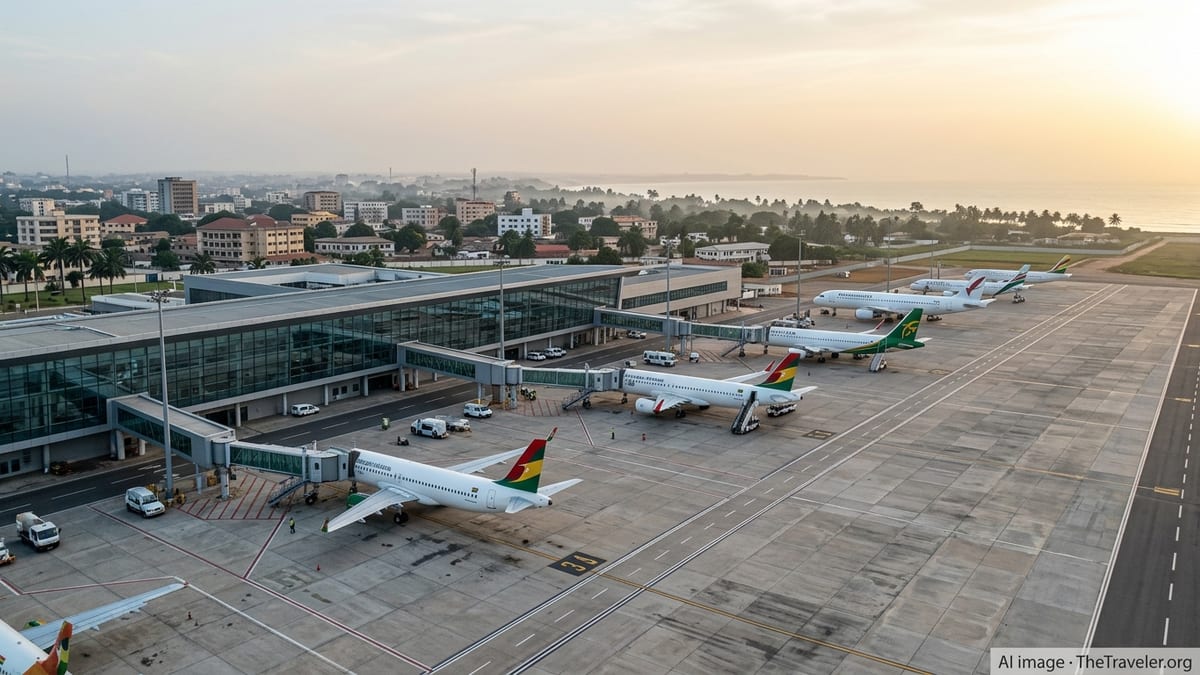
Lomé’s own airport development is central to its aviation ambitions. Gnassingbé Eyadéma International Airport has seen a steady program of upgrades, including the inauguration of additional parking stands for wide-body aircraft, reported by Togolese business media. This expansion increases the airport’s capacity to host larger jets and handle more simultaneous operations, a prerequisite for hub-style connectivity.
Togo’s strategic documents, including planning papers reviewed by international financial institutions, outline an objective to expand Lomé’s airport throughput from under one million passengers a year to around 1.5 million by 2026. The airport already houses the headquarters of regional carrier Asky Airlines, which uses Lomé as a transfer point for passengers from multiple West and Central African cities.
Industry coverage in recent months has highlighted Asky’s intention to add wide-body aircraft and explore longer-haul services between Togo and Europe. Analysts interpret these moves as part of a broader strategy to position Lomé as a secondary hub that can feed major intercontinental gateways while also strengthening intra-African links, particularly into landlocked and underserved markets.
In parallel, a new simulator training center based in Lomé has been announced in airline association bulletins, with operations targeted for mid-2026. The center is expected to support crew training for Asky and other African operators, adding a human-capital dimension to the city’s role in regional aviation and potentially attracting trainees and business visitors whose spending contributes to the local tourism economy.
Tourism Potential Around a Liberalized African Air Network
The tourism implications of these aviation shifts are increasingly visible in sector data. According to a recent white paper released at a major travel trade fair in Berlin, international seat capacity to Africa in 2026 is up by nearly one-fifth year on year, with Western Europe remaining the largest source region. The analysis stresses that increased airlift is directly linked to rising tourist arrivals and new opportunities for specialized tour operators.
For destinations such as Togo, which remain relatively under the radar compared with East and Southern African tourism powerhouses, this trend presents both challenges and opportunities. More competitive air transport can lower package prices and encourage experimentation by travelers willing to combine better-known destinations with emerging stops like Lomé, the Togolese coast or nearby cultural sites.
Regional integration efforts are also converging on the visitor experience. Ongoing African Union and United Nations tourism discussions have pointed to the importance of visa facilitation, digital travel systems and coordinated marketing in maximizing the benefits of improved air connectivity. If countries around the Gulf of Guinea move in step with aviation reforms discussed in Lomé in 2026, the corridor from Abidjan to Lagos, with Lomé as a central waypoint, could become significantly more attractive to both regional and long-haul tourists.
Observers note that the expanding role of airlines like Asky, along with partnerships involving larger African and global carriers, is beginning to redraw the map of feasible itineraries. Routes that once required multiple backtracking connections through Europe or the Middle East are gradually giving way to more direct intra-African links, narrowing travel times and simplifying logistics for tourism businesses and independent travelers alike.
Infrastructure, Investment and the Road to 2030
The Lomé 2026 meeting on African air transport will unfold as governments and investors look further ahead to 2030 and beyond. The African Union’s infrastructure commissioner has presented an aviation modernization plan valued at around 30 billion US dollars, focused on airport upgrades, safety oversight and digital systems needed to support the Single African Air Transport Market. That multi-year effort aims to align capacity with rising demand while keeping safety performance in line with global standards.
Togo is positioning itself within this landscape through a combination of policy and infrastructure moves, from earlier plans for expanded terminals and a secondary airport site near Lomé to current efforts to attract training, maintenance and logistics activities. Each of these components strengthens the case for airlines to deploy more aircraft and for tour operators to include Togo in broader regional products.
Tourism planners are watching how quickly reforms on taxes, charges and competition rules translate into actual fare reductions and new routes. Experiences from other liberalized markets suggest that benefits accumulate gradually as carriers test demand, adjust schedules and launch joint ventures or code shares. In the African context, 2026 is being seen as an inflection point, with Lomé as one of the platforms where technical policy discussions and commercial interests intersect.
While the outcomes of Lomé 2026 will depend on political will and implementation across many countries, the direction of travel is clear. A more connected African sky, supported by modern infrastructure and collaborative regulation, has the potential to unlock a new phase of tourism growth, with West African capitals such as Lomé moving from peripheral stops to integral links in the continent’s travel network.