

More news on this day
When African leaders, regulators and airline chiefs gather in Lomé in June 2026 for a high-level meeting on air transport, the stakes will reach far beyond aviation policy. The summit is being framed as a decisive moment for the continent’s long-planned Single African Air Transport Market, with direct consequences for how, where and how easily travelers will move across Africa in the decade ahead.
Get the latest news straight to your inbox!
A High-Level Summit With Continental Reach
A recent report from the African Union on its 2025 activities highlights Lomé as the host of a high-level air transport meeting in June 2026, convened under the political “champion” of the Single African Air Transport Market. The gathering is expected to bring together ministers, regulators, airline executives and financial partners at a time when momentum behind liberalizing African skies is growing but uneven.
Publicly available African Union documentation describes the Lomé 2026 summit as part of a broader push to coordinate implementation of the Single African Air Transport Market, a flagship initiative of Agenda 2063. The aim is to move from political declarations toward practical steps such as aligning regulations, granting traffic rights and upgrading infrastructure so that airlines can operate more freely across borders.
By anchoring these debates in Lomé, the summit also places a spotlight on West Africa’s emerging aviation corridors. Policymakers and industry observers are watching to see whether the meeting will deliver binding timelines and enforcement mechanisms that could translate into new city pairs, better schedules and lower fares for travelers within the region.
The Lomé 2026 agenda is expected to intersect with a series of other continental forums. Recent international aviation weeks organized under the International Civil Aviation Organization and specialized industry meetings run by African airline bodies have already called for accelerated Single African Air Transport Market implementation and for gaps between signature and enforcement to be closed by the end of 2026. Lomé is positioned as the venue where these strands could be consolidated into a common roadmap.
Lomé’s Bid to Be a West African Air Hub
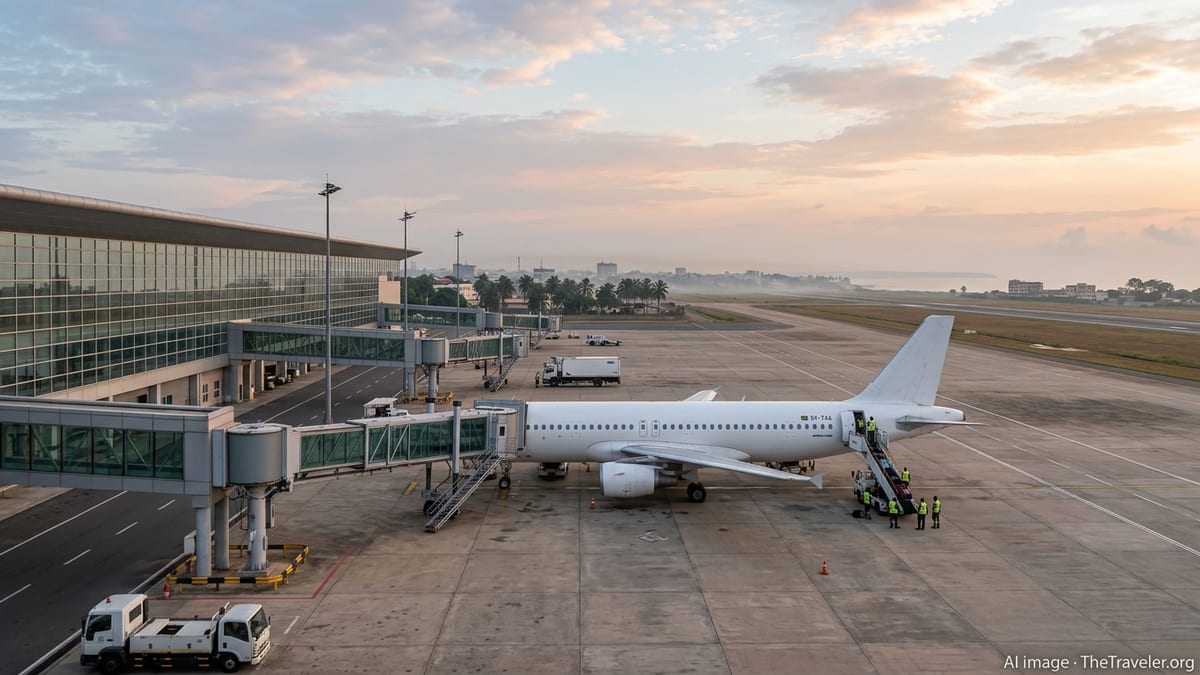
Lomé’s selection as host city is not accidental. Over the past decade, Togo has pursued a deliberate strategy to turn the capital into a regional air transport hub. Gnassingbé Eyadéma International Airport, also known as Lomé–Tokoin International Airport, serves as the home base for pan-African carrier ASKY Airlines and is positioned as a junction linking West and Central African capitals with longer-haul flights to Europe and beyond.
According to investment promotion material published by Togolese authorities, the government has prioritized airport upgrades alongside port expansion to establish the country as a multimodal logistics gateway to West Africa. Earlier reporting from aviation trade publications noted that a modern passenger terminal in Lomé was designed with capacity for several million travelers a year, well above the country’s domestic demand, underscoring its hub ambitions.
Policy papers and business press coverage describe how partnerships with established African airlines have helped build connectivity from Lomé to dozens of cities across the region. A network of regional services, combined with the city’s position on the Gulf of Guinea, has made it a convenient transfer point for travelers from landlocked states and secondary markets that lack direct intercontinental flights.
Hosting the Lomé 2026 air transport summit effectively casts the city as a showcase for what greater liberalization under the Single African Air Transport Market could look like in practice. For travelers, the message is clear: West African airports like Lomé are no longer just gateways for outbound flights but also potential bases for multi-stop itineraries across the continent.
SAATM: From Policy Blueprint to Traveler Reality
The Single African Air Transport Market has been under discussion for years, but recent developments suggest a shift from concept to implementation. Public statements from African Union transport officials indicate that nearly 40 of the continent’s 55 states have now signed on to the initiative, representing a large share of existing passenger traffic. Industry analysis published by African airline associations points to 2026 as a target horizon to “finish the job” of putting liberalization into effect.
At its core, the Single African Air Transport Market seeks to remove many of the bilateral restrictions that currently govern African air services. Instead of separate air service agreements for each country pair, eligible African airlines would be able to operate freely between participating states, with expanded fifth-freedom rights, more flexible capacity decisions and streamlined approvals.
Studies commissioned or cited by African Union bodies argue that this could translate into tangible benefits for travelers: more routes, higher frequencies, competitive pricing and improved reliability. Reports also emphasize potential economic gains including billions of dollars in additional gross domestic product and hundreds of thousands of new jobs tied to tourism, trade and aviation-linked services.
The challenge, repeatedly underlined in official communiqués and industry commentary, lies in closing the gap between commitments and enforcement. Some states that endorsed the Single African Air Transport Market have been slow to adjust national laws, open their markets to foreign African carriers or reduce sector-specific taxes and charges. The Lomé 2026 summit is being closely watched as a test of whether political pledges can be converted into enforceable frameworks that travelers will feel in booking engines and airport departure boards.
Why Lomé 2026 Matters for Travelers
For most passengers, aviation summits can feel distant from the realities of planning a trip or choosing a route. Yet the decisions expected in Lomé have clear implications for how easy, affordable and frequent intra-African air travel may become by the late 2020s. If the summit can secure concrete steps toward a continent-wide open market, travelers could see more non-stop links between secondary cities, better timed connections and expanded choice among African carriers.
Travel industry analysts point out that Africa remains one of the least connected regions by air relative to its size and population. Many itineraries between neighboring states still require detours through distant hubs, adding hours and cost. Liberalized market access under a fully implemented Single African Air Transport Market could allow airlines based in hubs such as Lomé, Accra or Dakar to stitch together new triangular and multi-stop routes that respond to real demand rather than bilateral constraints.
For tourism boards and hospitality investors, Lomé 2026 is also being viewed as a bellwether. Improved connectivity is widely seen as a prerequisite for realizing growth forecasts in African beach, safari, cultural and business travel segments. Industry reports suggest that destinations with efficient regional air links see higher visitor spend, longer stays and stronger resilience to shocks, as travelers can re-route more easily if a single connection fails.
The summit’s location in a coastal West African capital may further raise the profile of the region among international travelers. Coverage around the event is likely to spotlight Lomé’s own attractions, from its seafront setting to emerging conference facilities, as well as the broader opportunities for multi-country itineraries combining Gulf of Guinea cities with inland cultural or nature destinations.
Infrastructure, Investment and the Next Decade of African Travel
The Lomé 2026 summit will unfold against a backdrop of rising aviation investment commitments. In late 2025, an African Union infrastructure briefing outlined plans for around 30 billion US dollars in aviation-related projects across the continent, including airport modernizations, air traffic management upgrades and safety improvements aligned with global standards. These projects are explicitly linked to unlocking the full potential of the Single African Air Transport Market.
Parallel initiatives led by international organizations and industry groups aim to strengthen safety oversight, expand training pipelines and promote sustainable aviation fuels. Recent conferences hosted under the International Civil Aviation Organization banner and regional airline associations have emphasized the need to align safety, environment and market-opening measures so that growth in air traffic does not compromise standards.
For travelers, the combination of market reform and infrastructure spending could reshape the experience of flying across Africa over the next decade. New or expanded terminals, upgraded runways and modernized air traffic control systems are expected to support more frequent services and reduce delays, while safety-focused programs seek to maintain or improve the sector’s record as traffic rises.
As the countdown to June 2026 continues, Lomé stands at the intersection of these trends. The city’s role as summit host, hub airport and symbol of West Africa’s aviation ambitions makes the meeting more than a technical discussion. For the continent’s travel future, and for the millions of passengers who may soon find African skies more open and connected, Lomé 2026 is shaping up as a milestone moment.