

More news on this day
Lomé, the coastal capital of Togo, is emerging as a strategic stage for African aviation in 2026, as regional and continental bodies prepare a high‑level air transport convention expected to push forward the Single African Air Transport Market, a more integrated African sky and new momentum for intra‑Africa travel.
Get the latest news straight to your inbox!
Lomé’s Growing Role in Africa’s Aviation Governance
Recent African Union documentation on aviation policy indicates that Lomé has been selected to host a high‑level meeting on African air transport in June 2026, under the leadership of the AU’s champion for the Single African Air Transport Market. This gathering is expected to bring together regulators, policy makers and industry stakeholders to review the pace of liberalization and identify practical steps to unblock longstanding barriers to continental connectivity.
The choice of Lomé reflects Togo’s growing visibility in aviation diplomacy. In the last few years the city has hosted regional transport reform meetings and air navigation coordination sessions backed by the African Civil Aviation Commission, giving local institutions experience in convening highly technical discussions on safety, charges and airspace management. Publicly available conference agendas show that these earlier events have already framed key issues that are likely to resurface in 2026, from performance‑based navigation to cross‑border oversight of air traffic services.
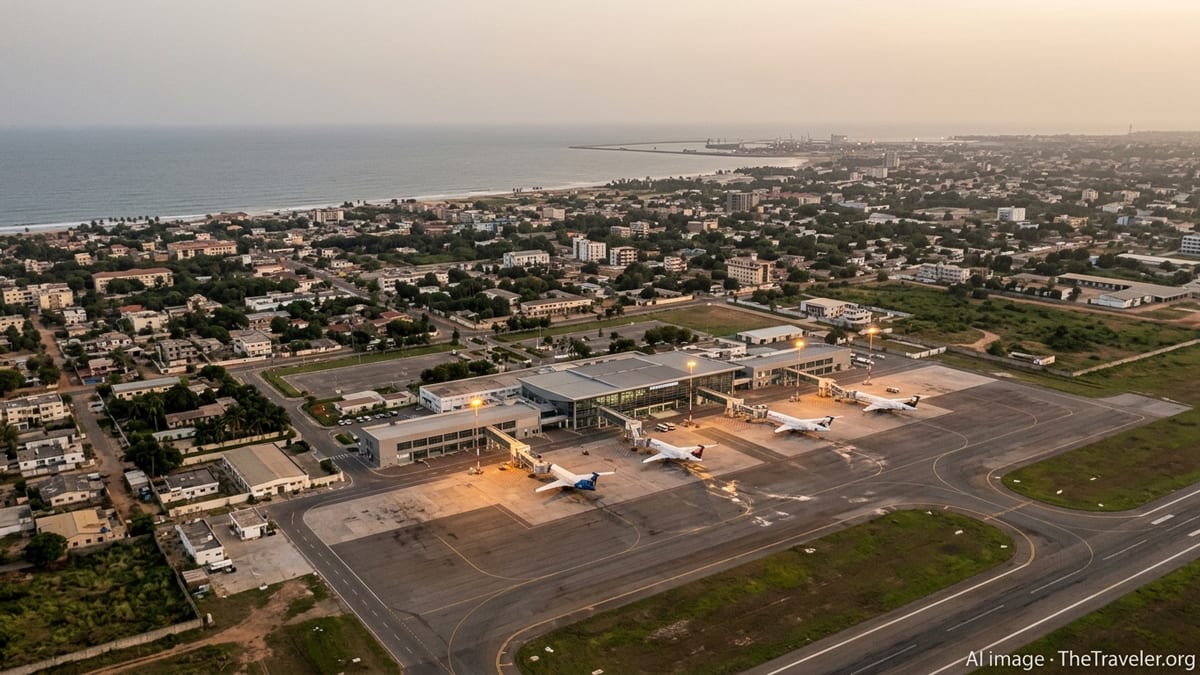
Lomé’s position at the center of West Africa’s coastline, combined with the presence of a home‑based regional carrier and an expanding international airport, has made it a natural hub for aviation policy debates. Industry reports note that air traffic flows through Lomé increasingly link Central, West and parts of Southern Africa, aligning the city’s operational role with its emerging political function as a venue for air transport negotiations.
For Togo, hosting the 2026 convention is also about influence beyond aviation. Analysts argue that Lomé’s frequent use as a venue for regional dialogues on trade, security and transport underscores a broader diplomatic strategy to position the country as a neutral facilitator in West African integration, with air connectivity now added to its portfolio.
SAATM and the Drive Toward a Single African Sky
The Single African Air Transport Market, launched as a flagship initiative under the African Union’s Agenda 2063, aims to liberalize air services across the continent by lifting restrictions on market access, capacity and pricing between participating states. African Union reporting for 2025 highlights that, while more than 30 countries have signed up, implementation has been uneven, with pockets of progress in West, East and Southern Africa but persistent regulatory and commercial bottlenecks.
Policy trackers and aviation journals suggest that the Lomé convention in 2026 is being framed as a milestone for SAATM, focused less on new declarations and more on operationalization. Key topics are expected to include harmonized competition rules, consumer protection frameworks, dispute resolution mechanisms and the role of regional economic communities in coordinating national regulators. Discussions are also likely to touch on digital tools for monitoring compliance, with some 2026 industry commentary already describing a push to “digitize SAATM” and make tracking of fifth‑freedom rights, slot allocation and schedule filings more transparent.
African Civil Aviation Commission working papers circulated in connection with earlier Lomé meetings illustrate how the concept of a Single African Sky is advancing in parallel to SAATM. While SAATM deals primarily with market access and airline freedoms, the Single African Sky focuses on technical and institutional integration in air navigation, including common performance targets, shared oversight platforms and cross‑border collaboration among air navigation service providers.
Specialists note that progress on these airspace initiatives is uneven but tangible. Cooperative projects piloted in West and Central Africa, discussed at a 2022 air navigation services gathering in Lomé, are seen as early testbeds for more ambitious continent‑wide platforms. The 2026 convention is expected to revisit these experiences and explore how they can be scaled, particularly as traffic forecasts for Africa point to sustained long‑term growth.
Lower Fares and New Routes to Unlock Intra‑Africa Travel
One of the most closely watched issues ahead of the Lomé convention is how policy reforms will translate into lower ticket prices and more direct routes for travelers who currently face some of the highest per‑mile airfares in the world. In 2024, air transport ministers from the Economic Community of West African States met in Lomé and endorsed a regional strategy to remove certain taxes from air transport and reduce charges by a targeted 25 percent from January 2026, a move that observers say could ripple across pricing structures for intra‑West African routes.
Subsequent summaries of the ECOWAS decision, published by regional business and policy platforms, underline that member states committed to reviewing the fiscal burden on air tickets and airport operations, which has long been cited by airlines as a key obstacle to network expansion. If implemented effectively, this reduction in charges could coincide with the 2026 convention and serve as a practical demonstration of how regional policy decisions can complement SAATM’s broader liberalization agenda.
Industry forecasts reinforce the potential upside. Boeing’s most recent long‑term outlook for Africa projects passenger air traffic growth averaging around 6 percent annually through the mid‑2040s, with the continent’s fleet expected to roughly double over that period. Analysts link this trajectory to demographic growth, urbanization and rising disposable incomes, but stress that tapping this potential depends heavily on cutting costs and simplifying travel across borders.
Observers also point to a growing number of visa reforms and mutual waiver agreements between African states as a parallel trend that could amplify the benefits of air transport liberalization. As more governments relax entry requirements for African visitors, the combination of lower fares, simplified access and more direct services could reshape how travelers and businesses move around the continent, with West African hubs such as Lomé well placed to benefit.
Lomé as a Connector in West and Central Africa
Beyond policy meetings, Lomé is steadily consolidating its role as a practical connector for West and Central Africa. Public information on route networks shows that ASKY Airlines, headquartered in the city, uses Lomé as its primary hub to link secondary and tertiary markets that often lack direct connections to major global gateways. The carrier’s model has been highlighted in regional aviation coverage as an example of how homegrown airlines can support intra‑Africa connectivity in tandem with larger intercontinental partners.
ATC News and similar outlets have recently noted Lomé’s growing profile, including recognition of ASKY for regional facilitation and connectivity. These developments indicate that the city’s airport is not only hosting more political and technical meetings but is also functioning as an operational platform for the kind of point‑to‑point and banked‑hub services that SAATM envisions on a wider scale.
Airport studies cited in trade and transport reports suggest that traffic through Lomé increasingly reflects both business and leisure flows, with passengers using the hub to connect between coastal economies and landlocked states in the Sahel and Central Africa. This pattern aligns with broader corridor initiatives that seek to integrate seaports, airports, rail and road networks across West Africa, positioning Lomé as a multimodal node rather than a purely point‑to‑point destination.
For travelers, the practical effect is a slowly widening menu of intra‑African options that bypass traditional European or Middle Eastern routings. While capacity constraints and pricing remain challenges, the combination of hub‑and‑spoke operations, competitive regional carriers and targeted policy reforms is gradually giving Lomé the profile of a mid‑sized but strategically located African aviation hub.
Continental Connectivity at a Crossroads in 2026
The broader context for the Lomé convention is a continent in the midst of rethinking its connectivity architecture. Academic research on African air transport supply decisions between 2016 and 2022 concludes that African carriers currently provide the most extensive connectivity within Africa, but often have less flexibility to adjust networks compared with some foreign competitors. This dynamic has sharpened the focus on how policy frameworks like SAATM and evolving alliances can give African airlines the regulatory space and commercial incentives to expand intra‑Africa services.
At the same time, new airport projects and hub strategies across the continent are reshaping competitive geography. In East Africa, for example, the ground‑breaking of a large new airport project near Addis Ababa in early 2026 is framed by Ethiopian stakeholders as a bid to reinforce that country’s position as a major African gateway. Similar efforts are under way in Nairobi, Accra and other emerging hubs, suggesting that West African centers such as Lomé will face both opportunities and pressure as traffic grows.
Analysts observing these developments argue that the success of SAATM and related initiatives will depend on whether they can balance healthy competition with a degree of coordination on standards, infrastructure investment and airspace management. In this environment, the African Civil Aviation Commission’s role as an executing agency and technical coordinator is likely to be prominent in Lomé, particularly on issues such as safety oversight, performance‑based navigation and cross‑border air navigation service provision.
With long‑term traffic growth projections and an expanding network of trade agreements such as the African Continental Free Trade Area, 2026 is shaping up as a pivotal moment for aligning aviation integration with broader economic objectives. The Lomé convention, sitting at the intersection of SAATM, Single African Sky ambitions and regional fare reforms, is expected to serve as a key test of whether Africa can translate years of policy design into tangible gains in routes, frequencies and affordability for travelers across the continent.