

More news on this day
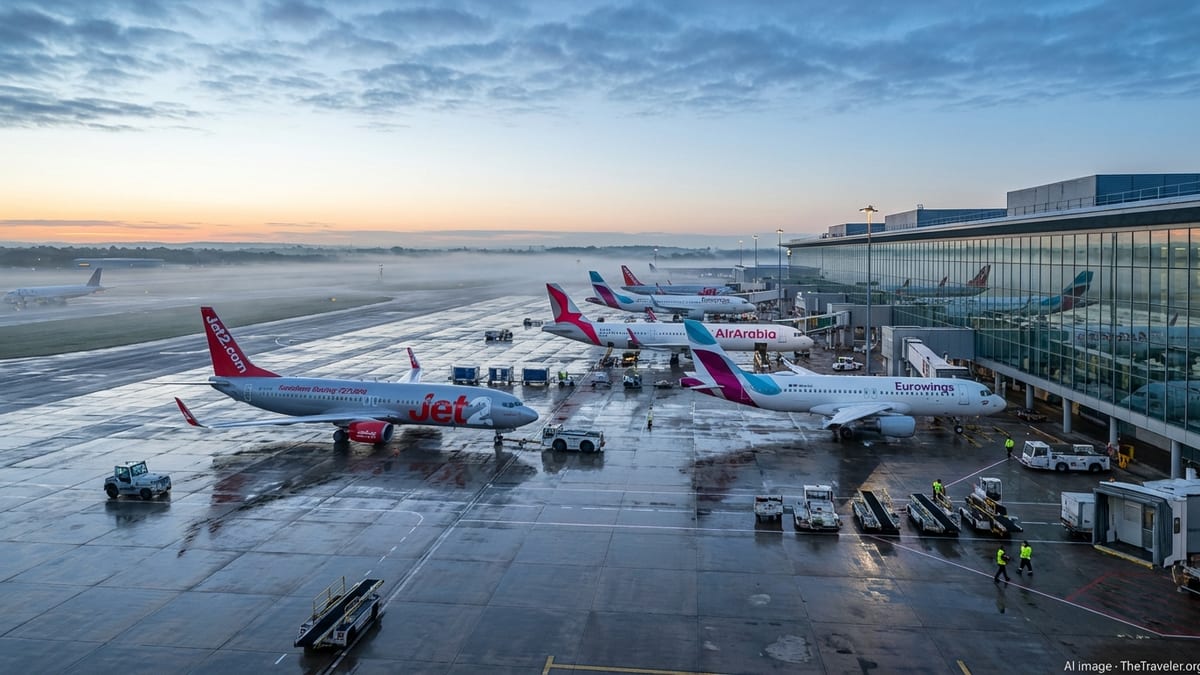
London Gatwick is entering 2026 in full growth mode, as Jet2, Air Arabia and Eurowings roll out new bases, double daily long haul links and dense European schedules that will push the airport’s capacity and route map to their strongest position in years.
Jet2 Turns Gatwick Into Its Newest UK Base
Jet2 is making a decisive move into the London market by opening a full-scale base at Gatwick from late March 2026, its first ever at the airport. The leisure carrier has secured slots for six aircraft, including five Airbus A321neo jets, instantly giving it enough scale to compete head-on with established holiday operators on core Mediterranean and Canary Islands routes.
From 26 March 2026, Jet2 will begin flying an initial network of 29 sun and city destinations across Spain, Greece, Portugal, Türkiye, Italy, Croatia, Bulgaria, Cyprus and Malta. High-frequency services are planned on crowd-pleasing routes such as Faro and Palma de Mallorca, each rising to 10 flights per week at peak, alongside dense schedules to Alicante, Málaga and Tenerife South.
The airport describes Jet2 as one of the largest new based airlines to arrive at Gatwick in a generation, pointing to the creation of more than 300 local jobs across flight deck, cabin crew, engineering, ground handling and administration. With an estimated catchment of nearly 15 million people able to reach Gatwick within an hour, Jet2 is positioning the base as a southern England counterpart to its strongholds in northern UK cities.
For summer 2027, Jet2 has already committed to a 27 percent increase in capacity from Gatwick, putting more than 1.1 million seats on sale and underlining the scale of its bet on the airport. That growth comes even before the first Gatwick flights take off in March 2026, highlighting the carrier’s confidence in long term demand from London and the South East for package holidays.
Air Arabia’s Double Daily Sharjah Link Boosts Long Haul Options
While Jet2 is focused on short and medium haul leisure traffic, Air Arabia is reshaping Gatwick’s long haul low cost offering. From 29 March 2026, the Sharjah based carrier will begin a new double daily non stop service linking its Gulf hub to London Gatwick, using Airbus A321neo LR aircraft configured for longer range operations.
The schedule, featuring two flights per day in each direction, is designed to capture both overnight and daytime demand. Early morning and afternoon departures from Sharjah are set to feed into morning and evening departures from Gatwick, providing flexibility for business travellers, price sensitive leisure passengers and those visiting friends and relatives across the Middle East and South Asia.
For Gatwick, the route adds another Gulf gateway alongside existing services, but with a distinctly value focused proposition. Air Arabia’s model of unbundled fares, paid ancillaries and relatively dense seating on the A321neo LR enables competitive pricing on a sector traditionally dominated by full service rivals. Industry observers expect the new service to stimulate price competition for London to Gulf and beyond traffic, particularly for connections into markets in India, Pakistan and North Africa.
The double daily pattern also brings welcome additional long haul capacity to Gatwick at a time when transcontinental slots at the airport remain tightly contested. Airport executives say the Sharjah flights will help diversify the long haul portfolio beyond North America and traditional holiday routes, reinforcing Gatwick’s positioning as an alternative London gateway for global connections.
Eurowings Opens a Fresh German Front From Gatwick
On the short haul network, Eurowings is leading a German push at Gatwick with new routes to Cologne and Stuttgart that debut in spring 2026. The value carrier, part of the Lufthansa Group, will launch flights to Cologne on 29 March with 13 services per week, before adding six weekly flights to Stuttgart from 13 April.
The Cologne route, effectively offering close to double daily frequencies on several days of the week, gives Gatwick passengers a direct link into one of Eurowings’ key bases and a major cultural and business centre on the Rhine. Stuttgart, in turn, opens the door to southwest Germany’s automotive and high tech industries, as well as leisure access to the Black Forest and nearby wine regions.
These routes mark Eurowings’ first foray into Gatwick, after historically focusing its UK presence on London Heathrow and, prior to the pandemic, London Stansted. The new services are made possible by a reshuffle of slots within the Lufthansa Group and a temporary lease of Gatwick slots previously tied to an ITA Airways route, underlining how competitive access to London’s airspace has become.
Gatwick’s executives view Eurowings as a cornerstone of a broader expansion in German connectivity. Alongside Condor’s planned three daily Frankfurt services, the airport expects the Cologne and Stuttgart flights to draw both point to point travellers and those connecting onwards through German hubs, deepening ties between the UK and one of its most important trading partners.
Capacity Surge: Gatwick’s 2026 Schedule Swells
The combined moves by Jet2, Air Arabia and Eurowings come against a backdrop of rapid schedule growth at Gatwick. The airport expects to offer more than 230 routes in summer 2026, a figure that brings it close to, and in some segments beyond, its pre pandemic reach. New carriers and fresh routes across Europe, Africa, the Middle East and Asia are pushing aircraft movements and seat capacity sharply higher.
Jet2’s opening base alone will add thousands of weekly seats on core Mediterranean and islands routes from March through October, reinforcing Gatwick’s role as a major holiday gateway for southern England. At the same time, Air Arabia’s double daily Sharjah service adds a significant long haul uplift, with two wide schedule windows each day designed to maximise aircraft utilisation and catch multiple demand segments.
Eurowings contributes additional short haul density to key German markets, while other newcomers such as Condor and Air France, both planning new or expanded services from spring 2026, round out the picture. Analysts note that Gatwick is now seeing a multi airline, multi country wave of investment arrive in a relatively compressed timeframe, concentrating capacity growth into the late 2025 and 2026 seasons.
For travellers, the effect will be visible in the departure boards: more choice of airlines on popular routes, greater frequency on peak leisure days and new direct links to cities that previously required a connection via Heathrow or continental hubs. For Gatwick, the upswing promises higher utilisation of its single main runway while preparations continue for a second operational runway later in the decade.
Competitive Pressures on Fares and Holiday Packages
The arrival of Jet2 at scale is expected to intensify competition in Gatwick’s already crowded leisure market. The airline’s package first approach, bundling flights with accommodation, transfers and in resort support, puts it in direct rivalry with easyJet holidays, TUI and other tour operators that have grown strongly from the airport since travel restrictions were lifted.
Industry observers say Jet2’s 29 route network, combined with a 27 percent capacity uplift already scheduled for summer 2027, is likely to translate into keener pricing on core Mediterranean destinations, particularly during school holiday peaks. With more than 1.1 million Jet2 seats already on sale for 2027, and significant capacity from incumbent carriers, travel agents forecast a buyer’s market for families flexible on dates and airports.
Air Arabia’s double daily Sharjah service adds a different kind of price pressure, introducing a low cost player onto a long haul corridor usually led by network airlines. The airline’s value proposition, built around competitive base fares and paid extras, should appeal to cost conscious passengers who might otherwise have connected via other Gulf hubs. Aviation analysts expect that effect to ripple through fares offered by competing carriers on overlapping city pairs.
Eurowings is set to sharpen fares on the London to Germany axis, where business heavy demand has historically supported higher prices. With 13 weekly services to Cologne and six to Stuttgart, the carrier will be able to offer frequent promotions and off peak deals, while still catering to corporate travellers seeking flexibility on weekday schedules. In aggregate, Gatwick’s 2026 cohort of new and expanding airlines looks poised to anchor a more price sensitive environment across several major markets.
Economic Impact for Gatwick and the South East
Beyond lower fares and greater choice for passengers, the expansion by Jet2, Air Arabia and Eurowings carries tangible economic implications for Gatwick’s surroundings. Jet2’s decision to base six aircraft at the airport translates directly into hundreds of new jobs, from pilots and cabin crew to engineers, operations controllers and ground handlers. Ancillary employment in catering, retail, hotels and transport is likely to add significantly to that total.
Gatwick’s broader growth plans, including the now approved project to bring a second runway into regular use by repositioning its existing standby strip, are forecast to create thousands more roles by the end of the decade. Officials have spoken of up to 14,000 additional jobs and around one billion pounds in annual economic benefit once the dual runway operation is fully established, with today’s airline announcements seen as early evidence of the demand underpinning that investment.
The intensified schedule with Germany, the Gulf and Mediterranean destinations is also expected to stimulate inbound tourism to London and the wider South East. Eurowings’ Cologne and Stuttgart links, in particular, provide new direct access for German visitors to reach the UK capital and nearby coastal and countryside destinations. Meanwhile, Air Arabia’s Sharjah flights give tour operators in the Gulf region fresh scope to package the UK as part of wider Europe itineraries.
Local business groups argue that long term connectivity gains will help attract foreign investment to the region, especially in sectors that value accessible air links for staff travel and logistics. At the same time, some community organisations remain concerned about the potential for increased noise and environmental impact, setting the stage for continued debate as Gatwick’s traffic volumes climb.
Balancing Growth With Sustainability and Capacity Constraints
The surge in new routes and based aircraft is unfolding as Gatwick navigates a delicate balance between growth, environmental commitments and physical capacity limits. Approval of the airport’s 2.2 billion pound second runway project in 2025 came with explicit conditions related to noise control, air quality and surface access, including a target that half of all passengers should reach the airport by public transport.
As more airlines announce expanded schedules for 2026 and beyond, Gatwick is under pressure to demonstrate that additional flights can be handled within those constraints. The airport has outlined plans to boost rail capacity, streamline station access and support bus and coach links for the growing catchment. For carriers like Jet2 and Eurowings, which rely heavily on punctual, high utilisation aircraft rotations, operational resilience on the ground will be critical.
Environmental campaigners, who opposed the second runway approval, have warned that the wave of new flights risks undermining the UK’s climate goals, particularly if growth in aviation outpaces efficiency gains and sustainable fuel uptake. Campaign groups are already signalling further legal challenges and public campaigns as Gatwick’s traffic rebounds and surpasses previous peaks.
Airport management counters that newer aircraft types, such as Jet2’s A321neo fleet and Air Arabia’s A321neo LR, offer substantial per seat fuel burn and noise reductions compared with older jets. They argue that concentrating growth at Gatwick, where rail and coach access is strong, is preferable to pushing demand to smaller regional airports with fewer public transport options. The debate is likely to intensify as the 2029 target for full dual runway operations approaches.
Travellers Face a Transforming Gatwick in 2026
For passengers, the most immediate impact of these airline moves will be felt from the start of the summer 2026 season. Holidaymakers departing from Gatwick will see Jet2 branding join the familiar line up of easyJet, TUI and others, with a wide selection of flight only and package options on core sun routes. Early morning and evening Air Arabia departures will add new choices for those heading to the Gulf and beyond, while business travellers may gravitate to Eurowings for efficient links to Cologne and Stuttgart.
Inside the terminal, Gatwick is steadily adjusting its operations and passenger experience for higher volumes. Retail and food outlets are being refreshed to capture increased dwell time, and digital wayfinding and security upgrades are being rolled out to smooth peak morning and weekend flows. Airport executives emphasise that maintaining reliability through the ramp up is as important as securing new airlines.
As capacity builds and the second runway project progresses in the background, Gatwick is positioning 2026 as a turning point: the year when new airline bases, daily long haul links and expanded European connectivity begin to reshape its profile in the intensely competitive London market. For Jet2, Air Arabia and Eurowings, the airport offers a high profile stage to test how far they can grow in the shadow of Heathrow, and how much fresh demand can be unlocked in one of Europe’s most dynamic travel catchments.