

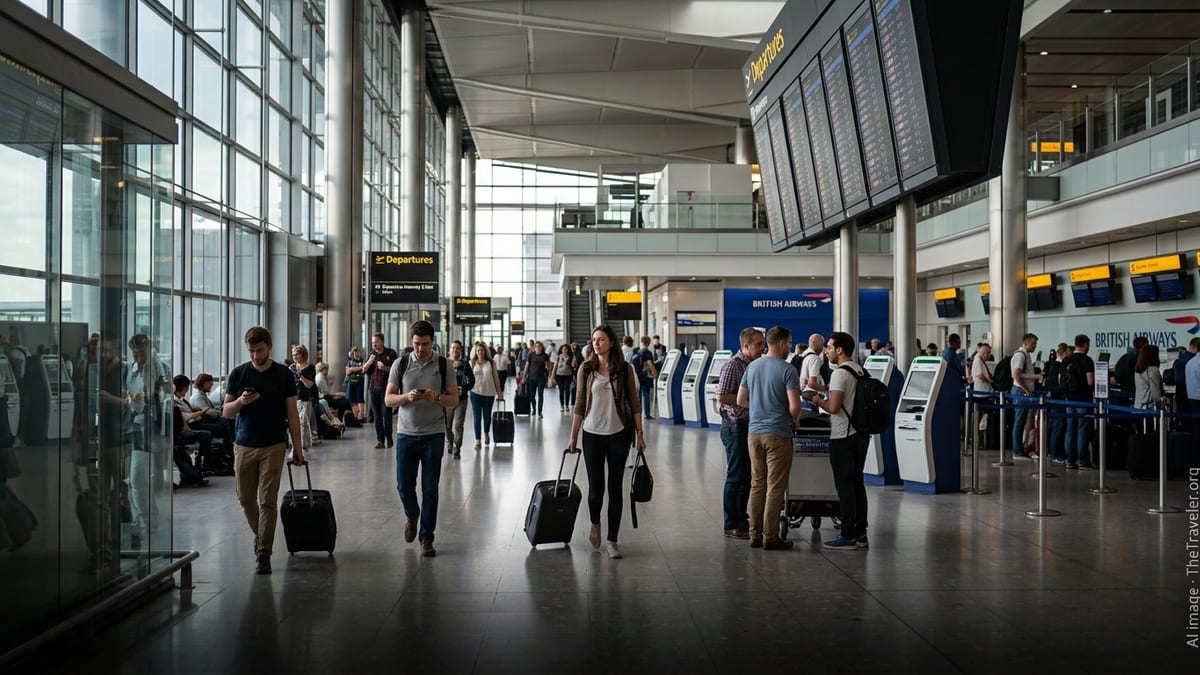
How Early You Should Arrive for Departures
Heathrow itself advises arriving at least 2 hours before a short haul flight within Europe and around 3 hours before a long haul departure to destinations such as the United States or Asia. In practice, this is a sensible minimum rather than a luxury. Security queues, road traffic on the M4 or M25, and crowded check in areas can all eat into that buffer, especially at peak times such as Friday evenings, school holidays and early morning waves of transatlantic flights.
As a realistic example, a traveler flying London Heathrow to New York JFK on a 10:30 a.m. flight from Terminal 5 should plan to be inside the terminal by about 7:30 a.m. This usually allows 20 to 30 minutes to clear check in and bag drop with British Airways, another 20 to 40 minutes for security, and still enough time to walk to a gate that may be a 10 to 15 minute walk away. Arriving at 9:00 a.m. for the same flight is possible on a good day, but leaves very little margin for delays or queues.
Short haul passengers with only cabin baggage have slightly more flexibility, but should still treat the 2 hour guideline seriously. For instance, someone departing on a 6:45 p.m. flight to Amsterdam from Terminal 3 could aim to clear the terminal doors by 4:45 p.m. If they already have a mobile boarding pass and no checked bag, they may be through security in 20 minutes on a quiet weekday. However, if security queues spike to 40 minutes or more, that extra hour becomes valuable.
It is also worth remembering that many airlines close their bag drop and check in desks 45 to 60 minutes before departure. For example, long haul flights on major carriers at Heathrow commonly cut off checked baggage 60 minutes before scheduled departure. That means rolling up to the terminal 90 minutes before a flight with heavy traffic on the roads can put you uncomfortably close to missing that window, even if you clear security quickly afterward.
Understanding Terminals and Airline Locations
Heathrow currently operates four passenger terminals for departures: Terminals 2, 3, 4 and 5. Terminal 1 closed several years ago, and signage has largely been updated to reflect this. Knowing which terminal your airline uses is essential because the buildings are not connected airside for departing passengers, and a last minute terminal mistake can add 20 to 30 minutes of travel time by shuttle bus or train.
Terminal 5 is the home of British Airways and Iberia for most of their Heathrow operations. If you are flying BA to destinations such as New York, Berlin or Johannesburg, you will almost certainly depart from Terminal 5. The terminal is split into a main building and satellite concourses that require additional transit once you are through security. Walking times to some gates can reach 15 to 20 minutes, so you should factor this in once your boarding pass shows a gate number.
Terminal 3 is a major base for a range of long haul carriers, including many oneworld and SkyTeam airlines. This is where you are likely to depart if you are flying Virgin Atlantic to the United States or Caribbean, or certain American Airlines and Delta routes. Terminal 3 has a large central security area and a broad mix of high street and luxury shops after security, which can be useful if you arrive early and want to eat or shop before boarding.
Terminal 2, often called The Queen’s Terminal, serves many Star Alliance airlines. If you are flying Lufthansa to Germany, United Airlines to the United States, or Air Canada to Toronto, you will probably use Terminal 2. Terminal 4, on the other hand, is home to a mix of carriers including some Middle Eastern and Asian airlines. Both terminals have their own rail and bus connections, but from a passenger perspective the main point is that you cannot simply walk from Terminal 2 to Terminal 4 inside the secure zone. If you arrive at the wrong terminal, you will need to leave, travel by train or bus, and go through security again.
Getting to Heathrow: Trains, Tube, Taxis and Parking
Heathrow is served by several rail and road options, each with different prices and journey times. For many travelers from central London, the Elizabeth line and the Piccadilly line of the London Underground provide the best balance of cost and convenience. The Piccadilly line runs directly from central stations such as Green Park and King’s Cross to Heathrow’s Terminals 2 & 3, Terminal 4 and Terminal 5 stations. Off peak, the journey from central London typically takes 45 to 55 minutes and costs roughly the same as any other Zone 1 to Zone 6 Tube trip using Oyster or contactless payment.
The Elizabeth line offers a faster, more spacious service from central hubs like Paddington, Tottenham Court Road and Liverpool Street to Heathrow. Journey times from Paddington are often around 28 to 35 minutes, with trains running through to Terminal 2 & 3 and Terminal 4 or 5 depending on the service. Fares are higher than the Piccadilly line, roughly about double a standard Zone 6 Underground fare, but still well below the premium charged by dedicated airport expresses.
Travelers who value speed above price may choose the airport express service running from London Paddington to Heathrow. The non stop ride to Terminals 2 & 3 is commonly around 15 minutes, and a few minutes more to Terminal 5. A walk up single ticket can cost several times as much as the Tube. Advance purchase and off peak discounts can lower this, but it remains one of the most expensive ways to reach the airport. For example, a family of four buying walk up tickets at the station may find that a pre booked private car or rideshare from central London costs a similar amount.
By road, black cabs and ride hailing services such as Uber and Bolt are widely used. A typical off peak fare from central London to Heathrow in a licensed taxi might range from the equivalent of a mid double digit to low triple digit pound figure, depending on traffic and exact pickup point. Pre booked minicabs often quote a fixed price, which can be attractive for early morning flights. Drivers generally prefer to drop passengers directly at the terminal forecourts, but as explained below there is now a dedicated forecourt charge per vehicle visit that influences how some people choose to arrive.
Drop Off Charges, Parking and Meeting Points
Heathrow introduced a terminal drop off charge at its forecourts, which has recently risen. As of 2025, the standard fee was 6 pounds per vehicle entry to the terminal drop off zones, payable online or by phone by midnight the day after the drop off. In 2026, the charge has been reported as 7 pounds per visit on many consumer and transport sites, and travelers should expect a figure in that range. The fee applies to all vehicles using the forecourt, including private cars, taxis and ride hailing services. There is no payment machine at the airport; instead, the vehicle’s number plate is captured and the driver or owner must pay separately afterward or risk a penalty charge.
For travelers who want to avoid this fee, there is a free alternative. Heathrow’s official long stay or park and ride car parks allow passengers to be dropped off without paying the terminal forecourt charge, then transfer to the terminal by shuttle bus. In practice, this usually adds at least 15 to 25 minutes to the journey time compared with driving directly to the forecourt, and may not be worth it for very early flights or heavy luggage, but can be attractive for cost conscious families or frequent visitors.
Short stay car parks next to each terminal are convenient for people who want to park their own car for a few hours, pick up or drop off passengers and accompany them inside the terminal. Prices are significantly higher than long stay parking if you leave your car for more than a few hours, but for a quick goodbye coffee or helping elderly relatives check in, the proximity can be worth the cost. For example, leaving a car for 2 to 3 hours in a short stay car park at Heathrow can cost a noticeable two digit sum, whereas long stay car parks are priced for 24 hour or multi day use.
Meeting departing travelers is easiest in the public check in halls of each terminal, usually close to the airline’s check in zone. If you are arranging to meet a friend who is connecting through Heathrow and rechecking bags, agree on a specific landmark such as the oversized baggage desk in a particular zone or a named café in the departures hall. This reduces confusion when mobile data or roaming does not work smoothly. Once the traveler passes through security, access for non passengers is not allowed, so any farewells or handovers must happen before that point.
Check In, Bag Drop and Security: What to Expect
Most airlines operating at Heathrow now encourage passengers to check in online via their website or mobile app, often opening 24 hours before departure. Doing this in advance speeds things up significantly when you arrive at the airport, since you can usually go straight to a bag drop desk or, if you are traveling with only hand luggage, directly to security. Travelers flying with major carriers like British Airways, Virgin Atlantic, Lufthansa and United will typically see separate queues for bag drop and full service check in.
Each airline sets its own check in and bag drop closing times, but a common pattern at Heathrow is that short haul flights stop accepting checked baggage around 45 minutes before departure, and long haul flights at about 60 minutes before departure. For instance, a 2:00 p.m. flight to Rome may close bag drop around 1:15 p.m., while a 2:00 p.m. flight to Chicago could close checked baggage around 1:00 p.m. Cutting it close to these times leaves no room for delays in reaching the airport, and staff may not be able to override the system if you arrive even a few minutes late.
Once you have your boarding pass and have dropped any checked bags, you will move to security. Heathrow’s security checkpoints generally open early in the morning, often from around 4:00 a.m., and remain open until the last departures of the day. Security wait times vary widely. On a typical weekday mid morning, you might pass through in 15 to 25 minutes. During busy summer weekends or school holidays, queues can stretch to 40 minutes or more. Heathrow publishes indicative live wait times on its website and app, which can help you decide how quickly to move from check in to security.
All departing passengers go through the same standard security screening, regardless of cabin class. Laptops, tablets and liquids in small containers must normally be removed and placed in separate trays, although Heathrow has been trialling more advanced scanners at some lanes that reduce the need to unpack. Travelers should still follow the familiar 100 millilitre liquid rule and pack clear plastic bags, as procedures can vary between terminals and lanes. Arriving at security prepared, with belts removed and pockets emptied in advance, can shave several minutes off your transit time and reduce the risk of bags being pulled aside for extra checks.
Saving Time: Fast Track, Timeslots and Lounges
For passengers who want to minimise queuing at security, several options exist. Many airlines offer a premium security lane as part of business or first class tickets, or for frequent flyer elites. In addition, Heathrow itself sells Fast Track security access on selected departures, either directly or as part of a bundle with parking or other services. These lanes do not let you skip security screening, but they often have shorter queues and can make a noticeable difference at peak times.
A relatively new feature at Heathrow is the ability to pre book a security timeslot on certain flights from Terminal 3. This free service, typically branded as a “Timeslot,” allows passengers to reserve a 15 minute window in which they can use a dedicated entry point to security. For long haul flights, the booking must usually be at least 90 minutes before departure, and for short haul around 60 minutes before. For example, if you are flying to Los Angeles at 11:00 a.m. from Terminal 3, you might book a 9:15 to 9:30 a.m. timeslot and then plan to arrive landside around 8:15 a.m.
Beyond security, lounges can turn an early arrival into something more pleasant. Heathrow’s major terminals host airline operated lounges such as the British Airways Galleries and Concorde lounges in Terminal 5, Virgin Atlantic’s Clubhouse in Terminal 3, and Star Alliance lounges in Terminal 2, alongside independent lounges accessible via day passes and membership schemes. A traveler with a Priority Pass, for instance, might use the Plaza Premium or similar lounges in Terminal 2 or 4 to enjoy quieter seating, food and showers while waiting for a late evening departure.
However, lounges do not eliminate the need to pay attention to gate information. Heathrow often assigns gates later than some airports, and it is common for long haul flights to show “Gate opens” rather than a specific gate number until 45 to 60 minutes before departure. Lounge staff will usually announce boarding calls for major airlines, but you should still monitor screens and allow enough time to walk to satellite gates in Terminals 3 and 5.
Food, Shopping and Services in the Departure Areas
Once you clear security, Heathrow’s terminals feel much like large shopping malls with boarding gates attached. Each terminal has a mix of high street brands, designer boutiques and a variety of restaurants and cafés. Travelers departing in the early morning will typically find coffee chains, bakeries and grab and go outlets open by the time the first flights start boarding, while evening departures can take advantage of full service restaurants or bars.
For example, in Terminal 5 a traveler leaving on a 9:00 a.m. flight to Madrid could grab breakfast at a café overlooking the runway or choose a sit down restaurant before making their way to the satellite concourses. In Terminal 2, passengers waiting for a midday departure to Frankfurt might browse fashion or electronics stores, then pick up last minute essentials such as travel adaptors, headphones or toiletries before heading to the gate.
Heathrow also offers services aimed at making the departure process smoother. These include airport information desks, currency exchange counters, pharmacies and in some terminals spa or wellness outlets. Families can look for designated play areas for children in Terminals 2, 3 and 5, which can be especially useful during long waits caused by weather delays or aircraft rotations. Many seating areas now have plentiful charging points for phones, tablets and laptops, although it is wise to travel with your own multi port charger or power bank to avoid hunting for an available socket at busy times.
Duty free shopping is still popular, particularly for travelers arriving from outside the United Kingdom or European Union. Alcohol and tobacco prices can be attractive for long haul passengers, though you should always check customs allowances for your destination country. Electronics and luxury goods may not always be cheaper than central London, but can occasionally offer promotions or bundle deals that make sense if you were already planning a purchase.
The Takeaway
Departing from London Heathrow in 2026 requires a mix of time awareness, terminal knowledge and practical planning. Arriving 2 hours before a European flight and 3 hours before a long haul departure remains the safest rule of thumb, especially during busy seasons and for travelers checking bags. Knowing which terminal your airline uses, and how long it will take to travel there from central London by Tube, Elizabeth line, express train or taxi, can prevent stressful last minute rushes.
Real world examples show how small decisions add up. Choosing the Piccadilly line may save money but add 15 to 20 minutes compared with the Elizabeth line. Asking a friend to drop you at the forecourt is convenient, but now carries a per visit drop off charge that quickly becomes noticeable on repeated trips. Booking a free security timeslot in Terminal 3 or paying for Fast Track can be worth it on peak Friday evenings, while turning up prepared with online check in and correctly packed luggage is often enough to breeze through on quieter days.
Ultimately, Heathrow departures reward travelers who think through their journey from front door to gate. Check your terminal and airline guidance the day before, plan your route to the airport with a comfortable buffer, factor in the latest drop off and parking charges, and give yourself time to clear security without stress. With that groundwork in place, flying out of Heathrow becomes less of a challenge and more of a straightforward start to your trip.
FAQ
Q1. How early should I arrive at Heathrow before my flight?
For most travelers, plan to arrive at the terminal about 2 hours before short haul European flights and around 3 hours before long haul departures to North America, Asia or Africa. During peak holiday periods or if you need special assistance, adding an extra 30 minutes is sensible.
Q2. How do I know which terminal my flight leaves from?
Your airline and booking confirmation will list the terminal, and it is worth double checking on the day of departure because occasional terminal changes happen. British Airways mainly uses Terminal 5, many Star Alliance airlines use Terminal 2, several long haul carriers use Terminal 3, and a mix of carriers including some Middle Eastern and Asian airlines operate from Terminal 4.
Q3. What is the Heathrow terminal drop off charge and can I avoid it?
There is a per vehicle charge for using the terminal forecourt drop off zones, recently reported around the mid single digit to low single digit pound range per visit and rising over time. Drivers must pay online or by phone after the visit. To avoid the fee, you can use Heathrow’s free park and ride car parks and take a shuttle bus to the terminal, although this adds extra time.
Q4. Is the Tube or Elizabeth line better for getting to Heathrow?
The Piccadilly line on the Underground is usually the cheapest option from central London, taking roughly 45 to 55 minutes. The Elizabeth line is faster and more comfortable, often around 30 minutes from Paddington, but costs more. The best choice depends on your budget, luggage and how much time you have before check in and security.
Q5. How long does security usually take at Heathrow?
Security wait times vary by terminal and time of day. On a normal weekday, many passengers clear security in 15 to 30 minutes. At busy times such as Friday evenings or school holidays, it can stretch to 40 minutes or more. Heathrow publishes indicative live wait times on its app and information screens to help you judge when to head to security.
Q6. Can I use Fast Track or book a security timeslot?
Yes, many business and first class tickets, plus some frequent flyer tiers, include access to a premium security lane. Heathrow also sells Fast Track access on selected departures. In Terminal 3, some flights offer free pre booked security timeslots that give you access to a dedicated entrance at a specific time, usually 60 to 90 minutes before departure.
Q7. What if I only have hand luggage, can I arrive later?
Traveling with only cabin baggage and having a mobile boarding pass does give you more flexibility, since you can skip check in desks and go straight to security. Even so, you should still aim for about 2 hours before departure, as long queues at security or unexpected transport delays can quickly use up any time you thought you were saving.
Q8. Are there good food and shopping options after security?
Yes, all four departure terminals offer a broad mix of cafés, bars, full service restaurants and high street shops, as well as designer and duty free outlets. Travelers on early morning flights will find coffee and breakfast options open, while those on evening departures can typically choose from a range of sit down dining choices before boarding.
Q9. What parking options are best for departures?
Short stay car parks are closest to the terminals and suit drop offs, pickups and very short trips, but they are expensive for longer stays. Official long stay or park and ride car parks are usually better value for multi day trips and include shuttle buses to the terminals. Off airport car parks can be cheaper still, but require more transfer time and careful checking of customer reviews.
Q10. What should I do if I am connecting through Heathrow onto another flight?
If both flights are on one ticket and your bags are checked through, follow the “Flight Connections” signs after landing and you will be directed to the correct terminal and security check. If your connection involves separate tickets or collecting and rechecking bags, allow extra time to clear immigration, retrieve luggage, transfer between terminals landside and go through security again. In those cases, treating Heathrow like a fresh departure and allowing 3 hours or more is usually wise.