

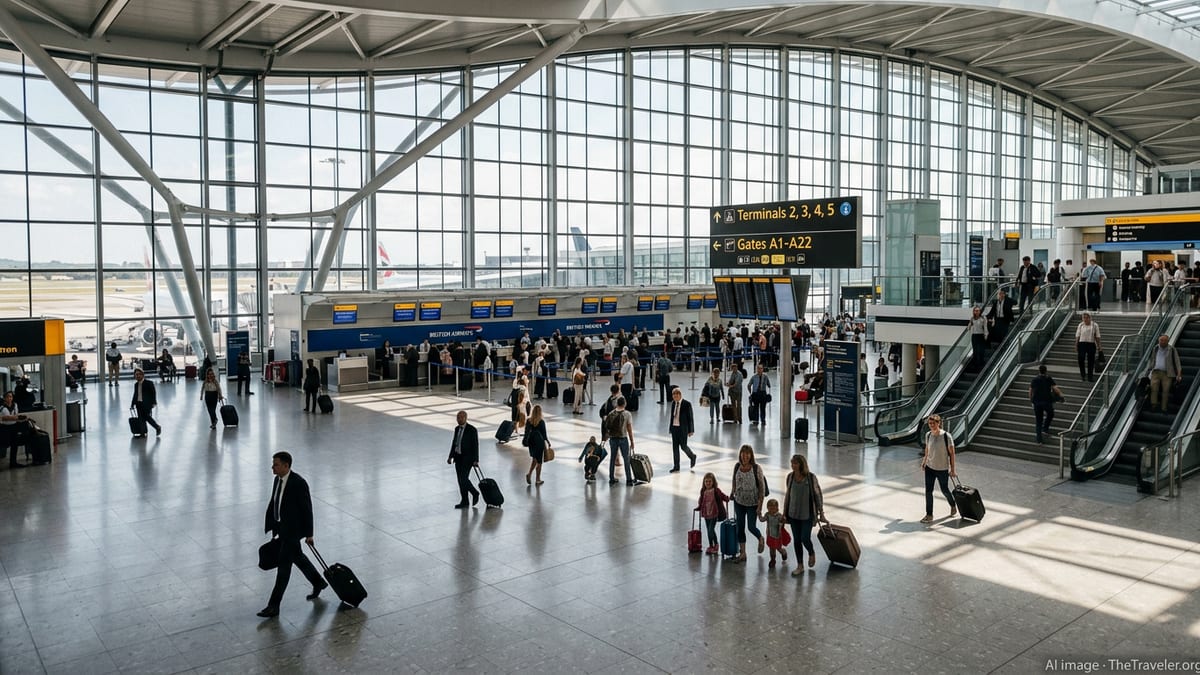
Heathrow in a Snapshot: The Big Picture Layout
Heathrow sits to the west of central London and operates four main terminals: Terminal 2, Terminal 3, Terminal 4 and Terminal 5. The old Terminal 1 is permanently closed. Terminals 2 and 3 share a central area between the two main runways, Terminal 4 stands alone on the southern side of the airport, and Terminal 5 occupies the far western side with its own satellite buildings. When you look at an airport map in the terminal or on your airline app, you will see this basic layout reflected very clearly.
Most passengers experience Heathrow in one of two ways. Either you arrive or depart from a single terminal and never leave its secure area, or you transfer between terminals as part of a longer international journey. In practice, this could mean landing from Chicago in Terminal 3 with American Airlines, then connecting onwards to Edinburgh with British Airways from Terminal 5. Understanding how those terminals relate to each other on the ground helps you plan realistic connection times and decide whether you can comfortably pick up a coffee or duty free before boarding.
The airport is roughly split into landside and airside zones. Landside covers everything before security checks, such as check in halls, ticket desks, train stations and public arrivals halls. Airside is the secure area after you clear security, where you find departure lounges, boarding gates, most duty free shops and airline lounges. Every terminal at Heathrow follows this same landside then airside structure, but facilities and walking distances can vary significantly between them.
Heathrow has its own transport spine running underneath and around the terminals, including a shared station complex for Terminals 2 and 3 and separate stations for Terminal 4 and Terminal 5. These are served by the Heathrow Express, Elizabeth line and London Underground’s Piccadilly line, which mirror the physical layout of the terminal clusters. For example, a Heathrow Express train from central London will first call at Terminal 2 and 3, then continue a few more minutes to Terminal 5, matching the east to west orientation of the airport.
Understanding Each Terminal’s Role and Layout
Each terminal at Heathrow has a slightly different character and airline mix. Terminal 2, branded The Queen’s Terminal, is the main Star Alliance hub and serves airlines such as United Airlines, Lufthansa and Air Canada. Its layout is relatively modern and compact, with a single main check in hall on the departure level, security at one end and a central airside concourse that branches out to the gate piers. Passengers arriving from New York with United, for example, will usually arrive at a pier gate and then follow a straightforward route to passport control and baggage reclaim on the lower level.
Terminal 3 is one of Heathrow’s older terminals but has been modernized in stages. It is used heavily by oneworld carriers like American Airlines and Cathay Pacific, as well as by Virgin Atlantic. Its landside layout includes a long check in hall with different airline zones, while airside you will find a circular-like arrangement of gates spread along several piers. The security area can see peaks during morning transatlantic departures, so a passenger flying to Los Angeles with Virgin Atlantic is advised to arrive at least three hours before departure to clear check in, security and reach the satellite gate areas.
Terminal 4, located on the southern side of the airfield, typically hosts many SkyTeam airlines along with various carriers from the Middle East, North Africa and Asia. Examples include Air France, KLM and some Gulf and regional airlines. Its isolated position means it has its own road access and rail station, and transfers to other terminals take a little longer. The internal layout is simple to understand, with a central check in hall feeding into a single main pier of gates. For a traveler arriving from Doha and connecting to a separate ticket flight from Terminal 2, planning an extra buffer for the landside transfer from Terminal 4 is essential.
Terminal 5 is the primary home of British Airways and handles the majority of its Heathrow flights, along with some Iberia services. It consists of a main building known as T5A and two satellite concourses, T5B and T5C, which are reached by an underground people mover. The landside area includes a multi level check in hall with different zones, while airside there is a central departure lounge with shops and restaurants surrounded by gate areas. A London to Johannesburg passenger will typically check in at the north end of the hall, pass through a bank of security lanes, then ride escalators down into the main shopping atrium before catching the shuttle train to the B or C satellite if required.
Landside: Check In, Arrivals and Ground Transport
On the landside of every terminal you will find three core elements organized in roughly the same order: ground transport access, check in and ticketing, and arrivals halls. For example, at Terminals 2 and 3 the train and Underground station is directly beneath the central area, with lifts and escalators bringing you up to the forecourts in a matter of minutes. Taxi ranks, ride share pick up points and bus stops are located just outside the doors, so a traveler stepping off the Elizabeth line from central London can be at the Terminal 2 check in desks within about five minutes of leaving the platform.
Check in halls at Heathrow are large, with rows of desks and self service kiosks grouped by airline or alliance. At Terminal 5, British Airways divides its check in into distinct zones labeled A through K, with full service desks for premium cabins and oversized baggage at one end and banks of self bag drop machines nearer the center. This physical zoning mirrors online information on boarding passes and the British Airways app, which will show your suggested zone. At Terminals 2, 3 and 4, airlines have dedicated islands, so signage such as "Lufthansa, United, Air Canada" or "Virgin Atlantic, Delta" guides you to the correct section.
Arrivals halls are always on a different level from departures, typically at ground level, and are clearly signed from baggage reclaim. When a flight from Tokyo lands in Terminal 3, passengers proceed through passport control, collect bags from one of the numbered carousels, and exit into a rectangular arrivals hall lined with currency exchange booths, coffee chains and meeting points. Friends and family wait behind barriers in front of sliding doors marked "Arrivals," a feature repeated across all terminals so that the meeting experience is intuitive even if you have never been to Heathrow before.
Ground transport options fan out from these arrivals halls. Taxis, private hire vehicles, hotel shuttles and local buses use lanes directly in front of each terminal, while longer distance coaches depart from marked bays. For example, a traveler arriving into Terminal 5 and heading to Oxford can follow signs to the coach stands and board a direct airport coach that typically runs throughout the day. This consistent arrangement at each terminal means that once you learn the pattern at one, navigating the rest becomes more straightforward.
Airside: Security, Departures Lounges and Gate Areas
Once you pass through security, you are in Heathrow’s airside world of departure lounges, shopping, dining and boarding gates. The layout is designed so that all passengers must pass through a central commercial area before reaching the gate zones. At Terminal 2, for instance, the security channels bring everyone into a bright central hall lined with duty free, cafes and mid range retailers. From there, broad corridors branch off toward different groups of gates, clearly signposted with ranges such as "Gates A1 to A26" or "Gates B31 to B49."
Security checkpoints themselves are usually located on the level above or behind the main check in hall, reached by escalators or lifts. At Terminal 5, passengers check in on the main concourse, then ride large escalators up one level to a bank of security lanes. Premium passengers and families may have access to dedicated lanes which often follow a parallel route but lead to the same airside departure lounge. In peak morning or evening waves, queues can stretch back into the escalator areas, so airlines routinely advise arriving two to three hours before departure on long haul routes.
Once airside, walking distances vary between terminals and even within them. Terminal 5 in particular can require additional time if your flight uses the B or C satellite buildings. After shopping or dining in the main T5A lounge, a passenger flying to San Diego might see on the screens that their gate is at B48. They then follow signs to the transit system, ride a short underground train to the B concourse and walk along a pier lined with further shops and seating before reaching the gate. In contrast, many gates at Terminal 2 are within a shorter walk from the main central lounge, which can be reassuring for less mobile travelers.
All terminals cluster airline lounges close to the main departure areas but slightly set back from the highest traffic corridors. For example, at Terminal 3 there is a well known cluster of oneworld lounges used by carriers like American Airlines, Cathay Pacific and Qantas, all accessed from a central corridor that branches off the main shopping zone. This makes it easy for eligible passengers to relax in a lounge, then walk ten minutes or less to reach their boarding gate once it is announced on the screens.
Connecting Between Terminals: Flight Connections and Landside Routes
Heathrow handles a large number of connecting passengers every day, and its layout includes both airside Flight Connections routes and landside public transport links between terminals. If your flights are on a single ticket and your bags are checked through, you will normally follow the purple Flight Connections signs immediately after leaving your inbound aircraft. For example, arriving at Terminal 3 from Boston and continuing to Madrid on British Airways from Terminal 5, you would not follow signs to Arrivals, but instead head to the dedicated connections bus and security area.
These airside connections routes use secure buses and corridors that run behind the scenes between the terminals, so you do not need to clear UK immigration. The process typically involves a brief document check, a bus ride that can take 10 to 20 minutes depending on routing and traffic, and a second pass through security before emerging airside in your departure terminal. Airline and airport guidance for international to international connections often suggests a minimum connection time of around 1 hour and 30 minutes, although complex routes or peak travel periods may require longer.
If you are connecting on separate tickets or need to collect baggage, you must use landside routes between terminals. In practice, this means exiting through Arrivals, collecting your bags, and then taking either the free Heathrow Express shuttle between Terminals 2 and 3 and Terminal 5, or the free Elizabeth line and Piccadilly line services in the Heathrow travel zone. For instance, a passenger arriving on an independent low cost flight into Terminal 4 and connecting to a Star Alliance flight from Terminal 2 could ride the free rail shuttle via the central station, then make the short walk from the shared station concourse up to Terminal 2 check in.
Time allowances for landside transfers should be generous, especially if you must recheck bags or change transport modes. Walking from the Terminal 2 and 3 station platforms to Terminal 3 check in can take around ten minutes when dragging luggage, and queues at check in and security can absorb another hour or more. Travelers who schedule separate tickets with only a 90 minute gap between scheduled arrival at Terminal 4 and departure from Terminal 5 are taking a risk; a more comfortable cushion of three to four hours is usually advisable at a large multi terminal airport like Heathrow.
Wayfinding, Signage and Practical Navigation Tips
Heathrow’s layout is supported by a consistent system of wayfinding and color coded signage. Flight Connections routes are marked with prominent purple signs, arrivals paths use clear white and yellow signage, and public transport is highlighted by well known symbols for the Underground, trains and buses. Inside the terminals, gate numbers are always grouped and listed on large digital boards, so a quick glance will show which pier or satellite your flight is departing from and how long the walk is estimated to be.
Real world experience shows that the key to navigating Heathrow is to trust the overhead signs rather than following crowds. For example, when emerging from security at Terminal 2, many passengers instinctively move toward the nearest shops, but the sign for "Gates B" might direct you down a quieter side corridor toward an escalator. Following this, rather than the majority flow, ensures you reach your remote gate in good time. Similarly, in Terminal 5, ignoring early shopping temptations until after you know whether your flight is using the B or C satellite can save you an extra shuttle train ride later.
Digital tools mirror the physical layout in useful ways. Many airlines, including British Airways and large alliance carriers, embed interactive maps of Heathrow in their mobile apps. These often highlight the distance and walking time from your current location to a specific gate or lounge. Airport information screens and announcements also reflect the terminal structure: gate numbers and boarding announcements are grouped by pier, and late gate changes will usually keep a flight within the same pier cluster to avoid major disruption.
For passengers with reduced mobility or traveling with small children, understanding the layout in advance allows you to request assistance at sensible points. All terminals have assistance desks near check in and at key arrivals exits, and electric carts or wheelchairs can be arranged to shuttle you through long corridors, particularly in Terminal 5 where the satellite buildings can add distance. Families often find it easier to regroup at clearly marked central meeting points in the departure lounge before walking to the gate together, instead of weaving back and forth among the shops.
Facilities, Services and How They Are Distributed
Facilities at Heathrow are distributed according to each terminal’s footprint and passenger mix, but there are common patterns that reflect the overall layout. Airside, you will usually find the largest concentration of food outlets and retail near the center of each terminal. Terminal 5, for example, has a multi level atrium with high street coffee chains, sit down restaurants and designer stores clustered around open seating areas. As you move farther down each pier toward the gates, shops become smaller and more functional, typically offering grab and go snacks, last minute travel essentials and newsstands.
Restrooms, water fountains and seating areas are spaced at regular intervals along the corridors and near gate clusters. Family rooms and baby changing facilities are usually close to the central lounge areas, while dedicated quiet zones and workspaces are common near lounges and some remote gates. A traveler waiting for a delayed evening flight from Terminal 4 to the Middle East might choose to sit in a quieter zone near the far end of the pier, where there are still clear views of the gate screens and staff but fewer crowds than in the main commercial area.
Landside facilities are oriented around arrivals and departures needs. Arrivals halls offer currency exchange kiosks, mobile SIM card counters, car hire desks and convenience shops, reflecting the needs of passengers just entering the country. Departures check in levels tend to emphasize baggage services, ticketing and info desks. For instance, at Terminal 3 you will see airline ticket counters along one side of the hall and oversized baggage handling points near the far ends, where travelers can check in surfboards, musical instruments or sports equipment before heading upstairs to security.
Airport hotels and car parks are arranged around the edges of the terminal clusters, with shuttle buses linking them to the forecourts. Many travelers choose a hotel near their departure terminal to simplify the last morning’s journey. Someone catching a 7 am British Airways flight from Terminal 5, for example, might stay at a hotel nearby the night before and take a five to ten minute shuttle ride directly to the T5 forecourt, rather than navigating inter terminal transfers during the early morning rush.
The Takeaway
Heathrow’s reputation as a complex mega hub is partly deserved, but once you understand how its terminals are laid out the airport becomes much easier to navigate. Four active terminals are spread across three main clusters, each with a similar internal pattern of landside arrivals and departures, followed by airside lounges and gate piers. Knowing in advance which terminal your airline uses and whether you will transfer airside or landside gives you a clear framework for planning connection times and ground transport.
For most journeys, the practical steps are simple: confirm your terminal, allow enough time to reach the correct check in hall, follow the signs for security, then keep an eye on the departure screens for your gate. If you are connecting between terminals, look first for the purple Flight Connections signs for through tickets, or use the free rail shuttles if you must exit and recheck bags. And if in doubt at any point, Heathrow’s layouts are supported by visible information desks, clear signage and staff who spend every day helping passengers move smoothly between the same set of well defined zones.
By viewing Heathrow not as a maze but as a series of linked but self contained terminal buildings, you can approach even tight connections and busy travel days with more confidence. The airport’s size will always mean some walking and waiting, but a basic understanding of its organization turns what might feel like an intimidating transit point into a manageable, even familiar, part of your journey.
FAQ
Q1. Which terminal is British Airways at Heathrow?
British Airways primarily operates from Terminal 5, although a number of its flights also depart from and arrive at Terminal 3.
Q2. How long does it take to transfer between terminals at Heathrow?
Airside Flight Connections between nearby terminals often take 45 to 90 minutes including security, while landside transfers with baggage can easily require two to three hours.
Q3. Do I need to go through security again when connecting at Heathrow?
Yes, even when you remain airside you will normally pass through a second security screening as part of the Flight Connections process between terminals.
Q4. Are the trains between Heathrow terminals free?
Yes, Heathrow Express, Elizabeth line and Piccadilly line services between the terminals within the airport zone are typically free, provided you remain within that zone.
Q5. How early should I arrive at Heathrow before my flight?
Most airlines recommend arriving about two hours before short haul European flights and around three hours before long haul departures, especially at busy times.
Q6. Which terminal is best for shopping and dining?
All terminals offer a range of shops and restaurants, but Terminal 5 and the renovated areas of Terminal 2 generally have the largest and most varied selections.
Q7. Can I walk between terminals at Heathrow?
Terminals 2 and 3 are within walking distance of each other via an underground walkway, but transfers to Terminals 4 and 5 are more practical by train or bus.
Q8. Where do I meet arriving passengers at Heathrow?
You should wait in the public arrivals hall of the correct terminal, directly in front of the sliding doors marked Arrivals, just beyond customs and baggage reclaim.
Q9. Is it possible to stay airside during an overnight layover at Heathrow?
In most cases the secure airside areas close overnight, so passengers with very long layovers are usually required to clear immigration and stay landside or in a nearby hotel.
Q10. How do I find my gate at Heathrow if it is not shown yet?
Gates often appear on departure boards 45 to 90 minutes before departure; until then, remain in the main departure lounge of your terminal and watch the screens for updates.