

Understanding Heathrow’s Overall Layout
Heathrow is laid out in three main clusters that you will see reflected on any airport map: the central area with Terminals 2 and 3, the southern area with Terminal 4, and the western area with Terminal 5. When you look at an airport diagram, picture two parallel runways with T2 and T3 roughly in the middle, T4 offset to the south near cargo and hotels, and T5 on its own to the west. Most transfers and wayfinding decisions start with understanding which of these three clusters you need.
On maps inside the terminal and on the Heathrow app, Terminals 2 and 3 are typically labeled as “Heathrow Central.” This is where you also find the Central Bus Station and the main rail hub for the Elizabeth line, Heathrow Express, and Piccadilly line. Terminal 4 has its own smaller rail station to the south, while Terminal 5 has a combined rail and Underground station to the west. If you are planning a connection, it helps to think in terms of “Central, South, West” rather than just terminal numbers.
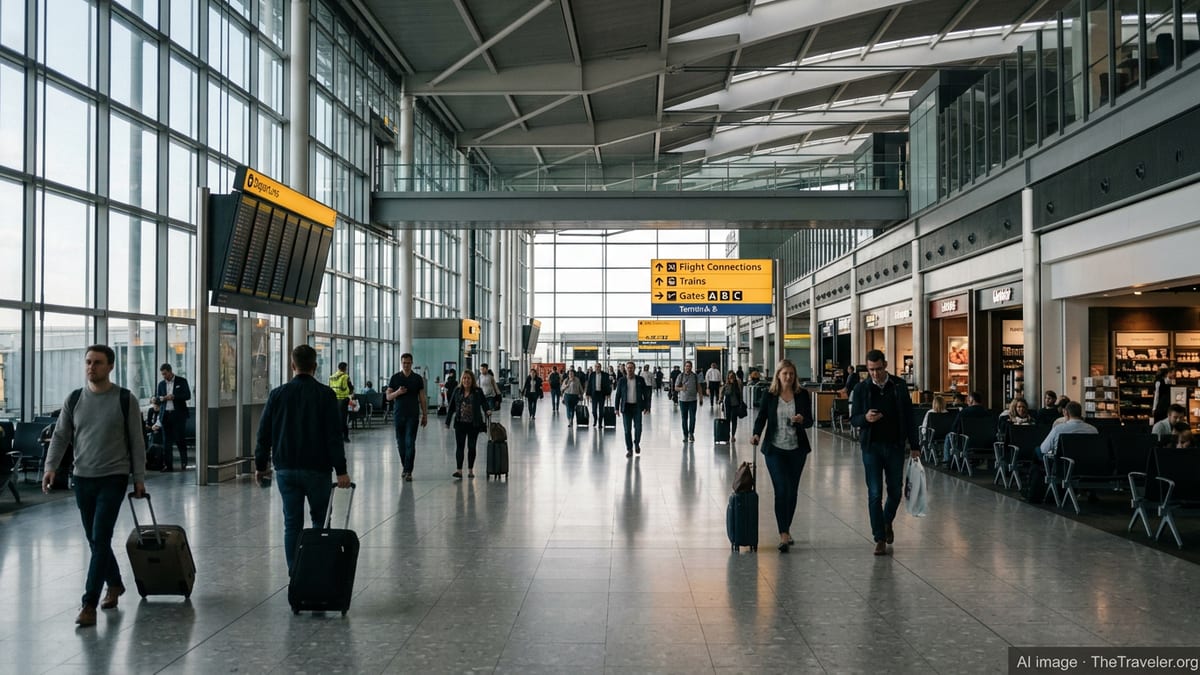
Heathrow’s maps distinguish clearly between “airside” and “landside” areas. Airside is everything after security, including gates, lounges, and the purple “Flight Connections” routes. Landside is before security, where you find check in, arrivals, car parks, and public transport. A key navigation decision is whether your journey keeps you airside between flights or whether you will exit to landside to recheck bags or change terminals independently.
For a practical example, imagine you arrive from New York into Terminal 3 and continue to Rome from Terminal 5 on the same ticket. On the map, you are moving from the central cluster (T3) to the western cluster (T5). If you follow the purple Flight Connections signs, your path will be airside and handled by dedicated buses and security checkpoints, so you never see the public arrivals halls. If instead you are self-connecting on separate tickets, you will follow signs to Arrivals, clear immigration, collect your luggage, and then use the free trains or Underground to travel landside from Heathrow Central to Terminal 5.
How to Read Heathrow Maps and Signs Quickly
Heathrow uses a consistent color system that mirrors what you see on printed and digital maps. Flight Connections areas and buses are typically shown in purple, while general terminal and gate information uses yellow boards with black text. Transport links such as the Elizabeth line and Piccadilly line appear with their familiar London rail colors. When you step off a plane, you can match what you saw online with the wall maps and overhead signs almost immediately by focusing on these color cues.
Large schematic maps are placed at key junctions: at the top of escalators, at main corridor intersections, just after security, and near rail and bus stations. These maps show simplified shapes of each terminal, marked with key zones such as “T2A” and “T2B” or “T5A,” “T5B,” and “T5C,” plus walking times in minutes. For example, you might see “T5A to T5C: 15 minutes including transit train.” Use those times as conservative estimates, especially if you walk slowly or are traveling with children.
Gate numbers are clustered by pier, which is clear both on maps and on the large departure boards. In Terminal 2, gates with a prefix “A” are in the main building, while “B” gates sit on a separate satellite pier reached via an underground walkway with travelators. In Terminal 5, A gates are in the main hall, B and C gates are on separate satellite buildings reached by an underground transit train and walkways. On the diagram, these satellites often look like branches extending from the main terminal block, and you should always allow extra walking time if your gate begins with B or C.
A useful real-world habit is to confirm your gate cluster as soon as it appears on the screen, then compare it to the map. For instance, if your British Airways flight from Heathrow to Edinburgh shows as “Gate A10, Terminal 5,” you know you are staying in T5A and can likely reach your gate in under 10 minutes from security. If a long-haul flight to Singapore shows “Gate C65,” the map will remind you that you need both the transit train and a longer walk, so you might leave the lounge 20 to 25 minutes before boarding time instead of the usual 10 to 15.
Terminal 2: The Queen’s Terminal in Practice
On maps, Terminal 2 appears as a main hall labeled T2A with a long satellite pier labeled T2B connected by an underground tunnel. T2 handles many Star Alliance airlines, so if you are flying with carriers such as Lufthansa, United Airlines, or Air Canada, you are likely to use this terminal. Check in and arrivals are both located in the main T2A building, with security feeding you into the central departures area before you branch off to your specific gate wing.
After security in T2A, you enter a large central plaza filled with shops and seating, clearly shown on the terminal map as the hub from which corridors to the A and B gates extend. If your boarding pass shows an A gate, you will remain in this main building. Walking times across T2A are typically under 10 minutes. If you are departing from a B gate, follow signs to “Gates B” and expect around 10 minutes of walking, including travelators, through the underground link. The maps emphasize this connection by indicating walking time and often depicting the tunnel with a distinctive shape.
For a concrete example, consider an itinerary where you land from Frankfurt with Lufthansa into a T2A gate and connect to a United Airlines flight to Chicago from a T2B gate. Airside maps will show a purple Flight Connections symbol directing you through a short corridor to resecurity if needed, then onward signage to the B gates tunnel. Even at a relaxed pace with a small bag, count on 15 to 20 minutes to get from an A gate through the hub and out to the B pier, which is why airlines often recommend at least 60 minutes for a same-terminal connection.
Landside, Terminal 2 connects directly to the Heathrow Central Bus Station and the shared Terminals 2 & 3 rail station via underground walkways. On broader airport maps, you will see a single cluster labeled “Terminals 2 & 3” for both the railway platforms and the Underground. Walking from T2 arrivals to the rail station typically takes around 5 minutes via signposted corridors. This is useful if you are arriving at T2 and heading straight into central London on the Elizabeth line or Heathrow Express, or if you need to get to another terminal using the free inter-terminal train services.
Terminal 3: Long Piers and Central Connections
Terminal 3 sits immediately west of Terminal 2 in the central cluster, and the two are linked airside by passageways and landside by shared walkways to the bus and rail hubs. Many long-haul carriers operate from T3, including several North American and Asian airlines, so maps for this terminal tend to emphasize multiple long gate piers radiating from a compact central departures core.
After security in T3, you enter a ring-shaped shopping and seating area. On terminal maps, this looks like a central circle or horseshoe with gate corridors branching off. Some piers can involve walks of 10 to 15 minutes from the main area, especially for the higher gate numbers at the far ends. For instance, if your flight to Los Angeles departs from a gate at the tip of a long pier, maps often highlight approximate walking times, reminding you not to wait until “boarding” is called before you leave the café or lounge.
If you are connecting between airlines that both use Terminal 3, such as a morning arrival from Boston and an onward afternoon flight to Madrid, the airport’s flight connection maps will direct you along internal corridors marked with purple Flight Connections signage. These diagrams show where you will pass through a dedicated security checkpoint before reentering the departure lounge. Realistically, moving from an arrival gate at one end of T3 to a departure gate at the opposite end can take 25 to 30 minutes including security and walking, so a 90-minute connection feels comfortable but a 60-minute one requires you to move briskly and avoid long detours in the shops.
For passengers arriving at T3 and heading into London, the maps make it clear that you share the same rail and bus infrastructure as T2. From T3 arrivals, expect about 10 minutes on foot through clearly signed underground passages to reach the Central Bus Station or the Terminals 2 & 3 rail and Underground platforms. If you have heavy luggage, trolleys are usually allowed along these walkways, and lifts are indicated clearly on the wayfinding diagrams.
Terminal 4 and Terminal 5: Separate but Connected
Terminal 4 is shown on Heathrow-wide maps as a stand alone building to the south of the main runways, served by its own rail and Underground station. It is often used by SkyTeam and other non alliance carriers, along with a range of long haul services. Because of its location, transfers between T4 and the other terminals almost always involve a train or shuttle bus, something that maps and route planners emphasize with arrows and timing notes between clusters.
When you land at T4 and are connecting to another terminal airside, follow the purple Flight Connections signs. You will typically be directed to a bus transfer route that appears on airport schematics linking T4 to the central terminals or to T5, depending on your ticket. Real world transfer times vary with traffic on the airfield roads, but it is prudent to allow at least 60 to 90 minutes total for a T4 to T3 or T5 connection, more if you are changing airline alliances and must recheck bags landside.
Terminal 5, home to British Airways and a few partner airlines, dominates the western part of Heathrow’s layout. On maps, it is depicted as a main building labeled T5A, flanked by two satellite buildings T5B and T5C, all linked by an underground transit system. Check in and security are in the T5A structure, which houses the main departures hall. Once airside, you might take escalators down to the transit train for B and C gates, or walk to nearby A gates. It is common for short haul European flights to use A gates, while long haul and busy flights use the satellites.
In practical terms, if your flight to Madrid leaves from a B gate, maps show a short transit ride of a few minutes followed by a further 5 to 10 minute walk to the far gates. For long haul departures to destinations like Johannesburg or Tokyo from C gates, add several extra minutes. Airlines often begin boarding 45 minutes before departure for long haul from these satellites, and the maps help you judge when to leave the main T5A shops or lounges to arrive on time without rushing.
Moving Between Terminals: Trains, Buses, and Walking Routes
Heathrow’s airport wide maps highlight three primary ways to move between terminals: free rail services, the London Underground, and dedicated buses. For landside transfers within the airport boundary, the Elizabeth line and Heathrow Express trains shuttle between Heathrow Central (Terminals 2 & 3) and Terminal 5, while separate services and the Piccadilly line link to Terminal 4. The airport indicates that inter terminal rail travel on these routes is free, as long as you stay inside the Heathrow stations’ ticketed zone and follow the guidance provided at the machines and gates.
If, for example, you land at Terminal 2 and need to check in for a separate flight from Terminal 5, the map route is straightforward: from T2 arrivals follow signs along the underground walkway to the “Trains” icon, descend to the Heathrow Central platforms, then board the next Elizabeth line or Heathrow Express service to Terminal 5. The ride itself takes only a few minutes, and trains typically run every 15 minutes or better during the day. In typical conditions, you can go from walking out of T2 arrivals to standing in T5 check in in around 20 to 30 minutes, not counting airline queue times.
Heathrow maps also show the Piccadilly line as a cheaper, all stop option connecting the terminals, but for pure inter terminal transfers many travelers find the Elizabeth line or Heathrow Express quicker and easier because of the simple platform layout and larger luggage spaces. A common real world pattern is to use the free Heathrow Express between Terminals 2 & 3 and Terminal 5 when you are self connecting on separate tickets, then switch to the Underground or Elizabeth line only once you are ready to head into central London.
Bus routes appear on dedicated airport transport maps, with icons for the Central Bus Station by Terminals 2 & 3 and smaller bus areas at Terminals 4 and 5. There is also a free travel zone on certain local buses around the airport perimeter. This can be useful if, for example, you land at T4 and stay overnight at a nearby hotel on Bath Road, then catch a free local bus back to T2 the next morning. The maps usually highlight which bus stops and sectors fall inside the free zone, but if you are short on time, trains remain the simpler option for navigating between terminals.
Airside Connections and Minimum Times
For passengers transferring between flights on a single ticket, Heathrow’s Flight Connections maps and signage are critical. As soon as you disembark, watch for the purple “Flight Connections” signs rather than heading to Arrivals. These directional signs usually appear before you reach immigration and direct you through corridors, escalators, or buses toward a dedicated connections security point and then back into the departure level of your onward terminal.
Official guidance suggests that same terminal international connections can often be done in around 60 minutes, while more complex combinations such as Terminal 5 to Terminal 3 or Terminal 4 to Terminal 5 may require 90 minutes or more. Your airline’s booking engine will usually enforce a minimum connection time when you buy a through ticket. For example, a through ticket from Chicago to Edinburgh via Heathrow on a single carrier might give you a 1 hour 40 minute layover in Terminal 5, which is generally considered adequate when your bag is checked through and you follow the purple signs promptly.
Real world experience, however, shows that walking distances, security queues, and late inbound flights can all eat into that buffer. On the ground, this means you should treat the walking times printed on terminal maps as the minimum and add a few minutes for comfort. If maps show “T2A to T2B: 10 minutes,” assume 15, especially at peak times. If Heathrow’s connection tools show that your T3 arrival and T5 departure are linked by a bus and further security screening, board the first available transfer bus and avoid detours into shops before clearing security.
One practical example: imagine you land from Toronto at Terminal 3 at 10:00 and your onward flight from Terminal 5 to Glasgow leaves at 11:40 on the same ticket. On paper this 1 hour 40 minute connection fits typical guidelines. In practice, it might take 10 to 15 minutes to reach the Flight Connections area, another 10 to 20 minutes for transfer security, 10 minutes for the airside bus ride and disembarkation at T5, and finally 10 to 15 minutes to get from the T5 arrivals level through the departure lounge to your UK domestic gate. Following airport maps and signage efficiently, and avoiding unnecessary stops until you are through T5 security, can make the difference between an easy walk and a rushed jog.
Self Connections, Arrivals, and Ground Transport
Self connecting means you have booked separate tickets that the airlines do not recognize as a single journey. In that case, Heathrow’s maps and signs will not treat you as a connecting passenger, and you must follow the Arrivals route, collect your luggage, and then use landside routes to recheck it. This usually involves navigating from your arrival terminal to another terminal’s departures area using the trains, Underground, or buses shown on the broader airport map.
Suppose you arrive from Dubai on an airline using Terminal 3 and have a separate low cost ticket from Terminal 4 later that morning. After following the Arrivals signs at T3, you clear UK border control, collect your bag, and exit into the public arrivals hall. From there, you follow overhead signs to “Trains and Underground,” walk the 10 minutes or so to the Terminals 2 & 3 rail and Underground station, then either take the Piccadilly line or dedicated rail services to Terminal 4. On maps, this looks like a simple one stop ride from the central cluster to the southern cluster, but in time it usually takes 45 to 75 minutes from plane door to the check in queue at T4, depending on queues.
If your goal is to reach central London rather than another terminal, Heathrow maps also highlight three main rail options. The fastest is the premium non stop service to Paddington, mid priced and rapid Elizabeth line services that stop at multiple central London stations, and the budget friendly Piccadilly line that runs directly into the Underground network. For example, a traveler landing at T5 might walk 5 to 10 minutes from arrivals to the underground platforms, ride the Elizabeth line to central London in roughly half an hour, and change to other Tube lines as needed.
For coaches and buses, the Central Bus Station between Terminals 2 and 3 is the key landmark. Maps show it directly above the rail and Underground station, linked by escalators and lifts. This is where you find long distance coaches to cities like Bristol, Cardiff, Birmingham, and Oxford, along with local buses to west London and nearby towns. If you land at T5 and have a coach from the Central Bus Station, budget around 30 to 40 minutes to get from the plane, through arrivals, onto the free train to Heathrow Central, and then up to the bus stands, following the route indicated on the combined rail and bus station map.
The Takeaway
Heathrow’s size can be intimidating when you view it as a tangle of numbers, letters, and acronyms, but it becomes much simpler once you anchor yourself with a mental map of the three terminal clusters and the key transport links between them. Whether you are connecting airside via the purple Flight Connections routes or self connecting landside using the free inter terminal trains, most journeys boil down to following consistent colors, symbols, and walking time markers that are repeated on physical maps, screens, and the Heathrow app.
In practice, the best strategy is to check your terminal and likely gate cluster before you fly, study the basic layout of that terminal for five minutes, and then, on arrival, trust but verify by glancing at the big wall maps as you follow the overhead signs. Give yourself more time than the printed minimums for long piers and satellite buildings, especially in Terminals 2 and 5, and move directly toward connections or ground transport before stopping to shop or eat. With this approach, Heathrow turns from a confusing mega hub into an airport you can navigate with the same confidence as a frequent flyer.
FAQ
Q1. How much time do I need to connect between terminals at Heathrow?
Most travelers should allow at least 60 minutes for same terminal international connections and 90 minutes or more when changing terminals, especially between Terminal 4 or 5 and the central terminals. If you are on a single ticket, your airline will only sell you an itinerary that meets its minimum connection time, but adding an extra half hour where possible is sensible, particularly during busy morning and evening peaks.
Q2. Are the trains between Heathrow terminals really free?
Certain Heathrow rail services between terminals are free within the airport boundary. This typically applies to the trains shuttling between Heathrow Central for Terminals 2 and 3 and Terminal 5, and selected services serving Terminal 4. You may need to tap a bank card, Oyster card, or collect a free inter terminal ticket from machines to open the gates, but no fare is charged for those specific short journeys.
Q3. What is the easiest way to get from Terminal 2 to Terminal 5?
The simplest landside route from Terminal 2 to Terminal 5 is to follow signs from T2 arrivals to the rail and Underground station at Terminals 2 and 3, then board the next free Heathrow Express or Elizabeth line service to Terminal 5. The ride itself is only a few minutes, and trains typically run at least every 15 minutes during the day. Overall, expect about 20 to 30 minutes from leaving baggage claim at T2 to reaching the T5 departures level, not including airline check in queues.
Q4. Can I walk between Heathrow terminals instead of taking a train or bus?
You can walk between some central facilities such as Terminal 2, Terminal 3, the Central Bus Station, and the shared rail and Underground station using underground walkways. However, longer walks directly along the perimeter roads between clusters like Terminal 4 or Terminal 5 and the central terminals are not practical or recommended for most travelers. For those moves, Heathrow’s free trains or inter terminal buses shown on the airport maps are a much better option.
Q5. How do I find my gate in Terminal 5’s B and C satellites?
Once you clear security in Terminal 5, check the departure boards to see if your flight is assigned to an A, B, or C gate. If it is a B or C gate, follow signs and terminal maps to the transit train, which runs frequently between T5A, T5B, and T5C. After disembarking, allow another 5 to 10 minutes to walk along the pier to your exact gate. Airlines recommend that you leave the main lounge or shopping area at least 20 to 25 minutes before the boarding time when heading to B or C gates.
Q6. I am self connecting on separate tickets. Should I follow Flight Connections signs?
If you are self connecting, you should follow the Arrivals signs, not the purple Flight Connections signs, unless your second airline has confirmed it will transfer your bag and treat the trip as a through ticket. After you enter the arrivals hall and collect your luggage, follow the maps to the trains or buses linking your arrival terminal to your departure terminal. Then check in again landside as if starting a separate journey.
Q7. Where can I find the main bus and coach station at Heathrow?
The Central Bus Station is located between Terminals 2 and 3 and is clearly marked on airport maps. It sits above the Terminals 2 and 3 rail and Underground station and is linked by lifts, escalators, and indoor walkways. Long distance coaches to many UK cities and numerous local buses depart from here. If you arrive at Terminals 4 or 5, you will need to take a free inter terminal train or Underground service to Heathrow Central to reach the bus station.
Q8. How accessible is Heathrow for travelers with reduced mobility?
Heathrow’s terminal maps show lifts, step free routes, and accessible restrooms in each building. The underground walkways between Terminals 2, 3, and the transport hubs include elevators and ramps, and the trains linking the terminals are designed to handle wheelchairs and mobility aids. If you request assistance from your airline in advance, staff can meet you at the aircraft and guide you along the most accessible paths marked on the airport’s diagrams.
Q9. Do I go through UK immigration on every Heathrow connection?
Whether you pass through UK border control depends on your routing and ticket type. If you are connecting internationally on a single ticket and remain airside via the Flight Connections route, you normally do not clear full UK immigration. If you are connecting to a domestic UK or Ireland flight, or you are self connecting on separate tickets, you will typically follow the Arrivals route, pass through passport control, collect your bags, and then proceed to your onward check in.
Q10. Is the Heathrow map on the airport app worth using, or are signs enough?
The overhead signs and large wall maps are usually sufficient for most travelers, but the official Heathrow app can be very helpful if you are unfamiliar with the airport or have a tight connection. The app’s maps often show live estimates of walking times to your gate and clear diagrams of train and bus routes between terminals. Many travelers use a combination of both: they glance at the app while seated or in a queue, then confirm with the physical signs when it is time to move.