

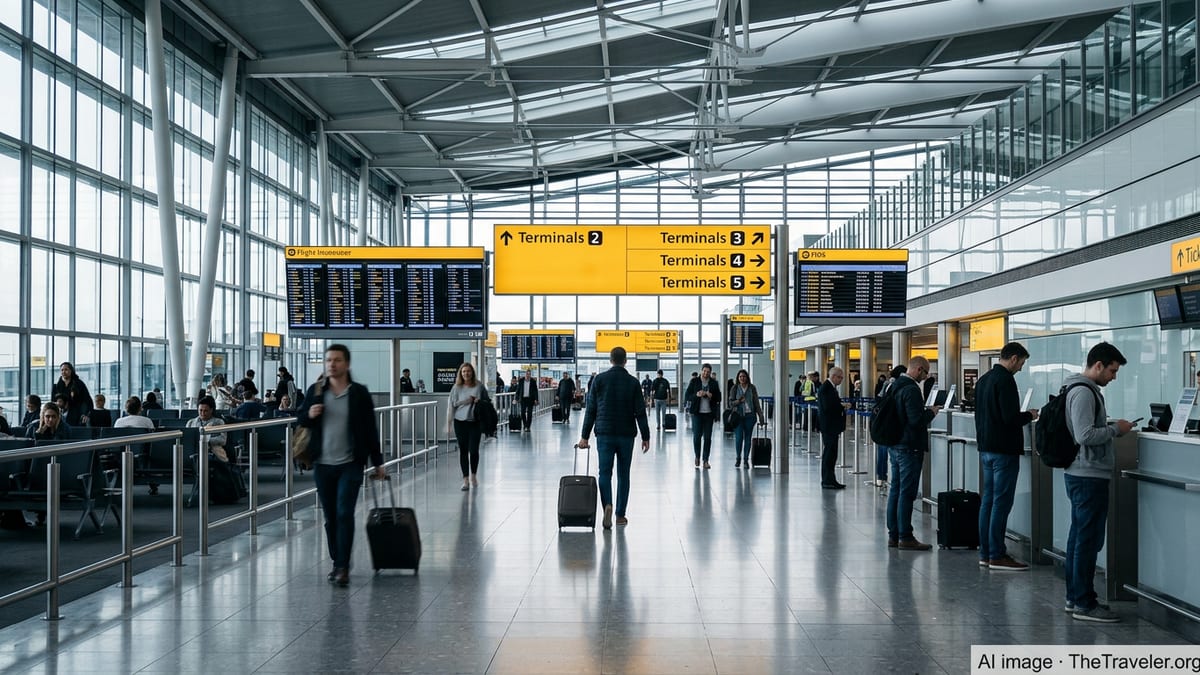
Heathrow at a Glance: How the Terminals Are Organized
Heathrow currently has four active passenger terminals: Terminal 2, Terminal 3, Terminal 4, and Terminal 5. Terminal 1 closed to passengers in 2015 and is being demolished as part of a long-term plan to expand Terminal 2, while Terminal 3 is expected to be phased out later in the next decade if expansion plans go ahead. For now, all four active terminals are fully operational and busy.
Terminals 2 and 3 sit in the central area of the airport, close together and sharing the same Heathrow Underground and Heathrow Express station. From these stations you can reach London Paddington in about 15 to 20 minutes on the Heathrow Express, or central London in roughly 45 to 60 minutes on the Piccadilly line, depending on where you are going and the time of day.
Terminal 4 is on the southern side of the airfield, connected to the central terminals by a free shuttle train on the Elizabeth line and Heathrow Express spur, as well as buses. Terminal 5 lies to the west, with its own dedicated Underground and rail station. Both Terminal 4 and Terminal 5 feel more self-contained, with their own check-in halls, security areas, and arrival facilities geared to the airlines that use them most.
In practice, you can think of Heathrow’s layout like this: Terminal 2 for Star Alliance, Terminal 5 for British Airways and Iberia, Terminal 4 for many SkyTeam and Gulf carriers, and Terminal 3 for a mix of long-haul airlines and oneworld partners such as American Airlines and Japan Airlines. There are exceptions, but this mental map is a helpful starting point when you glance at your ticket or app and see which terminal you need.
Terminal 2: The Queen’s Terminal and Star Alliance Hub
Terminal 2, often called The Queen’s Terminal, is Heathrow’s newest large terminal building and the main base for Star Alliance airlines at the airport. If you are flying Lufthansa to Frankfurt, United Airlines to Newark, or Air Canada to Toronto, you are very likely to be using Terminal 2. Other Star Alliance carriers such as Singapore Airlines, ANA and Swiss also operate here, which makes connections between Star Alliance airlines much easier than in the past.
In addition to Star Alliance, a small number of non-alliance airlines use Terminal 2. For example, Aer Lingus typically operates its Heathrow flights to Dublin and Cork from Terminal 2, which is useful if you are connecting between North American Star Alliance flights and Aer Lingus services to Ireland. Turkish Airlines also bases its Heathrow operations here, so a typical itinerary might see you arriving on United from Chicago and connecting onward to Istanbul on Turkish without needing to change terminals.
Terminal 2 handles both UK domestic and international flights. You might, for instance, arrive from Edinburgh with a domestic flight in the morning and connect to a mid-day Lufthansa departure to Munich from the same terminal. Walking distances are moderate, and most connections within Terminal 2 are straightforward, though you still need to allow sufficient time for security and passport control when changing from non-UK to UK flights.
Facilities in Terminal 2 are modern and geared towards transfer passengers. Security is usually efficient, but it can still be busy at peak times such as early morning and evening long-haul banks. Lounges for Star Alliance airlines are concentrated in the departures area, and the main shopping and dining zone includes familiar high-street brands alongside duty free, coffee chains, and sit-down restaurants, with typical quick meals ranging from about £8 to £20 depending on whether you choose a sandwich shop or a full-service restaurant.
Terminal 3: oneworld Partners, Premium Long Haul and Mix of Carriers
Terminal 3 is one of Heathrow’s older terminals, but it remains important because of the airlines that use it. Many oneworld alliance partners operate from Terminal 3, including American Airlines on routes such as London to Dallas Fort Worth or Miami, Cathay Pacific to Hong Kong, Japan Airlines to Tokyo, Qantas to Sydney via Singapore, and Finnair on some flights to Helsinki. Japan Airlines, for example, confirms its Heathrow operations from Terminal 3 in early 2026, which is helpful if you are planning a oneworld connection through London.
British Airways also operates a selection of services from Terminal 3, especially some long-haul routes and seasonal destinations that supplement its main base in Terminal 5. An example is British Airways’ announced seasonal service from Heathrow to Tivat in Montenegro using Terminal 3. In practice, this means a BA customer might fly into Terminal 5 from Glasgow and then connect across the airport by transfer bus to Terminal 3 for the onward holiday flight.
In addition to oneworld carriers, Terminal 3 hosts several major long-haul airlines outside of the global alliances. Virgin Atlantic, for example, operates most of its Heathrow routes from Terminal 3, including flights to cities such as New York, Los Angeles and Johannesburg. Some SkyTeam airlines also use Terminal 3 rather than Terminal 4, such as Delta Air Lines and China Airlines, so passengers should always check their booking or airline app instead of assuming all SkyTeam flights depart from Terminal 4.
Terminal 3 has a wide variety of lounges and retail, including independent lounges like Clubrooms by No1 Lounges, which opened a more premium space in 2025. This can be a good option if you are flying in economy but want a quieter environment with hot food, drinks and workspace for a few hours before a long-haul flight. Expect to pay in the region of £35 to £60 per person for entry, depending on the time slot and inclusions, with advance bookings usually cheaper than paying at the door.
Terminal 4: SkyTeam, Gulf Carriers and Emerging Airlines
Terminal 4, located on the southern perimeter of Heathrow, is home to many SkyTeam airlines and several Middle Eastern carriers. If you are flying Air France to Paris Charles de Gaulle, KLM to Amsterdam, or Saudia to Jeddah, there is a strong chance you will be departing from Terminal 4. Other SkyTeam members such as Korean Air, China Eastern and Vietnam Airlines typically use this terminal too, which is convenient for passengers planning multi-stop trips within the alliance.
Terminal 4 also attracts a cluster of Gulf and regional carriers. Saudia operates from here, and a new Saudi carrier, Riyadh Air, has announced plans to run a daily Boeing 787-9 service to Heathrow Terminal 4 by late 2025, reinforcing Terminal 4’s role as a hub for flights connecting Europe with the Middle East and beyond. Additional airlines from Africa and Asia also use this terminal, so you will often find long queues around late evening banks when multiple long-haul departures leave within a short window.
In September 2025, Terminal 4 briefly made headlines when part of the departures area was evacuated as a precaution due to a suspected hazardous substance incident. Operations resumed the same day and there has been no lasting impact, but this episode is a reminder that security and safety procedures at major hubs can sometimes trigger short-notice disruption. For travelers, the practical takeaway is to allow a margin of time for check-in and security, especially if you are catching an evening long-haul flight from Terminal 4 when the building is at its busiest.
Reaching Terminal 4 is slightly different from the central area. From Terminals 2 and 3, you can take a free shuttle train to Terminal 4, usually every 10 to 15 minutes, or use free local buses. From central London, the Piccadilly line of the Underground and some Elizabeth line or Heathrow Express services run via the central terminals, where you can transfer onward to Terminal 4. Journey time by Underground from central London typically ranges from 45 to 60 minutes depending on your starting point and time of day.
Terminal 5: British Airways, Iberia and Dedicated Facilities
Terminal 5 is Heathrow’s flagship terminal and the primary base for British Airways. Most BA flights operate from Terminal 5, including a substantial mix of domestic UK services, European short-haul routes such as London to Rome or Barcelona, and long-haul destinations worldwide. Iberia, British Airways’ sister airline, also operates from Terminal 5, which makes connections between London and Madrid straightforward within the same terminal.
In practical terms, if your boarding pass shows a British Airways flight number and your destination is not specifically listed as departing from Terminal 3, you can generally expect to be using Terminal 5. For example, a business traveler flying from New York JFK to London on BA and then onwards to Manchester or Edinburgh can often make a same-terminal connection within Terminal 5, moving through dedicated flight connections channels instead of reclaiming bags and going through arrivals.
Terminal 5 is split into several buildings. T5A is the main terminal with the majority of shops, restaurants and security lanes. T5B and T5C are satellite piers connected by an automated people mover and underground walkways. You will go through security in T5A and then use escalators and trains to reach the B or C gates if needed. Most domestic and many European flights depart from A gates, while some long-haul services use B or C gates, so be sure to check the gate screens once you clear security.
As with any large hub, security at Terminal 5 can be busy at peak times, especially early mornings from about 06:00 to 09:00 and evening long-haul waves from about 17:00 onwards. British Airways offers fast-track security to eligible premium cabin and elite-status customers, and there are several BA lounges across the T5 complex. Regular economy passengers can access independent lounges for a fee, or simply use the main concourse cafes and restaurants, where a typical coffee might cost around £3 to £4 and sit-down meals from £15 upward.
Getting Between Terminals: Transfers, Times and Realistic Expectations
Because different airlines and alliances use different terminals, many passengers need to transfer between terminals at Heathrow. The exact process depends on whether you are on a single ticket with through-checked baggage or on separate tickets where you must collect and re-check your bags. On a single ticket, you usually follow purple “Flight Connections” signs and use dedicated buses or corridors between security and departure areas without passing through UK immigration.
A common example is a Star Alliance connection within Terminal 2 or between Terminals 2 and 3. If you arrive in Terminal 2 on a United Airlines flight from the United States and then connect to a Lufthansa flight to Germany, both flights may depart from Terminal 2, meaning your transfer can be as simple as walking between gates after security. However, if you arrive on a Singapore Airlines flight into Terminal 2 and connect to a Virgin Atlantic flight in Terminal 3 on separate tickets, you might have to enter the UK, collect your bags, walk or take a short shuttle to Terminal 3, re-check your luggage, and go through security again.
Transfers between the central terminals (2 and 3) and Terminal 5 are handled mainly by flight connections buses when you stay airside. If you arrive on a British Airways service into Terminal 5 and connect to a BA or oneworld partner in Terminal 3, airport signs route you to a transfer bus, with typical transfer times from aircraft door to new gate ranging anywhere from 60 to 120 minutes in busy periods. For self-connecting passengers who need to go landside, a realistic estimate is at least 3 hours between scheduled arrival and departure times, especially if you have to clear immigration and re-check baggage.
Transfers involving Terminal 4 can take longer because of its location. For airside connections, you may take a dedicated bus from Terminal 5 or the central terminals to Terminal 4 following the flight connections signage. Airport regulars frequently describe Terminal 4 to Terminal 5 as one of the slowest transfers, so self-connecting travelers should be cautious about booking tight layovers here. A 3.5-hour window without checked luggage might be workable for a confident traveler who moves quickly and encounters no delays, but many people prefer 4 hours or more when connecting on separate tickets, especially at busy travel times such as summer weekends or school holidays.
Practical Tips for Check-in, Security and Arrivals in 2026
For most flights departing Heathrow, airlines open check-in about three hours before long-haul departures and two hours before short-haul flights, with some flexibility early in the morning when counters open for the day. Many carriers now strongly encourage or require online check-in via app or website, which can shorten your time at the airport if you are traveling with hand luggage only. For example, British Airways, Lufthansa and Air France all support mobile boarding passes that you can store in your phone wallet, often combined with automated bag-drop kiosks at the terminal.
Security rules at Heathrow broadly follow UK and European standards. You will still need to remove laptops and large electronics from your bag in many lanes, though new security scanners are being introduced in stages and may eventually reduce the need to remove liquids and laptops. For now, assume that the usual 100 millilitre liquid rule applies and pack accordingly, using a single clear plastic bag for liquids in your hand luggage. Queues can be unpredictable, but arriving 2 to 3 hours before departure is a sensible guideline for most economy passengers.
On arrival, non-UK and non-Irish passengers typically pass through passport control where automated e-gates are available to many nationalities, including citizens of the European Union, the United States, Canada, Australia, New Zealand and several other countries. Processing times can range from a few minutes at quiet times to longer waits during busy morning or late-evening banks when several wide-body aircraft arrive close together. Baggage delivery times also vary by terminal and time of day, but 20 to 45 minutes from landing to first bags on the belt is a reasonable expectation on most days.
For transport into London, all four terminals offer access to the Underground’s Piccadilly line and to rail services. From the central area (Terminals 2 and 3) and Terminal 5, the Heathrow Express or Elizabeth line can take you to London Paddington in around 15 to 30 minutes, with fares varying depending on how far in advance you book and whether you travel off-peak. From Terminal 4, you can use a short shuttle train to the central area or to Terminal 5 to pick up the main services. Black cabs and app-based private hire cars are available outside each arrivals hall; into central London, expect a typical taxi fare in the region of £60 to £100 depending on traffic, time and exact destination.
The Takeaway
The key to handling Heathrow with confidence is to focus on your terminal. Once you know whether you are using Terminal 2, 3, 4 or 5, everything from transport into London to lounge options and transfer times becomes more predictable. Star Alliance and Aer Lingus travelers gravitate to the modern Terminal 2, many oneworld and long-haul carriers gather in Terminal 3, SkyTeam and several Gulf airlines cluster in Terminal 4, and British Airways and Iberia dominate Terminal 5.
Real-world examples help bring this to life. A family flying from New York to Rome on Star Alliance might arrive on United into Terminal 2 and then walk to a connecting Lufthansa or Swiss flight in the same terminal. A business traveler heading from Manchester to Johannesburg on British Airways may check in and connect entirely within Terminal 5. A leisure traveler booked on separate tickets from a low-cost European carrier into Terminal 3 and onward on a Middle Eastern airline from Terminal 4 should plan for a longer, more complex transfer involving a change of terminals and another trip through security.
Heathrow will continue to evolve in the coming years, with plans for a third runway and major terminal changes still under discussion. For 2026, though, the basics remain stable: know your terminal, arrive with enough time, follow the signs carefully, and use your airline’s app for live updates on gates and schedules. With that approach, even one of the world’s busiest airports becomes manageable, and your time at Heathrow can be a smooth part of your journey rather than a source of stress.
FAQ
Q1. How do I find out which terminal my flight uses at Heathrow?
Check your booking confirmation, e-ticket or airline app, where the terminal is usually listed next to the flight number. If it is not shown or you are unsure, use the airline’s website or contact the carrier directly shortly before travel, as terminal assignments can change for operational reasons.
Q2. Is it possible to walk between Heathrow terminals?
You can walk between Terminals 2 and 3 using clearly signed pedestrian walkways in the central area, which typically takes around 10 minutes. For Terminal 4 and Terminal 5, practical transfer options are trains and buses, not walking, due to their distance from the central terminals and the airfield layout.
Q3. How much time should I allow for a terminal change on a single ticket?
If your flights are on a single ticket with through-checked luggage, most airlines and the airport consider 90 minutes a typical minimum connection time between terminals, though this can vary by route and carrier. Arriving earlier or booking a longer layover is often wise, especially during peak travel seasons or if you prefer a more relaxed transfer.
Q4. What if I am on separate tickets and have to change terminals?
On separate tickets, you usually need to enter the UK, collect your baggage, change terminals using train or bus, then check in again and pass through security. In this case, 3 to 4 hours between scheduled arrival and departure times is a safer guideline, particularly for transfers involving Terminal 4 or Terminal 5 or when you are unfamiliar with the airport.
Q5. Does every airline in an alliance always use the same Heathrow terminal?
No. While Star Alliance generally uses Terminal 2, many SkyTeam carriers use Terminal 4 and most oneworld partners use Terminals 3 or 5, there are exceptions. For instance, some SkyTeam airlines use Terminal 3, and British Airways splits a portion of its flights between Terminal 5 and Terminal 3, so you should always verify your specific flight’s terminal before you set out.
Q6. Are security procedures different between terminals?
Security rules are largely the same across all Heathrow terminals, following UK regulations on liquids, electronics and personal items. What differs is the layout, staffing and volume of passengers at any given time, which means queues can be longer in some terminals during peak hours. Arriving early and having your liquids and electronics ready for screening helps to speed things up wherever you depart.
Q7. Can I use lounges in a different terminal from my departure gate?
In most cases, you can only use lounges in the terminal you are departing from, because you need to clear security and remain airside near your gate. Even if you could technically leave one terminal and enter another landside, the time required to re-clear security usually makes it impractical. Plan lounge visits in the same terminal as your departing flight and allow time to reach your gate.
Q8. How do I get from Heathrow to central London from any terminal?
All terminals connect to central London by the Underground’s Piccadilly line and by rail. From Terminals 2 and 3 and Terminal 5, you can take Heathrow Express or Elizabeth line trains to London Paddington, while Terminal 4 is linked by a short shuttle train to the central area or Terminal 5 where you can join mainline services. Taxis and private hire cars are also available at each arrivals forecourt if you prefer door-to-door travel.
Q9. What happens if my terminal changes close to departure?
Occasionally, airlines switch terminals at short notice for operational reasons. If this happens, your airline should notify you via email, text message or its app. The airport flight information screens and announcements in the terminals also reflect any changes. If you arrive at the wrong terminal, staff can direct you to the correct one using trains or buses, but this can add extra time, so checking your terminal on the day of travel is important.
Q10. Are there plans to close or move any Heathrow terminals in the future?
Heathrow has long-term proposals for a third runway and a reconfiguration of the terminal layout, including expanding Terminal 2 and ultimately closing Terminal 3. However, these projects are subject to regulatory approvals, government decisions and investment timelines. For travelers in 2026, the practical reality is that Terminals 2, 3, 4 and 5 all remain open and you should rely on your airline’s most recent information rather than future planning documents.