

More news on this day
Passenger numbers through Nigeria’s airports are rising again after the pandemic shock, yet a decade of weak growth, shrinking domestic capacity and underperforming infrastructure has left the country’s air transport sector punching well below the weight of its 200‑million‑plus population.
Get the latest news straight to your inbox!
A Flat Line Behind Recent Passenger Gains
Federal Airports Authority of Nigeria data indicates that total passenger movements across the country’s airports reached about 12.5 million in 2024, slightly below the 13.4 million recorded in 2023 despite modest growth on international routes. Domestic and international flows combined remain in the same band as mid‑2010s levels, when Nigeria’s aviation market was already described as underpenetrated for the size of its economy and population. Industry analyses drawing on FAAN statistics for 2013 to 2021 show total passenger numbers hovering around 15 to 17 million in the pre‑pandemic years, underlining how the sector has struggled to break out of a narrow range even before Covid‑19 disruptions.
Recent figures point to a structural shift rather than a broad‑based expansion. International traffic has grown more robustly, with movements on overseas services reported to have climbed by more than 16 percent between 2022 and 2024. By contrast, domestic traffic has been far more volatile, with local airlines cutting capacity or exiting routes in response to surging costs and currency pressures. For travelers inside Nigeria, this has translated into fewer choices, higher fares and, in many cases, a return to road transport despite security and time concerns.
The stagnation stands out more starkly when set against Nigeria’s demographic and economic trajectory. The country has added tens of millions of residents over the past decade, and its largest cities have expanded rapidly. Yet air travel volumes have not followed the same upward curve, suggesting that aviation has become less accessible in real terms, particularly for middle‑ and lower‑income passengers who once represented a growing share of domestic demand.
Costs, Currency and the Squeeze on Nigerian Carriers
Escalating operating costs sit at the heart of Nigeria’s stalled air travel growth. Jet fuel prices, already a major expense line for airlines worldwide, have risen sharply in local currency terms, with sector commentary highlighting a jump in Jet A1 from below 900 naira per litre at the end of 2023 to around 1,500 naira within months. Airlines that earn most of their revenue in naira but pay for fuel, spare parts, leases and insurance in dollars have been especially exposed to the depreciation of the local currency.
Financial reports and market commentary note that carriers have responded by raising fares, trimming unprofitable routes and grounding aircraft to conserve cash. While these measures have helped some operators stay afloat, they have also dampened demand, particularly outside the busiest trunk routes linking Lagos, Abuja and a handful of regional capitals. Aviation fuel, which can account for roughly a third of an airline’s operating costs, has become a brake on network development rather than a simple input cost.
Taxation and regulatory charges also weigh heavily on the industry. Airline groups have publicly warned that new tax measures scheduled to take effect in 2026 risk pushing already fragile carriers toward collapse if not adjusted. Operators point to a long‑standing web of fees, levies and statutory charges that, when layered on top of fuel and foreign exchange costs, leave little room for competitive pricing. The result is an air travel market that is both expensive for consumers and financially precarious for providers.
The currency dimension has further complicated the picture. Periodic shortages of foreign exchange have affected airlines’ ability to repatriate revenues, service dollar‑denominated obligations and acquire critical parts. Market observers note that these constraints have contributed to aircraft being parked for extended periods and have discouraged long‑term fleet investment, limiting capacity growth even as demand in some corridors remains resilient.
Infrastructure Gaps and Underused New Airports
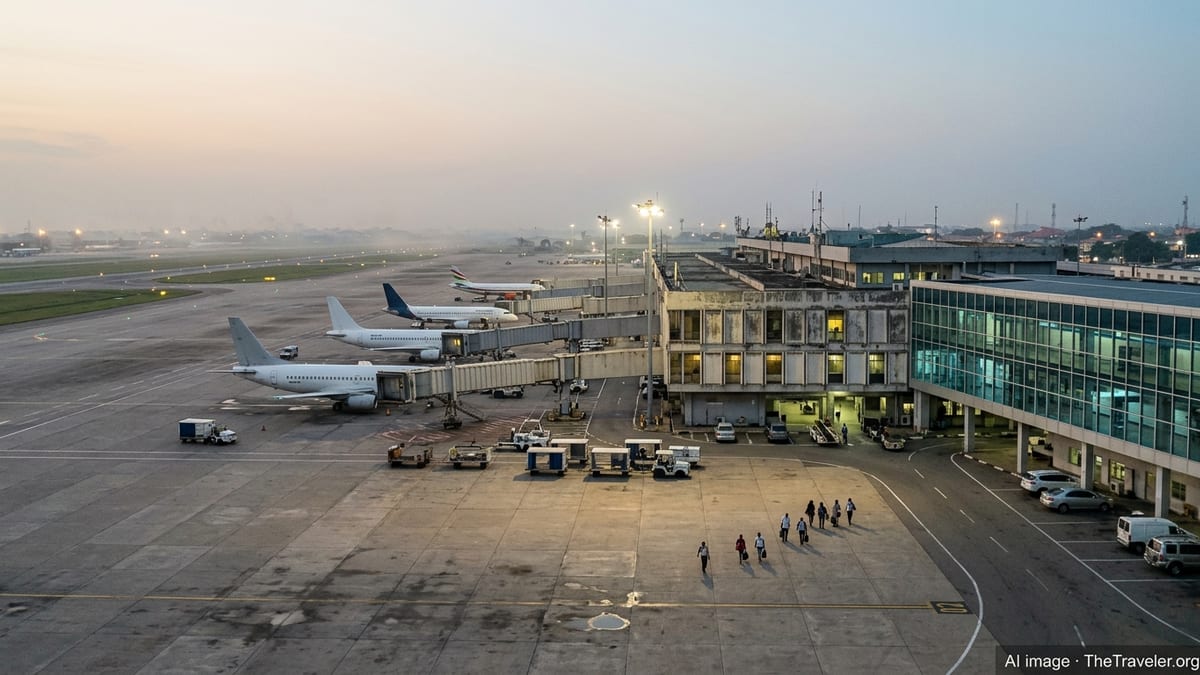
Nigeria has invested in new terminals and greenfield airports over the past decade, but these projects have not yet translated into a step‑change in performance. A prominent example is the new international terminal at Lagos’s Murtala Muhammed International Airport, one of five facilities financed through a loan and partnership framework with China in the early 2010s. Subsequent committee reports and media investigations highlighted design challenges, including limited apron space that made it difficult to accommodate larger aircraft and a rushed relocation of airlines that strained operations.
Elsewhere, the proliferation of state‑backed airports has raised questions about economic viability. Analysis in Nigerian business and travel press describes a growing number of facilities with low traffic volumes, limited commercial activity and high maintenance costs. Aviation specialists cited in these reports argue that scarce public funds are being dispersed across many small airports rather than concentrated on upgrading critical national gateways and improving safety‑related infrastructure such as runway surfaces, lighting and navigation aids.
The condition of legacy terminals also affects passenger experience and airline efficiency. Coverage of Lagos’s older international terminal has drawn attention to issues such as unreliable air‑conditioning, aging baggage systems and overcrowded departure halls. Travelers report long queues, delays at security and immigration, and inconsistent service standards, all of which make Nigerian airports less competitive as regional hubs compared with peers in Accra, Addis Ababa or Kigali.
Attempts to address these gaps through concession and public‑private partnership models have moved slowly. Aviation analysts note that potential investors are cautious about committing capital where traffic growth is uncertain and regulatory frameworks are perceived as unstable. Debates have intensified over whether the state should rebuild key terminals itself or prioritize private‑sector participation focused on commercial operations, while retaining public oversight of safety‑critical assets.
Safety Perception, Service Quality and Passenger Behavior
Nigeria’s aviation regulators have sustained compliance with international safety oversight programmes, and the country has previously attained key benchmarks that allowed local carriers to operate to destinations such as the United States. However, the financial fragility of airlines, aging fleets and patchy ground infrastructure continue to shape traveler perceptions. Public commentary often links delayed or cancelled flights, extended waiting times and abrupt schedule changes to underlying systemic weaknesses.
Service quality inside terminals is another recurring theme. Passengers have complained in local and international media about overcrowding, limited seating, malfunctioning facilities and inconsistent enforcement of procedures. Social media posts and travel blogs frequently contrast newer terminals, where operations are described as more orderly, with older sections of airports where queuing systems and passenger information are seen as inadequate. While such accounts are anecdotal, they influence travel decisions, especially for international visitors comparing options across West Africa.
These experiences feed into broader behavioral shifts. For domestic travel, some Nigerians who once flew regularly between major cities now opt for road journeys, despite security concerns on certain corridors, citing high fares and unreliable schedules. On the international side, corporate travelers and members of the diaspora continue to sustain demand, but leisure and discretionary travel remain constrained. The net effect is a market where growth is driven by a relatively narrow segment of passengers, limiting the network effect that typically underpins aviation expansion.
Regional Competition and Missed Hub Potential
West Africa’s air transport map has evolved over the past decade, and Nigeria has not always been the primary beneficiary. Industry studies on unserved and underserved African routes note that, as of the 2024 northern summer season, only a small number of direct services linked Nigeria with North America, compared with a broader range of long‑haul connections available from hubs in Ethiopia, Kenya, South Africa and the Gulf states. Nigeria’s large population and economy generate significant origin‑and‑destination traffic, but much of that flow connects through foreign hubs.
Within the region, airports in Accra, Abidjan and Dakar have positioned themselves aggressively as transfer points for West and Central Africa, supported by national or home‑based carriers with growing fleets of narrow‑body and wide‑body aircraft. Nigeria’s main airports handle substantial traffic, yet only a limited share of it involves seamless onward connections on Nigerian airlines. The collapse or downsizing of previous flag carriers, combined with the struggles of newer entrants, has constrained the country’s ability to anchor a strong home‑grown hub strategy.
Analysts argue that this missed potential matters for more than connectivity rankings. A vibrant hub can generate employment, attract aviation‑related investment and support tourism and services exports. Nigeria’s current trajectory, with modest passenger growth and limited long‑haul presence, leaves these wider benefits underdeveloped. As other African states press ahead with open‑skies agreements, airport upgrades and fleet renewal, the competitive gap may widen if Nigeria does not adapt.
Policy discussions increasingly focus on how to reverse the trend: stabilizing airline finances, rationalizing taxes and charges, targeting infrastructure investment at high‑impact bottlenecks, and aligning aviation strategy with broader economic goals. Until these elements come together, Nigeria’s air travel market is likely to remain trapped in a pattern of incremental gains that fall short of the country’s scale, leaving the sector in a holding pattern rather than on a clear climb path.