

More news on this day
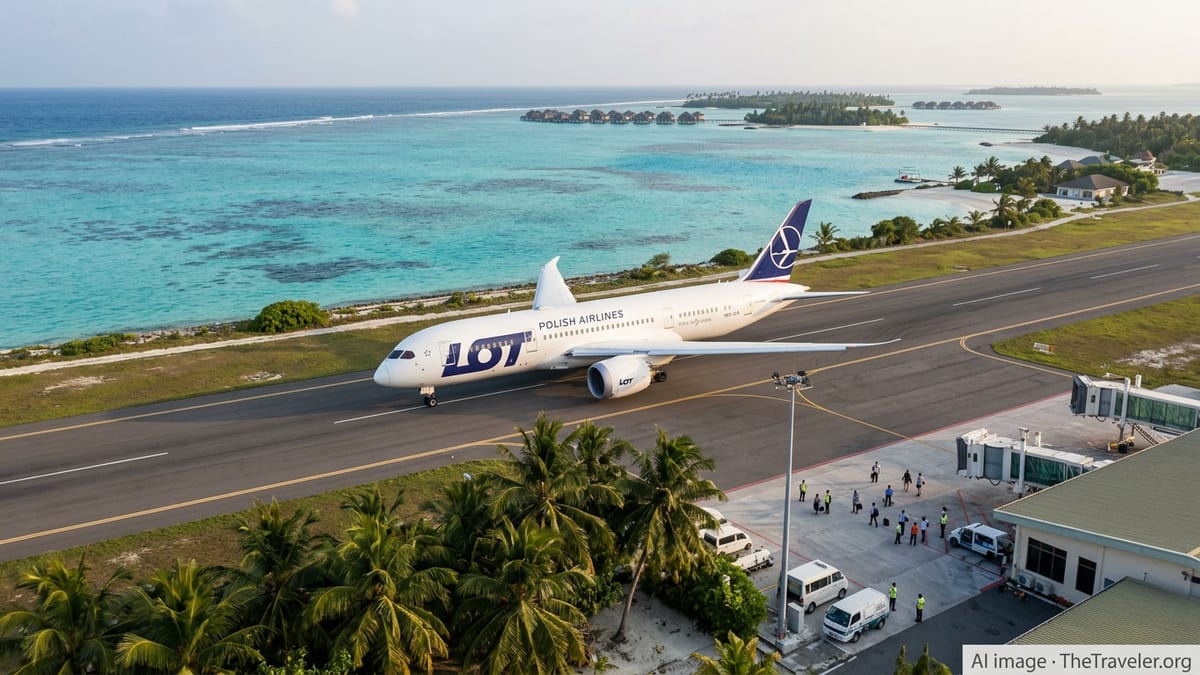
LOT Polish Airlines has scheduled special repatriation flights from Sri Lanka and the Maldives to bring stranded Polish tourists home and preserve key holiday links after unprecedented Middle East airspace closures upended travel across two of the Indian Ocean’s most tourism-dependent destinations.
Emergency Flights to Clear Tourism Backlog
Poland’s flag carrier confirmed it will operate one-off services from Colombo and Malé next week, targeting package tourists whose original journeys were cancelled when several Middle Eastern countries abruptly shut their airspace following a sharp escalation in regional conflict at the end of February. The special LOT services are being coordinated with Polish authorities and local tour operators, who report hundreds of citizens unable to secure alternative routings back to Europe.
The Colombo and Malé operations are designed as direct, high-capacity lifts to Warsaw, bypassing traditional Gulf hubs that normally funnel most European leisure traffic from Sri Lanka and the Maldives. Travel industry sources describe the flights as a critical “pressure valve” at a time when commercial alternatives via the Gulf remain unreliable, heavily backlogged or priced far beyond typical package-tour budgets.
According to Polish officials, the repatriation flights form part of a broader bridge between military-led evacuations from the Middle East and civilian tourism markets in nearby regions. While the primary focus remains on citizen safety, ensuring that holidaymakers are not stranded indefinitely in resort destinations has quickly emerged as a secondary objective for European governments and airlines.
LOT’s move signals that European carriers are willing to temporarily redraw their networks to protect outbound tourism economies that have been collateral victims of a crisis unfolding thousands of kilometres away. For Sri Lankan and Maldivian operators, the message is that key source markets are not closing the door, even as traditional routes remain constrained.
Middle East Airspace Crisis Ripples Across Indian Ocean
The need for emergency flights underscores how swiftly the Middle East conflict has reshaped global air corridors. When Iran, Iraq, several Gulf states and neighbouring countries restricted or closed their skies in late February, long-established Europe–Asia routes via hubs such as Dubai, Doha and Abu Dhabi were suddenly severed, stranding travellers across multiple continents and forcing mass cancellations.
On 1 March alone, industry data showed thousands of flights affected worldwide as airlines scrambled to reroute or ground services that normally depend on overflight rights through the region. For leisure travellers in the Indian Ocean, this translated into a wave of last-minute disruptions, with carriers from the Gulf, South Asia and Europe all forced to adjust schedules or suspend services.
In Sri Lanka, local media and airport authorities have reported rolling cancellations of flights to the Middle East, particularly on routes feeding into Gulf hubs that connect onward to Europe and North America. Similar patterns emerged in the Maldives, where a high proportion of tourists arrive and depart on itineraries that include at least one Middle Eastern stop, leaving resort islands grappling with unexpected extended stays and complex rebooking challenges.
While some airlines have begun to cautiously restore limited services as the situation evolves, capacity remains far below normal, and routings are often circuitous. Against that backdrop, dedicated repatriation flights like LOT’s are being viewed by tour operators as a pragmatic stopgap, offering clarity to travellers who have seen multiple rebookings collapse in recent days.
Safeguarding Tourism Continuity in Sri Lanka and the Maldives
For Sri Lanka and the Maldives, both heavily reliant on European arrivals, the stakes extend well beyond the immediate task of flying stranded guests home. Hoteliers, ground-handling agents and tourism boards fear that images of marooned travellers and repeated cancellations could undermine confidence during what should be a crucial high season.
By stepping in with tailored repatriation services, LOT is helping local partners send a different signal to the market: that even in a period of acute regional instability, there are structured, state-backed pathways to get visitors home. Tour operators say this assurance is already influencing booking behaviour, with some clients reluctant to cancel outright if they know contingency plans exist.
Industry executives in Colombo and Malé note that the repatriation flights are also allowing resorts to turn over inventory more predictably. Guests who expected to stay one or two extra nights have, in some cases, faced the prospect of week-long delays amid shrinking seat availability. Clearing these backlogs frees up rooms for new arrivals whose itineraries bypass the Middle East entirely, often through Southeast Asian or direct European gateways.
Tourism officials are quietly lobbying for similar ad hoc services from other European carriers if the crisis drags on. However, LOT’s rapid mobilisation has drawn particular praise from Polish and local stakeholders alike, showcasing how a medium-sized network airline can act nimbly when coordinated closely with government crisis-response teams.
Coordination Between Airline, Government and Tour Operators
The special flights from Sri Lanka and the Maldives are being organised in tandem with Poland’s foreign ministry and crisis management centre, which has been overseeing a large-scale evacuation programme from the Middle East since the escalation of hostilities. Military aircraft and LOT-operated services have already carried thousands of people back to Poland from Gulf states and neighbouring countries, offering a tested framework for rapid deployment of additional capacity.
For the Indian Ocean missions, the emphasis has shifted from immediate conflict-zone evacuation to controlled repatriation of tourists in stable but affected destinations. Passenger lists are being compiled through Polish consular channels and commercial partners, while LOT handles operational planning, aircraft allocation and crew logistics along longer, Middle East-avoiding routings.
Tour operators in Poland have been instructed to consolidate affected customers onto the special flights, rather than piecing together separate itineraries through a patchwork of third-country hubs. This approach, they say, minimises both cost and risk for travellers, many of whom lack the flexibility or insurance coverage to absorb high last-minute fares or prolonged layovers.
The operation also illustrates the increasingly blurred lines between commercial and state-backed aviation in times of geopolitical crisis. While LOT’s repatriation flights will operate on a commercial basis, with standard ticketing and conditions, their timing, routing and target passenger groups are clearly being shaped by government priorities and diplomatic coordination.
What Travellers Should Expect in the Coming Days
For tourists currently in Sri Lanka and the Maldives, the launch of LOT’s repatriation flights offers a structured exit route, but it does not mean an immediate return to normality in regional aviation. Travellers are being urged by both airlines and consular services to remain flexible, monitor updates closely and prepare for potential schedule changes at short notice as airspace restrictions and risk assessments continue to evolve.
Passengers booked on the special LOT services are advised to stay in close contact with their tour operators or the airline for final confirmation of departure times, check-in procedures and baggage rules. Given ongoing congestion at airports and the possibility of last-minute operational adjustments, industry experts recommend arriving well in advance and allowing for extended processing times.
Looking slightly further ahead, aviation analysts expect more European and Asian carriers to progressively rebuild non-Middle East routings to the Indian Ocean as aircraft and crews are repositioned. In the interim, repatriation flights such as LOT’s are likely to remain a key tool for clearing stranded tourists and protecting the reputations of destinations that depend on seamless long-haul connectivity for their economic lifeblood.
For now, Sri Lanka and the Maldives are watching closely as the first special LOT aircraft departs with full cabins of relieved holidaymakers on board. Each successful rotation not only brings people home but also helps reassure future visitors that, even amid one of the most serious aviation disruptions in recent years, the route between Europe and the Indian Ocean remains open, if temporarily more complicated.