

More news on this day
Ultra-low-cost airlines in the United States are sharply increasing pilot compensation, with recent pay data and contract analyses indicating that top captains at Allegiant, Frontier, and Spirit can approach or exceed about $270,000 in annual earnings in 2026, underscoring how competition for cockpit talent is reshaping the economics of budget air travel.
Get the latest news straight to your inbox!
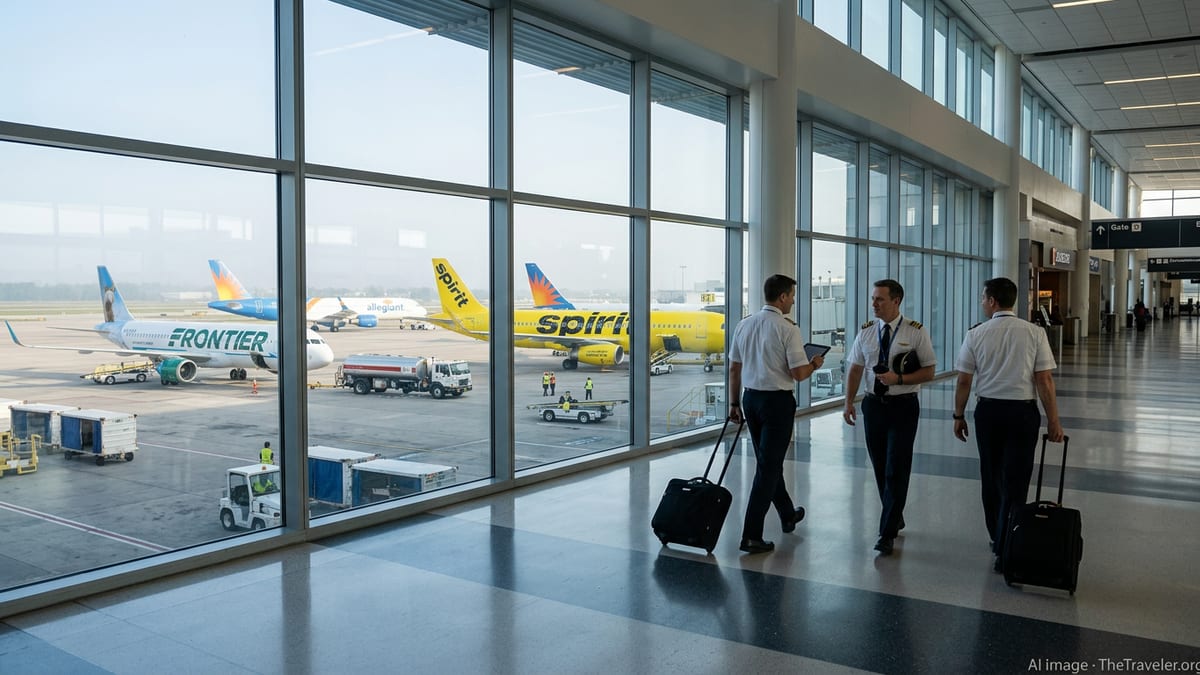
New Pay Scales Push Low-Cost Pilots Into Higher Brackets
Publicly available 2026 pay tables and industry analyses show that experienced captains at several ultra-low-cost carriers now earn in the mid- to upper-$200,000 range, a level that was once largely confined to legacy network airlines. A detailed 2026 salary breakdown from a flight-training and career site lists Frontier Airlines captains at around $202,000 at the low end and as high as $270,000 at the top of the scale, depending on seniority and aircraft assignment, with similar though slightly lower bands for some peers in the low-cost segment.
Separate career-path guidance from another aviation education provider cites 2026 captain pay bands at Frontier reaching $270,000, framing this as part of what it calls a “golden age” for pilot compensation, driven by a structural pilot supply gap and strengthened bargaining at many unionized airlines. Taken together, these figures suggest that while base pay still varies by company, rank, and hours flown, top earners at Allegiant, Frontier, and Spirit are now operating in pay territory that would have been unusual for low-cost carriers a decade ago.
Industry pay-comparison writeups also note that low-cost carriers continue to offer lower entry-level wages than the largest network airlines, particularly at Allegiant, where early-career first officers are still paid noticeably less than counterparts at major carriers. However, as pilots advance and log more hours, the gap narrows, and senior captains at Allegiant and Spirit can now reach annualized earnings that approach the $250,000 to $270,000 range when including schedule-driven flying and typical per-diem allowances.
For travelers, these rising pay scales highlight a shift in what it costs to staff the cockpit on low-fare routes. While ultra-low base fares remain central to these brands, higher pilot compensation is becoming a more visible part of the cost structure underpinning those tickets.
Contract Pressures and the Legacy of the Pilot Shortage
The steady rise in pilot earnings at low-cost carriers is closely linked to the broader labor market that emerged after the pandemic. Multiple contract analyses compiled from pilot groups and financial research indicate that new agreements at major U.S. airlines between 2022 and 2024 delivered cumulative raises of roughly 30 to 40 percent, setting new benchmarks that lower-cost competitors have been under pressure to follow.
Commentary from pilot organizations and pay-comparison studies consistently describe Allegiant and Frontier as lagging behind the majors until recently, particularly on monthly pay values and long-term career earnings. As large carriers like Delta, United, and American raised wages and enhanced retirement contributions, ultra-low-cost airlines risked losing experienced captains and high-time first officers to better-paying rivals, putting pressure on them to lift their own salary structures in order to retain talent and support growth plans.
At Frontier, union communications and external pay tables show that contract talks have focused heavily on stemming pilot attrition by bringing pay closer to market levels. The 2026 salary bands cited in independent training-school and career guides, which put top Frontier captain pay near $270,000, appear designed to make the airline more competitive with peers while still reflecting its low-cost business model.
Allegiant has faced similar dynamics, with independent reporting describing how early-career first officers earn significantly less than pilots at major carriers and somewhat less than some rival ultra-low-cost operators. Nonetheless, Allegiant’s overall pay structure has shifted upward alongside the rest of the sector, and industry observers note that the company is having to balance wage increases with its strategy of serving smaller and leisure-focused markets.
Spirit’s Restructuring Shows the Complex Side of Higher Pay
Spirit Airlines offers a contrasting case study in how pilot pay interacts with financial stress. In 2025, Spirit entered Chapter 11 protection and sought temporary labor concessions in order to secure financing and stabilize operations. According to coverage from aviation news outlets and restructuring summaries, Spirit’s pilots approved an agreement that includes an 8 percent hourly wage reduction and a cut to company retirement contributions beginning January 1, 2026, measures expected to save tens of millions of dollars annually.
These short-term cuts sit atop what had already become a relatively competitive pay scale for a low-cost carrier. Industry salary comparisons for 2025 and 2026 place Spirit alongside Frontier and other budget airlines in terms of captain earning potential, with senior pilots able to reach into the mid- to high-$200,000 range based on typical monthly flying. Even with temporary reductions, Spirit’s pilot pay remains materially higher than it was just a few years ago.
The Spirit agreement illustrates the delicate trade-off between maintaining attractive pilot compensation and preserving a low-fare cost structure in periods of financial strain. Public summaries of the deal emphasize that the concessions are time-limited and tied to a broader restructuring plan, with restoration dates for pay and retirement benefits slated later in the decade. For pilots weighing long-term career decisions, the prospect of restored and potentially higher future pay is an important factor in staying with the carrier.
For travelers, Spirit’s situation is a reminder that higher labor costs do not exist in isolation. When an airline under financial pressure needs to offer competitive pilot salaries to ensure safe, reliable operations, it must simultaneously manage route networks, fleet utilization, and ancillary fees in order to remain viable in the ultra-low-cost segment.
Impact on Fares, Routes, and the Travel Experience
As Allegiant, Frontier, and Spirit move closer to the $270,000 threshold for top pilot salaries, analysts are watching how this shift feeds through to ticket prices and route strategies. Aviation salary overviews aimed at travelers note that rising pilot and crew costs are one factor behind the reduction of some small-city routes and the concentration of capacity on higher-demand leisure and sun destinations since 2022.
Ultra-low-cost carriers have traditionally relied on dense seating, high aircraft utilization, and unbundled pricing to offset lower fares. Increasing pilot pay adds another fixed cost that must be absorbed through fuller aircraft, targeted surcharges, or carefully managed network decisions. In practice, this can mean more seasonal flying, a focus on large leisure markets, and fewer marginal routes where higher crew costs are harder to recover.
However, pilot pay is only one component of an airline’s cost base, and industry guides caution against assuming that every wage increase translates directly into higher fares. Fuel prices, competitive dynamics on individual routes, airport fees, and demand patterns all play significant roles. For many travelers, the most noticeable effects of a more expensive cockpit may be indirect, such as reduced schedule options at smaller airports or shifts in departure times that align better with crew duty rules and aircraft rotations.
At the same time, higher pilot compensation can support improved reliability. Better-paid pilots are often more likely to stay with a carrier, reducing training churn and helping airlines maintain more stable schedules. For Allegiant, Frontier, and Spirit, that stability is especially important, because operational disruptions can quickly erode the appeal of ultra-low fares if customers experience repeated delays or cancellations.
What Rising Pilot Pay Means for Future Low-Cost Growth
The trend toward higher pilot salaries at Allegiant, Frontier, and Spirit suggests that the traditional gap between low-cost and legacy pay is narrowing, at least at the senior captain level. Training and career-planning organizations now tell aspiring aviators that they can build a viable long-term career at some ultra-low-cost carriers, with 2026 earning potential that approaches what mid-tier legacy airlines offered not long ago.
For the airlines, this evolution presents both opportunities and constraints. More competitive pay can help attract experienced aviators during periods of fleet expansion or route launches, but it also raises the stakes on every flying decision, from aircraft utilization to seasonal scheduling. Growth strategies that once relied on very low labor costs must now account for pilot pay that more closely reflects the broader U.S. airline market.
Travelers watching fare trends in 2026 are likely to see a low-cost landscape that remains highly price-sensitive but somewhat more mature. Budget carriers will still compete aggressively on base fares, yet the underlying economics are shifting toward a model in which pilots at Allegiant, Frontier, and Spirit can increasingly expect annual earnings climbing toward $270,000 at the top of the scale, solidifying their place in a rapidly changing aviation labor market.