

More news on this day
A 48-hour strike by Lufthansa pilots is disrupting air travel across Germany on March 12 and 13, with hundreds of flights canceled or rescheduled at major hubs and thousands of passengers facing delays, missed connections and last-minute itinerary changes.
Get the latest news straight to your inbox!
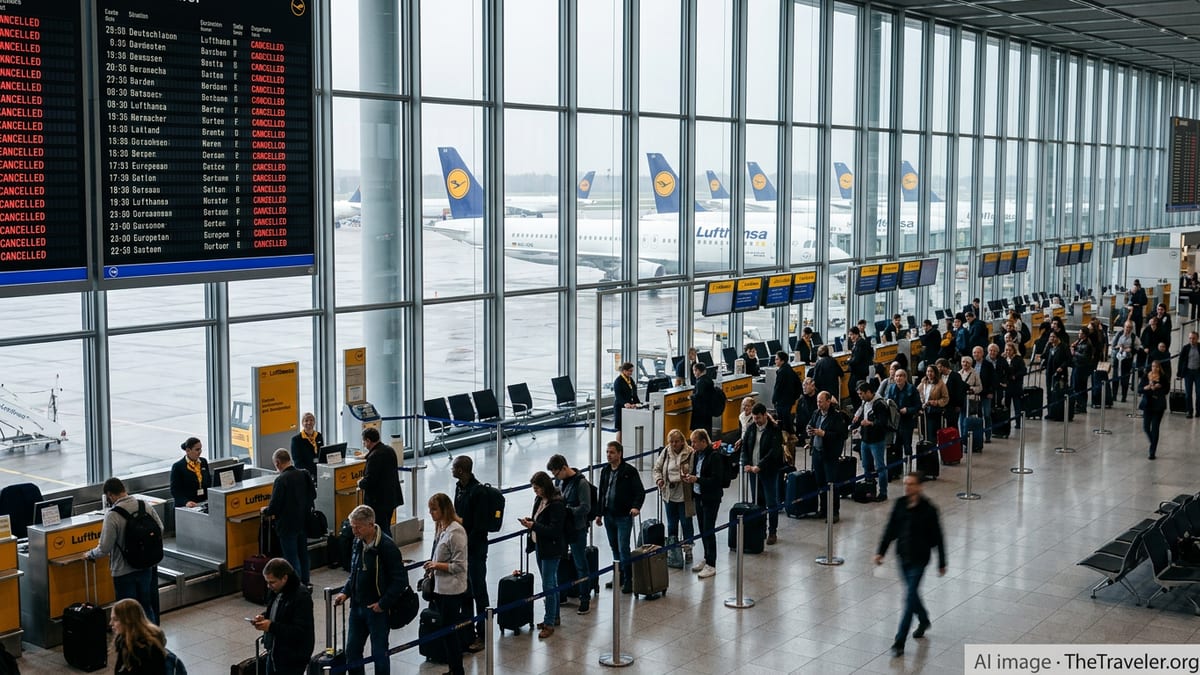
Strike Halts Departures at Major German Hubs
The walkout, called by the Vereinigung Cockpit pilots’ union, began at 00:01 on March 12 and is due to run until 23:59 on March 13, targeting Lufthansa’s main passenger airline, Lufthansa Cargo and its regional subsidiary CityLine. The industrial action focuses on flights departing from German airports, hitting the carrier’s tightly timed hub operations at Frankfurt and Munich.
Lufthansa has warned that its special strike timetable still means several hundred flights will not operate over the two-day period. Short-haul European services and domestic German routes are bearing the brunt of cancellations, though some long-haul departures are also affected as crews join the walkout or aircraft are left out of position.
Terminal departure boards at Frankfurt and Munich early Thursday showed long stretches of canceled services, with travelers queuing at rebooking counters and customer service desks. Airline staff distributed vouchers and information sheets while urging passengers to use digital channels to rearrange their journeys where possible.
While flights operated by group carriers such as Swiss, Austrian Airlines, Brussels Airlines, Air Dolomiti and Eurowings are continuing, their services are also under pressure as Lufthansa attempts to reroute stranded customers onto remaining seats within the wider network.
Union Pushes for Better Pay and Rostering
The pilots’ union called the 48-hour strike after protracted negotiations over pay, working conditions and job security failed to produce a new collective agreement. Representatives argue that pilots should receive salary increases that reflect both inflation and Lufthansa’s recent return to strong profitability following the pandemic slump.
Union officials have also criticized what they describe as increasingly demanding rosters, with dense flying schedules and insufficient rest periods between long-haul duties. They contend that improved planning and more predictable working hours are needed to safeguard both safety and work-life balance for cockpit crews.
Lufthansa management has countered that it has already put a substantial offer on the table and warns that further wage hikes could undermine efforts to keep ticket prices competitive in a market still shaped by cost-conscious leisure travelers and price-sensitive corporate clients. The company insists that its proposal preserves long-term jobs at the airline while recognizing the contribution of pilots.
Talks are expected to resume after the strike, but both sides have so far shown little sign of narrowing the gap between the union’s demands and the airline’s cost targets. Travel industry analysts note that with pilots holding a critical position in operations, even limited industrial action can quickly translate into large-scale disruption.
Passengers Face Cancellations, Rerouting and Crowded Trains
For travelers, the immediate impact of the strike is being felt in cancellation notices arriving just hours before departure and in crowded scenes at check-in areas and airline lounges. Many passengers report receiving rebooking offers on alternative Lufthansa Group flights or partner airlines, while others are advised to postpone trips or seek refunds.
On domestic German routes, Lufthansa is offering affected customers the option to switch to Deutsche Bahn rail services at no additional cost, a standard contingency during major disruptions. Trains on key intercity corridors such as Frankfurt to Munich and Frankfurt to Berlin are expected to be busier than usual as air passengers shift to the rail network.
Travel rights organizations are reminding passengers that under European passenger protection rules, those whose flights are canceled at short notice by a strike of the airline’s own staff may be entitled to care, rerouting and, in many cases, financial compensation. However, they caution that processing claims can take weeks given the volume of affected bookings.
Tour operators and corporate travel managers are working to re-accommodate groups and business travelers, often by rebooking via other European hubs such as Zurich, Vienna or Amsterdam. Some travelers are choosing to keep their long-haul itineraries by starting journeys from neighboring countries where flights are not covered by the strike call.
Lufthansa Says Majority of Schedule Still Operating
Despite the large number of cancellations, Lufthansa stresses that it expects to operate more than half of its planned flight program over the two strike days. The airline has published a slimmed-down timetable that prioritizes long-haul connections and key feeder routes, aiming to preserve at least part of its global network.
Operational managers have been working to consolidate passengers from multiple canceled flights onto remaining services with higher-capacity aircraft, particularly on transatlantic and Asian routes. Where possible, flight times have been adjusted to ensure that critical intercontinental links into Frankfurt and Munich remain viable despite reduced short-haul feed.
In statements to German media, executives emphasized that teams were “working around the clock” to minimize disruption, though they acknowledged that many customers would still experience major changes to their plans. The carrier is urging travelers to check their flight status frequently on the airline’s app or via digital notifications and to avoid going to the airport if their service is marked as canceled with no confirmed alternative.
Industry observers say the strike comes at a sensitive time for Lufthansa, which is balancing higher staffing costs with investment in new aircraft and cabins while facing strong competition from low-cost and Gulf carriers. Any extended labor conflict could make it harder for the airline to deliver on financial targets and expansion plans.
Travelers Advised to Monitor Flights and Consider Alternatives
With the strike scheduled to run through Friday night and knock-on disruptions likely into the weekend, frequent flyers and occasional travelers alike are being urged to plan conservatively. Travel advisors recommend allowing extra connection time, being flexible about routing and considering neighboring airports such as Zurich, Vienna, Brussels or Amsterdam when booking last-minute alternatives.
Passengers still due to fly with Lufthansa during the strike period are advised to monitor their booking closely in the hours before departure, as additional cancellations and schedule changes remain possible. Checking in as early as online systems allow can help secure remaining seats on consolidated services, particularly for those traveling on essential business or to time-sensitive events.
For future trips, experts say travelers booking critical journeys through Germany in the coming weeks may wish to choose fully flexible fares or itineraries that can be rerouted via other carriers at short notice. While unions and management typically seek to avoid longer-term stand-offs, the current dispute underlines how quickly industrial action can affect even well-planned itineraries.
For now, the focus remains on clearing the immediate backlog of disrupted passengers as the 48-hour walkout unfolds. Once the strike ends and negotiations resume, travelers and the wider aviation industry will be watching closely to see whether a lasting agreement can be reached that stabilizes operations at one of Europe’s most important airline groups.