

More news on this day
Lufthansa is accelerating its long-haul premium revamp, opening bookings for its next-generation Allegris business class on Boeing 787-9 Dreamliners from Frankfurt and signaling a major upgrade on key Germany–United States–India routes from April 15, 2026.
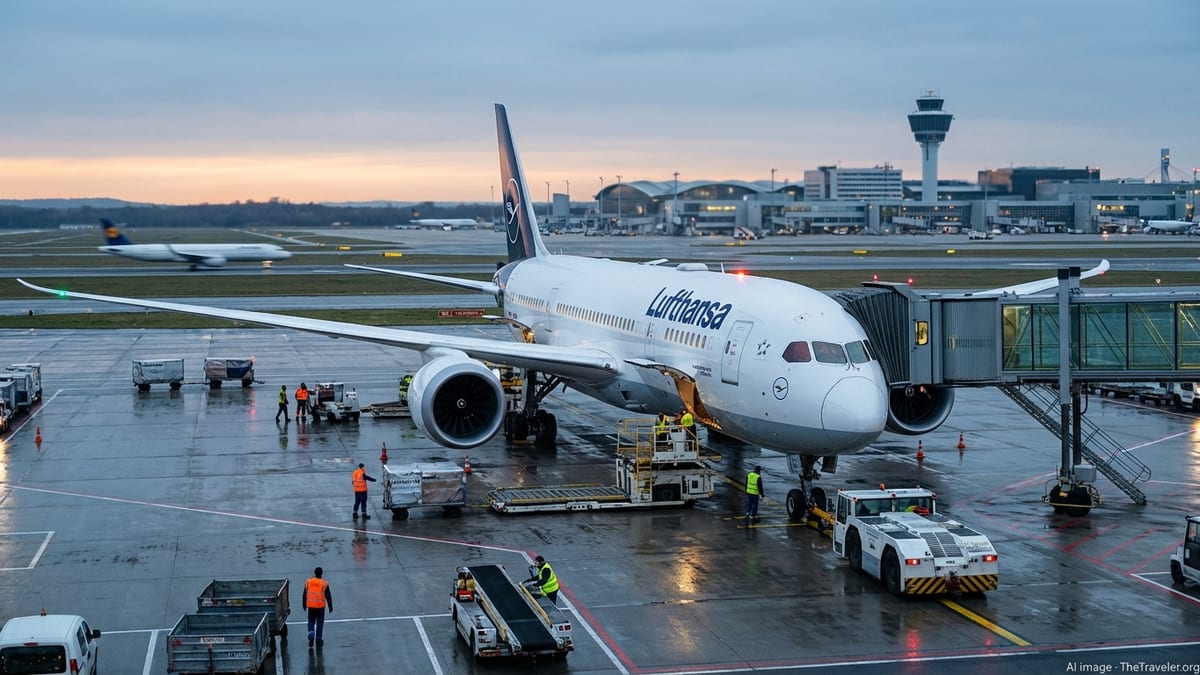
Frankfurt Becomes Heart of the Allegris Dreamliner Rollout
The Boeing 787-9 is emerging as the backbone of Lufthansa’s Allegris expansion from Frankfurt, with the hub positioned as the launchpad for a new era of long-haul premium travel. The airline received its first Allegris-equipped 787-9 in late August 2025 and began scheduled operations between Frankfurt and Toronto on October 9, 2025, using the fuel-efficient twinjet as a platform for its redesigned cabin concept.
Initially, Lufthansa used the early aircraft primarily for training and familiarization, as well as for gradually integrating the new product into its network without disrupting existing schedules. Frankfurt’s central role reflects both its status as the group’s largest intercontinental hub and its strong demand from corporate travelers and high-yield leisure passengers connecting between Europe, North America, and India.
The 787-9s based in Frankfurt are configured with 28 business class seats, 28 premium economy seats, and 231 economy seats, allowing Lufthansa to match capacity to demand on long, thin routes and competitive trunk markets alike. As more Dreamliners arrive through 2026 and 2027, the German flag carrier plans to steadily phase the type onto additional intercontinental services, with Allegris at the center of its premium strategy.
Certification Breakthrough Unlocks Allegris Business Cabin
The Allegris rollout on the 787-9 has been defined as much by regulatory hurdles as by product innovation. For months after the Dreamliner’s Frankfurt debut, only four of the 28 business class seats, the front-row business suites, could be sold to passengers, while the remaining seats were blocked pending additional certification requirements from U.S. regulators. The highly customized architecture of the Allegris cabin, with multiple seat types and complex layouts in the same cabin, triggered an extended approval process.
That bottleneck is now easing. Starting April 15, 2026, Lufthansa is cleared to sell 25 of the 28 business class seats on its Allegris-equipped 787-9s. Only three seats in the second row will remain unavailable for sale until the final phase of certification is completed. For the airline, the shift from four to 25 saleable seats in the premium cabin transforms the revenue profile of each Dreamliner flight, enabling it to properly monetize the product that has been prominently marketed since its initial unveiling.
For passengers, the operational change means that Allegris is no longer a curiosity reserved for a handful of front-row suites but a full-scale cabin experience available across almost the entire business class section. Travelers can now book a much wider range of seat types, which in turn encourages Lufthansa to deploy the aircraft on more strategically important routes, including high-demand services to the United States and India.
New-Generation Business Class on Germany–United States Routes
Lufthansa’s summer schedule positions the Frankfurt-based 787-9 fleet squarely on transatlantic corridors where competition for premium travelers is intense. Under the current deployment plan, Allegris Dreamliners from Frankfurt operate to Austin, Rio de Janeiro, Bogotá, Cape Town, Shanghai, Hyderabad, and Hong Kong, with expansion to New York John F. Kennedy and Los Angeles from June and to Delhi from July. With the certification barrier largely removed from mid-April, these aircraft can now be fully leveraged on routes linking Germany and the United States, particularly those where schedule timing, connectivity, and corporate contracts favor Frankfurt over Munich.
In parallel, Lufthansa has already been rolling out Allegris on the Airbus A350-900 from Munich on several major U.S. gateways, including Chicago, San Francisco, San Diego, and New York-area airports. The 787-9 expansion at Frankfurt complements that footprint rather than duplicating it, allowing the group to offer the same next-generation experience from both hubs while tailoring aircraft type and schedule to specific markets.
For U.S.-based travelers, the difference will be tangible. The Allegris business class aims to compete directly with the latest premium products from North American and Gulf carriers by emphasizing privacy, extensive adjustability, and personalized space. On high-yield routes such as New York and Los Angeles, Lufthansa’s refreshed cabins form part of a broader arms race in premium travel, with rival airlines also rolling out updated suites, larger inflight entertainment screens, and enhanced soft products to win over frequent flyers.
Strengthened Germany–India Corridor via Frankfurt
India is another key pillar of Lufthansa’s 787-9 strategy. Frankfurt already functions as an important gateway between India, continental Europe, and North America, and the introduction of Allegris-equipped Dreamliners is designed to reinforce that role. Hyderabad joined the 787-9 network from Frankfurt under the Allegris program from late 2025, giving South India a direct link into the new cabin concept. From July 2026, Delhi is scheduled to be served by Frankfurt-based Allegris 787-9s, joining the growing list of Indian cities tied into Lufthansa’s refreshed long-haul product.
These developments come as India’s outbound travel market continues to expand, driven by both growing middle-class leisure demand and robust corporate and technology-sector traffic. By pairing the fuel-efficient 787-9 with a high-specification business cabin, Lufthansa is positioning itself to compete not only with European rivals but also with fast-growing Middle Eastern and Asian carriers that have aggressively targeted India–North America flows.
For Indian travelers connecting through Frankfurt to the United States, the Allegris rollout promises a more consistent experience from door to door. An itinerary such as Hyderabad to Frankfurt and on to New York or Chicago can increasingly be flown on aircraft equipped with the latest long-haul product, reducing the cabin mismatches that have long been a pain point for frequent flyers. As network planning continues through 2026, additional India services are expected to see Allegris deployments, particularly on flights synchronized with major North American connections.
Inside the Allegris Business Class Experience
At the heart of Lufthansa’s strategy is the Allegris cabin itself, a multi-billion-euro investment that reimagines the carrier’s approach to premium seating. In business class, the concept breaks with the traditional one-size-fits-all seat design and instead offers a family of seat types within the same cabin. Standard classic business seats can be reserved without additional charge, while passengers willing to pay a supplement can select from a menu of premium options tailored to their preferences.
These options include front-row suites with closing doors for added privacy, extra-space seats that provide greater personal area and legroom, window-adjacent privacy seats that shield travelers from the aisle, and extended-length beds up to 2.2 meters designed for taller passengers or those who prioritize sleep above all else. All seats convert to fully flat beds and are paired with larger high-resolution screens, expanded storage, and updated inflight entertainment systems aimed at matching contemporary expectations for long-haul travel.
The Allegris design language extends beyond hardware. Lufthansa has updated its soft product, including bedding, amenities, and dining, to better align with the new environment. Although fine-tuning continues based on passenger feedback and operational experience, the overarching goal is to deliver a premium cabin that feels both modern and flexible, giving travelers more control over how they use their space in flight.
Network Synergy Between Munich and Frankfurt
While the Allegris-equipped 787-9s are anchored in Frankfurt, the broader Allegris program spans both of Lufthansa’s main German hubs. Munich has led the way with the Airbus A350-900, which has been flying with Allegris cabins since May 2024. Routes from Munich to key U.S. and Asia-Pacific destinations, including Bengaluru, Chicago, New York, San Francisco, San Diego, Shanghai, and Tokyo Haneda, already showcase the new seats and service style to a growing share of the airline’s long-haul customers.
This dual-hub approach allows Lufthansa to segment its network more effectively. High-tech and corporate-heavy markets in southern Germany and northern Italy often favor connections via Munich, while Frankfurt remains the primary transfer point for much of western and central Europe, as well as for many India and North America flows. By placing Allegris-capable aircraft at both hubs, Lufthansa can offer premium continuity regardless of where a journey originates or terminates.
From a commercial standpoint, the coordinated deployment of Allegris on both A350-900s and 787-9s helps the airline appeal to global corporate accounts that value product consistency across markets. Travel managers booking multi-city itineraries that span the United States, Germany, and India can increasingly rely on Allegris availability when negotiating contracts and shaping preferred carrier lists.
Fleet Renewal, Sustainability and Competitive Positioning
The Allegris expansion on the 787-9 is intertwined with Lufthansa’s broader long-haul fleet renewal. The Dreamliner’s composite structure and advanced engines deliver fuel burn reductions of around a quarter compared with the older four-engine aircraft it is gradually replacing. That efficiency contributes directly to the airline’s emissions targets, while also lowering operating costs on long routes where fuel is a dominant expense.
Lufthansa has outlined plans to operate up to 29 Boeing 787-9s by the end of 2027, part of a wider long-haul order book that also includes additional Airbus A350 variants and future Boeing 777X aircraft. Many of these jets will ultimately feature Allegris cabins, embedding the new product as a core element of the fleet rather than a niche subfleet. In parallel, retrofits are planned or underway on select widebodies, including the Boeing 747-8, to extend Allegris across more of the existing network.
In competitive terms, the rejuvenated fleet and cabin are essential tools as Lufthansa faces intensified pressure from both sides of the Atlantic and from Gulf and Asian carriers. Premium demand on Germany–United States and Germany–India routes has rebounded strongly, but passengers have become more selective, often comparing seat type, privacy, and onboard amenities as closely as schedule and fare. With the Allegris business class now fully sellable on most seats aboard the 787-9, Lufthansa is better positioned to defend and grow its share of that lucrative segment.
What Travelers on Germany–U.S.–India Routes Can Expect Next
With bookings open for Allegris business class on 787-9 flights from April 15, 2026 onward, passengers traveling between Germany, the United States, and India can expect to see the new cabin appear on an increasing share of their preferred routes. Early adopters are likely to be frequent travelers on Frankfurt services to major U.S. cities and to Indian gateways such as Hyderabad and Delhi, where schedule planners have already aligned aircraft assignments with high-value demand.
Travelers should be prepared for some variability during the transition, as not every frequency on a route will necessarily be operated by an Allegris-equipped Dreamliner. Some rotations may still see earlier-generation aircraft or non-Allegris-configured 787-9s, depending on maintenance, deliveries, and seasonal capacity adjustments. Nonetheless, the trend line is clear: as more aircraft join the fleet and as remaining business seats receive final certification, the share of flights offering the full Allegris experience is set to grow steadily through 2026 and beyond.
For the broader market, the expanded Allegris footprint raises the bar for long-haul premium cabins connecting Europe, North America, and India. As Lufthansa presses ahead with its Dreamliner deployment from Frankfurt and continues its A350 Allegris program from Munich, rival airlines will face mounting pressure to respond with their own upgrades. For travelers on the busy Germany–United States–India corridor, that competition is likely to translate into better seats, more choice, and a new benchmark for premium travel across the Atlantic and into South Asia.